Historical Current
1960s–February 2009
The Decentralized Internet
How open networks, distributed machines, and peer-to-peer systems challenged central control before Bitcoin.
Explore the history ↓Documents, experiments, unfinished possibilities.
Follow the narrative; open a document to look closer.
01 / Chapter 01
Before the Network Could Be Decentralized
Independent computers could not cooperate until their networks learned to communicate.
Before a computer could join a global search for extraterrestrial intelligence, exchange pieces of a file with strangers, or participate in a monetary network, engineers had to overcome a simpler obstacle: computers were difficult to connect.
Early computer networks often belonged to particular universities, laboratories, or government programs. They relied on specialized equipment and assumptions about their users. Building another network did not automatically expand the first. It might simply create another island.
During the 1960s, researchers questioned whether communication had to depend on reserving a continuous circuit. At RAND, Paul Baran studied survivable communication systems; in Britain, Donald Davies developed packet-switching work; American research on interactive computing and resource sharing helped produce ARPANET. These were overlapping but distinct histories. The popular claim that the internet was designed simply to survive nuclear attack folds different projects into one convenient origin myth.
Packet switching offered a flexible alternative. Information could be broken into smaller units, carried through shared infrastructure, and reconstructed at its destination. Multiple users no longer had to behave as though each conversation owned a dedicated line.
That achievement created a new question. What if two networks used different machinery, addressing systems, and rules? A packet that crossed one network still needed a way into the next.
The solution would not be one enormous centrally managed computer system. It would be a set of agreements allowing independently built networks to interoperate. That distinction—cooperation without identical ownership—became one foundation for everything that followed.
02 / Chapter 02
A Network of Networks
Open protocols allowed independence at the infrastructure level, not freedom from every administrator.
In May 1974, Vinton Cerf and Robert Kahn published a proposal for communication across packet-switched networks. The ambition was deceptively radical. A network could keep much of its internal design while following shared rules for exchanging data with others.
The approach did not require every participant to buy the same machines or operate under the same institution. An expanding communications system could connect separately governed parts. Internet Protocol, formalized in RFC 791 in September 1981, specified how datagrams could move among interconnected networks.
But interoperability should not be mistaken for the absence of authority. Somebody still operated the routers and communication links. Networks still needed addresses, administrators, and procedures for handling failures. The Domain Name System, described in RFC 1034 in 1987, distributed information across servers while preserving a hierarchy of names and administration.
A second architectural argument helped shape the internet's later possibilities. In work circulated in 1981 and published in 1984, Jerome Saltzer, David Reed, and David Clark explained why some functions were best implemented at the ends of a communication system rather than trusted entirely to its interior. The principle was not an instruction to abolish institutions; it was a guide to placing functions where their correctness could best be established.
Taken together, open internetworking and end-to-end design created room for extraordinary innovation. A new application did not require replacing the world's communications infrastructure. Software on connected computers could assume roles that earlier systems had reserved for specialized network machinery.
The internet made it increasingly practical for independent machines to participate. It did not yet tell them how to agree, whom to trust, or what should happen when a coordinating party disappeared.
document · May 1974
A Protocol for Packet Network Intercommunication
A proposal for connecting independently designed packet networks through a common protocol. Read the paper behind the chapter’s architectural turning point.
Primary research · IEEE publication DOI
Read the original ↗03 / Chapter 03
The Edges Begin to Speak
Federated communication showed what networks could share—and who still controlled the servers.
Well before ordinary households browsed the Web, connected computers were exchanging conversations. Usenet grew from experiments in moving messages among Unix systems around 1979–1980. Different sites could exchange discussion material using mechanisms such as UUCP. The resulting community was not hosted in one universal conversation database controlled by a single company.
Yet local administrators retained power. A site decided which groups to carry, whom to serve, and which machines could connect. Messages moved through cooperation among institutions, not through the abolition of institutions.
Internet Relay Chat made another kind of distributed community visible. Developed by Jarkko Oikarinen in 1988, IRC connected users through servers that relayed conversations. Its 1993 protocol specification described server networks, channels, and special operator roles. People could encounter a sprawling conversational world without having to share a single central machine; the system still had its operators, topology, and points of failure.
The World Wide Web provided another essential contrast. CERN's 1993 decision to release key Web software freely helped make publishing through open protocols widely available. Anyone able to operate a server could potentially become a publisher. But an open Web page was not the same thing as a file automatically replicated among all its readers. The familiar browser-server relationship remained fundamental.
These systems showed that communities and publishers could participate beyond the boundaries of any one enterprise. They also taught a lesson that would recur for decades: technical openness and distributed operation do not necessarily remove concentrated authority.
The next leap was more tangible. Ordinary machines would stop being merely places where people read messages. Their unused processing power would become part of a shared resource.
specification · September 1981
RFC 791: Internet Protocol
The specification defines the internet datagram and its delivery across interconnected networks. It makes the shared packet layer available for close reading.
Primary specification · RFC Editor archive
Examine the source ↗document · 1984 · revised from the 1981 conference paper
End-to-End Arguments in System Design
An architectural argument about where functions belong in a communication system. It does not claim that institutions or intermediaries disappear.
Primary research · author-hosted MIT copy
Read the original ↗Document details
J. H. Saltzer, D. P. Reed and D. D. Clark · 1984 · revised from the 1981 conference paper
[3]Movement II The Power of Participation
04 / Chapter 04
A Supercomputer Made of Strangers
The first volunteer-computing projects discovered immense unused capacity—and a need to organize it.
Computers spend much of their lives waiting. In the 1990s, a growing number of people were buying machines more powerful than the tasks they performed every moment of the day. What if a research problem could make use of that idle capacity?
The Great Internet Mersenne Prime Search, launched in 1996, recruited volunteers to test candidates for exceptionally large prime numbers. Participants could devote processing time to mathematical work organized elsewhere. Over time, the need to coordinate assignments, avoid unnecessary duplication, and record results encouraged more systematic services such as PrimeNet.
Around the same period, volunteer cryptographic key-search efforts demonstrated a related possibility. Machines run by enthusiasts could test different portions of a very large search space. Each computer did a modest part; together, they could perform work beyond the practical reach of most individual participants.
The new resource was not a proprietary supercomputer. It was an agreement between an organizing project and a dispersed population of computer owners.
That distinction held a paradox. The computation could be widely distributed while the authority to assign work and certify the result remained concentrated. Participants usually did not need to find one another or negotiate a common answer. They needed the coordinator to give them something useful to do.
The model was powerful precisely because the work could be divided into many relatively independent pieces. But its success depended on the organizer's continued ability to define the problem and receive the answers.
Soon one scientific project would make this experience part of popular culture. Its volunteers would not be searching for prime numbers or breaking a test cipher. They would be looking toward the stars.
05 / Chapter 05
When the Keyserver Disappeared
A distributed effort survives a failure without becoming a leaderless system.
In March 1997, volunteers participating in a cryptographic key-search effort faced a problem that seemed to undermine their distributed achievement. The central coordinating keyserver disappeared.
The people performing the calculations were scattered across different computers. That was the point of the project. But if the system coordinating their assignments became unavailable, what work should they perform next—and where should they report it?
The group that became distributed.net reorganized. Its historical records describe volunteers coordinating through IRC, the creation of proxy infrastructure, and a public proxy network announced on March 24. The organization could preserve the collective effort because its participants had the technical knowledge and willingness to rebuild the coordinating arrangements.
There are two stories here. One is about the resilience of a community: the disappearance of a machine did not end the project. The other is about the limits of its architecture: replacing the keyserver did not remove the need to allocate work and count legitimate results.
In October 1997 the project completed its RC5-56 challenge, a notable demonstration of volunteer computing. Its participants had taken small pieces of work and, through persistence and coordination, produced a result no one participant could reasonably have pursued in the same way.
This was not a failed experiment in decentralization. It was an important success in distributed computation—alongside a vivid reminder that distributing labor and distributing authority are different achievements.
There was another connection hiding in the 1997 story. IRC, built for online conversation, had served as a means for volunteers to coordinate recovery. Years later, early Bitcoin software would also use IRC, this time as an aid to locating other nodes. The shared infrastructure is documented; a common design ancestry for their core algorithms is not.
project history · March 1997 events
The March 1997 keyserver crisis
The project’s retrospective history records unreliable coordination, the loss of the original keyserver, and the public proxy effort that followed.
Project retrospective · not a contemporaneous March 1997 document
Examine the source ↗When coordination disappeared
- March 1997
An unreliable keyserver
Participants faced repeated coordination failures while searching the RC5 keyspace.
[8] - 18 March 1997
The server disappears
The genx.net keyserver went offline permanently.
[8] - 24 March 1997
A public proxy network
After confirmation that the original effort had ended, the first distributed.net proxy became publicly available.
[8]
06 / Chapter 06
Millions of Computers, One Extraordinary Search
SETI@home made participation in global computation a household experience.
A user installed a program, and a different kind of screensaver appeared. Instead of an animation designed only to fill an idle monitor, the screen showed radio-signal analysis in progress. While its owner did other things—or went to bed—the computer was working on a scientific question: might a signal from space be evidence of intelligent life elsewhere?
The idea behind SETI@home had been proposed in the mid-1990s by David Gedye and developed by researchers at the University of California, Berkeley. The public project launched on May 17, 1999. It invited computer owners to contribute processing time to the analysis of radio-telescope data.
The raw information came through an arrangement involving the Arecibo telescope in Puerto Rico. In a detail that captures the era, data were recorded on physical tapes and transported to Berkeley because sending the full data stream over Arecibo's available internet connection was impractical. At Berkeley, the data were broken into work units for volunteer machines.
The project was immediately recognizable in a way earlier distributed-computing experiments rarely were. A participant did not need expertise in number theory or cryptanalysis. Curiosity about the universe was enough. The screensaver made a normally invisible contribution visible. Teams formed. People compared their computing totals. Ordinary personal computers became part of a scientific project far larger than their owners.
In their November 2002 technical account, the Berkeley researchers reported millions of participants and a level of computing activity that would have been extraordinary for a single conventional institution to assemble from personally owned machines. They also documented the operational details behind the wonder: servers, data distribution, software maintenance, result verification, and the constant challenge of managing a vast population of computers outside the project's control.
The cultural importance is inseparable from the architecture. SETI@home let ordinary people experience the power of distributed participation. Their machines were no longer merely using the internet. They were supplying productive work to something that existed because so many people joined.
But the power had a boundary. The volunteer computers did not independently decide which telescope data to analyze or whose findings counted. Berkeley defined the work and assessed the returns. Its global supercomputer was distributed in labor, not in final authority.
That distinction would become one of the key lessons this Current carries forward.
Modern explanatory diagram
One scientific project. Many independent computers.
- Radio-telescope dataRecorded data reach Berkeley
- Berkeley coordinating serversPrepare and assign work units
- Volunteer PCsIndependently process assigned units
- Returned resultsBerkeley compares results and validates the work
Distributed computation did not mean decentralized authority: Berkeley coordinated the work and assessed the returned results.
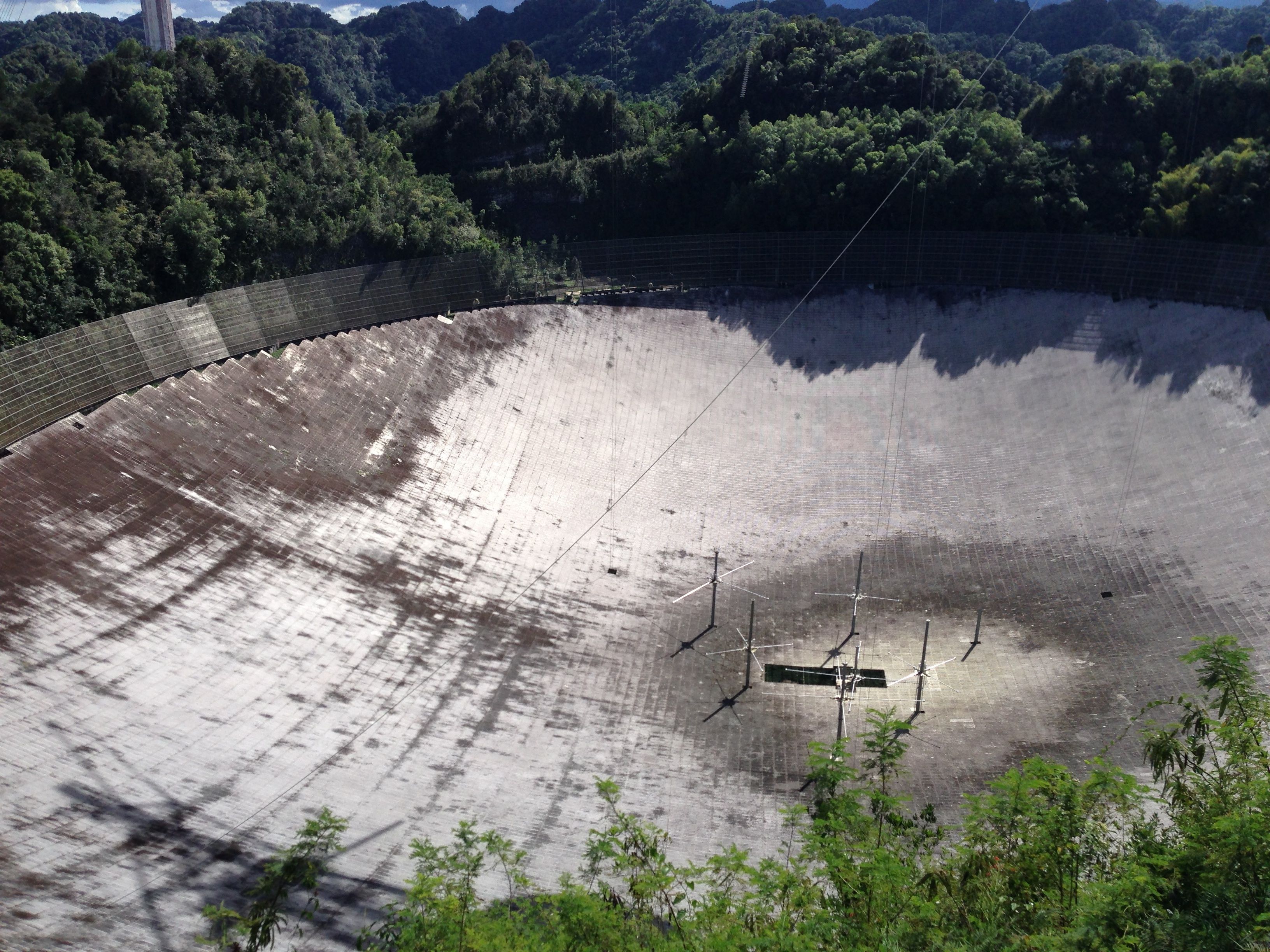
Arecibo Observatory in 2013. Its radio-telescope observations supplied the raw data analyzed by SETI@home volunteers. Photograph by Karen Pearce / National Science Foundation.
Image provenance
Photo: Karen Pearce / National Science Foundation; U.S. public domain, via Wikimedia Commons.


Photographed 2013-11-25. Unmodified Commons file; scaled for display without CSS cropping.
Commons identifies this photograph as U.S. public domain. Commons file uploaded 2018-01-19.
document · November 2002
SETI@home: An Experiment in Public-Resource Computing
Berkeley’s technical account describes work distribution, redundant computation, and operational limits. It documents public participation alongside centralized work coordination.
Primary research · Berkeley-hosted text · Communications of the ACM 45(11), pp. 56–61
Read the original ↗Document details
David P. Anderson, Jeff Cobb, Eric Korpela, Matt Lebofsky and Dan Werthimer · UC Berkeley · November 2002
[7]SETI@home: launch and measured participation
07 / Chapter 07
Who Checks the Work?
Participation brought mistakes, competition, cheating—and new systems for judging results.
The more computers SETI@home recruited, the less the project could assume about any individual machine. Volunteers had different hardware, different software environments, and different reasons for joining. Some computers produced errors. Some users attempted to manipulate the system's credits.
The Berkeley project could not simply accept every returned calculation as accurate. It assigned some work redundantly and compared results. Behind a friendly screensaver lay the less glamorous problem of deciding which submissions deserved trust.
The project also learned that volunteers did not contribute only for the scientific mission. People wanted to see what they had accomplished. They compared credits, competed in teams, and took pride in the work their machines completed. This was a system of incentives, even without payments or transferable money.
These pressures helped inform the Berkeley Open Infrastructure for Network Computing, BOINC. A BOINC-based SETI@home client became publicly available in June 2004. Instead of treating volunteer computing as software belonging to one experiment, BOINC provided infrastructure that other scientific projects could adopt. Participants could divide resources among projects with distinct research objectives.
The arrangement expanded opportunity without eliminating project administrators. Scientists still defined their tasks; the infrastructure still needed mechanisms to account for work and detect unreliable results.
Its importance becomes clearer when placed beside Bitcoin's later design. SETI@home could ask Berkeley to judge the result. Bitcoin could not require a Berkeley-like authority to declare which monetary transfers were valid without abandoning its stated goal.
That difference should not obscure the achievement. By the early 2000s, volunteer computing had demonstrated that independent machine owners would donate extraordinary resources for goals they cared about—and that those contributions demanded real engineering attention to validation, incentives, and abuse.
The next generation of networks would put another resource into the hands of participants. Instead of sending their idle processor time to a research institution, they would exchange information directly with one another.
Movement III The Central Point of Failure
08 / Chapter 08
The Files Moved, the Directory Stayed
Napster turned file sharing into a mass-market experience while keeping discovery under one operator.
At the end of the 1990s, downloading a song from another person's computer began to feel astonishingly easy. Napster let users search for music and connect with other users willing to share it. A person could encounter an enormous library without the operator of the service possessing every recording in that library.
The files generally traveled between users. The discovery service did not. Napster's servers maintained and searched the index that told a user where a requested file could be found.
For the people using the application, that distinction was largely invisible. What mattered was that the search worked. The centralized directory reduced friction and helped make the experience comprehensible. It also placed a critical function in the hands of an identifiable company.
When record companies challenged the service, its technical architecture became a legal fact. In February 2001, the Ninth Circuit described the relationship between Napster's centralized index and the transfers happening between users. The court's analysis turned on questions of knowledge, supervision, and control as well as copyright infringement.
The episode is often reduced to a claim that Napster failed because it was not decentralized. That conclusion confuses different things. Its directory was part of what made the service usable. Its concentration of control also made particular interventions possible.
Napster exposed a problem that would preoccupy peer-to-peer designers: if the contents of a network live with its users, must the list telling people where to find them remain under one operator?
There would be no single answer. Some designers tried to eliminate the index. Others distributed it among many systems. Still others accepted central functions because the gains in usability seemed worth the dependency.
court opinion · 12 February 2001
A&M Records, Inc. v. Napster, Inc.
The appellate opinion examines Napster’s service and the preliminary injunction. Its account of indexing and file transfers helps separate the directory from the exchange of files.
Primary court opinion · 239 F.3d 1004 · republished by Justia
Examine the source ↗09 / Chapter 09
Search Without a Central Directory
Gnutella moved queries among peers, exposing a different price for independence.
If Napster made locating files easy by consulting a company-controlled directory, Gnutella asked what a search would look like without that directory.
Its early protocol allowed connected computers to forward search requests among peers. A participant could ask nearby nodes, which could pass the request onward. The network's knowledge was no longer concentrated in one catalog. Each machine's connections became part of the mechanism by which queries spread.
The design was elegant in one sense and expensive in another. Requests could travel through many machines, consuming bandwidth and processing time even when most recipients had nothing useful to offer. As a network expanded, asking an ever larger population the same question became increasingly inefficient.
Gnutella also required a way to get started. A new user still needed an address of at least one existing participant. Early protocol documentation placed initial host discovery outside the core message protocol. A network with no central search index could still depend on a directory, host cache, or social channel merely to join.
Later adaptations attempted to improve performance, including more capable peers and revised network topologies. Those arrangements were not evidence that the original ambition had been pointless. They were responses to the practical consequences of scale.
The lesson was sharper than the slogan of removing middlemen: eliminating a central directory transfers the work of discovery somewhere else. Somebody—or some protocol—still has to find the information.
This realization opened the door to a major research question of the early 2000s: could peer discovery become efficient enough for large, changing networks without recreating a single indispensable index?
Modern explanatory diagram
Where does a search go?
Napster · centrally operated search
Peers ask the index where a file is available, then transfer the file directly.
Gnutella · queries among peers
Peers forward queries to their neighbors. Joining still requires finding reachable peers; removing the search index does not remove bootstrap dependencies.
Search coordination and file transfer are different jobs. These simplified topologies show that distinction, not every connection in a deployed network.
10 / Chapter 10
Information Without a Publisher to Silence
Freenet approached decentralization as a problem of storage, anonymity, and censorship resistance.
Not everyone trying to distribute information was trying to create a faster music search engine. Freenet began from a different concern: what if a publisher could be identified, threatened, or removed simply because a central machine stored the material?
The Freenet design described by Ian Clarke and collaborators proposed a network in which participating machines contributed storage and routed requests through one another. Data could be placed, replicated, and retrieved through the network rather than through a conventional publisher-controlled website. Concealing the identities of authors and readers was an explicit objective.
These ambitions created their own tensions. Routing through a changing network of machines could be inefficient. Availability and anonymity depended on technical conditions that were difficult to guarantee in every situation. A design intended to resist suppression was not automatically invulnerable to attacks, traffic analysis, or operational failure.
The historical contrast with Gnutella matters. Both departed from Napster-style central indexing, but they were not answering identical questions. Gnutella's early design concerned decentralized querying and sharing. Freenet treated the ability to suppress information as a first-order threat and tried to reshape storage and retrieval around that risk.
Other researchers pursued related problems from different directions. Berkeley's OceanStore proposal explored dependable storage across geographically dispersed and potentially untrusted machines. It emphasized persistence, replication, and cryptographic protections rather than promising an identical social mission to Freenet.
Together these projects enlarged the scope of distributed systems. The question was no longer only whether computers could exchange information directly. It was how information could remain accessible when its keepers were unreliable, untrusted, or under pressure.
For a monetary network, persistence and replication would also matter. But preserving many copies of data could not alone determine which of two conflicting claims to the same money should be accepted.
document · 2001
Freenet: A Distributed Anonymous Information Storage and Retrieval System
The research describes distributed storage and retrieval intended to resist censorship. This is an early research account, rather than a description of the project’s present-day software.
Primary research · expanded paper copy hosted by Princeton
Read the original ↗Movement IV The Problems Decentralization Creates
11 / Chapter 11
An Address Book Without an Owner
Distributed hash tables replaced indiscriminate searching with structured responsibility.
The appeal of eliminating a central directory was clear. The difficulty of doing so efficiently was just as clear. A network of thousands or millions of computers could not cheaply forward every request to every participant.
Research into distributed hash tables approached the issue differently. Rather than treating all participants as an undifferentiated crowd, these systems arranged a method for deciding which node should be responsible for a particular key and how another node could locate it.
Chord, presented in 2001, organized lookup using a structured relationship among node identifiers. Kademlia, published in 2002, used a different arrangement built around an XOR distance metric and procedures that could operate while nodes arrived, departed, or stopped responding.
A distributed hash table was not a magical global search engine. It could help find the node or peers associated with a known identifier. It did not, by itself, tell a user which movie to watch, whether a downloaded document was authentic, or who owned an asset. Those separate problems still required other mechanisms.
The ideas soon appeared in deployed applications. On January 8, 2004, eMule announced a Kad test client offering a Kademlia-based network as an alternative to its server connections. The announcement explicitly allowed users to choose servers, Kad, or both.
That detail captures the period's practical experimentation. Research into decentralized discovery did not immediately erase older architectures. Software could combine approaches while its developers and users learned which tradeoffs worked.
The deeper historical shift was that locating peers could increasingly become a responsibility shared by the network itself. But bootstrapping, authenticity, content discovery, and security still needed answers.
Modern explanatory diagram
Finding a peer is not deciding whom to trust.
Distributed lookup · DHT
- Key KA lookup request
- Routing peersForward toward the responsible part of the key space
- Responsible peerReturn the associated lookup information
Hybrid / supernode arrangement
- Ordinary peersConnect through a specialized peer
- SupernodeAggregates or routes lookup requests
- Other supernodesConnect clusters of ordinary peers
A DHT distributes responsibility for lookup. Hybrid networks give some peers special roles. Neither topology by itself establishes trust, validates a transaction, or creates consensus.
document · 2001
Chord: A Scalable Peer-to-peer Lookup Service for Internet Applications
Chord assigns responsibility for keys among participating nodes, offering a structured route to locating data as membership changes.
Primary research · SIGCOMM 2001 · MIT-hosted paper
Read the original ↗Document details
Ion Stoica, Robert Morris, David Karger, M. Frans Kaashoek and Hari Balakrishnan · 2001
[11]document · 2002
Kademlia: A Peer-to-peer Information System Based on the XOR Metric
Kademlia uses XOR distance to organize lookup. Read it alongside Chord as a distinct approach to finding a responsible node.
Primary research · author-hosted Stanford copy
Read the original ↗12 / Chapter 12
Why the Middle Came Back
FastTrack, eDonkey, Direct Connect, and Skype accepted specialized roles to make useful services.
The first peer-to-peer experiments revealed that completely symmetrical designs could be costly. Some computers had better connections, stayed online longer, or were better positioned to help others. Why should every machine behave as though it had identical capabilities?
FastTrack, used by applications including Kazaa, employed a tiered network in which capable peers became supernodes responsible for additional coordination and search activity. eDonkey distributed directory responsibilities across independently operated servers. Direct Connect used hubs to help participants find one another while transfers could take place between clients.
These architectures were neither Napster clones nor systems free of dependencies. Each shifted the location of useful coordination. A hub was still important to the community relying on it. A supernode could improve search without necessarily becoming one corporation's master index.
Skype carried similar tensions into voice communication. Contemporary measurement research described a network of ordinary clients, supernodes, and centralized login infrastructure. Its hybrid approach helped a consumer service connect users in difficult network environments, including situations involving firewalls and address translation.
It would be a mistake to grade these systems by the purity of their decentralization alone. They were responding to actual users. People wanted reliable searches, conversations, and downloads—not an ideological demonstration that no machine could have a special role.
The resulting architectures teach a more durable lesson: engineering distributes responsibilities according to what a service needs. Some forms of hierarchy can improve usability and reliability. Others create targets whose failure, control, or removal can disrupt the system.
Bitcoin would face its own tradeoffs. But the existence of specialized roles in earlier networks cannot establish that Bitcoin copied them, and removing a server never guaranteed that influence or control vanished.
13 / Chapter 13
The Swarm
BitTorrent made recipients part of the infrastructure distributing what they received.
A popular download creates an awkward burden for its publisher. If every person must retrieve an entire file from one original server, success can overwhelm the source. The more people want the file, the more expensive and difficult the distribution becomes.
BitTorrent reversed part of that relationship. It divided files into pieces and allowed participants to exchange those pieces with one another. A user who had received only a portion could already begin supplying that portion to others. The crowd was no longer only creating demand; it was adding distribution capacity.
The architecture made peer exchange useful in a way ordinary downloading did not. As participants joined, they could contribute pieces even before finishing their own copies. The collective system became a swarm—a shifting population of peers supplying one another.
Bram Cohen also confronted the temptation to take without contributing. His 2003 paper, Incentives Build Robustness in BitTorrent, described reciprocal strategies intended to make uploading advantageous to individual downloaders. The mechanism was practical and imperfect. Research published in 2007 showed that strategically modified clients could exploit aspects of its incentive system.
Early BitTorrent had another dependency: trackers. A tracker helped users find other peers sharing a file, even though the participants exchanged the data directly. The content transfer was distributed, but discovery still relied on a specialized service.
The evolution toward trackerless operation—including distinct Azureus and Mainline developments documented in 2005—reduced some of that dependency. Distributed hash-table techniques could help peers find one another without consulting the original tracker. The versions and implementations were not identical, and the historical record should not flatten them into one sudden breakthrough.
BitTorrent was a remarkable solution to distribution at scale. It did not solve the monetary problem Bitcoin would face. It was generally desirable for many peers to hold valid copies of a file. Monetary transactions also require a way to reject incompatible claims to the same funds.
Modern explanatory diagram
Recipients become distributors.
Pieces travel from the seed to peers ↓
Letters and colors identify distinct pieces of the same file; pale outlines indicate pieces not yet held. A peer can upload pieces it already has while downloading others, adding distribution capacity. This is a schematic snapshot, not a complete scheduling algorithm.
document · 22 May 2003
Incentives Build Robustness in BitTorrent
Cohen explains piece selection, peer selection, and the incentives behind exchanging upload capacity. This technical account provides the documentary companion to the swarm diagram.
Primary technical paper · copy hosted by Stanford
Read the original ↗14 / Chapter 14
Paying for Participation
Mojo Nation exposed the attraction and difficulty of economic incentives in resource-sharing networks.
The volunteer-computing projects of the 1990s depended heavily on curiosity, public recognition, and personal commitment. Peer-to-peer sharing posed a sharper problem. If everyone wanted bandwidth and storage but few people supplied them, the system could become less useful as it grew.
Mojo Nation, publicly released in 2000, explored a more explicit answer. It proposed a distributed resource-sharing system in which participants could earn and spend units known as Mojo in connection with network contributions. Rather than assuming that generosity would always be enough, it attempted to make cooperation economically meaningful.
The experiment was historically important because it placed incentives inside the design of a P2P system rather than treating participant behavior as an afterthought. But ideas attractive on paper proved difficult in deployment. Bryce Wilcox-O'Hearn's 2002 account, Experiences Deploying a Large-Scale Emergent Network, described practical difficulties encountered after real users began operating the software.
Mojo Nation and BitTorrent approached resource contributions differently. One tried to organize rewards around a token-like unit; the other emphasized reciprocal exchange of bandwidth. Neither can be casually recast as an early version of Bitcoin's monetary consensus.
An incentive is only as meaningful as the result it rewards. A file-sharing network asks people to supply storage or bandwidth. A volunteer-science project asks them to complete calculations correctly. A monetary network must make the production and validation of a transaction history resistant to forms of dishonest behavior that directly threaten the system's core purpose.
By the early 2000s, distributed-systems designers understood that user incentives were part of the architecture. The harder question was whether incentives could secure agreement when participants had no common administrator and might deliberately disagree.
15 / Chapter 15
A Protocol Is Not a Website
The Pirate Bay and the courts exposed where resilient networks still had vulnerable organizations.
BitTorrent's peers could keep exchanging pieces of a file without requiring the original publisher to send every byte. Yet people still needed ways to discover which files existed and how to join the relevant swarms. Websites and indexes remained useful—and vulnerable.
The Pirate Bay became a famous example of the difference between a distribution protocol and the organizations built around it. Swedish police seized servers in May 2006. The website's subsequent return became part of its public reputation for resilience, although contemporary accounts indicate that early restoration was not complete in every function.
The distinction matters more than the legend. Taking a website offline could disrupt discovery and convenience. It did not switch off all BitTorrent clients or erase copies already exchanged among peers. Nor did the technical design shield site operators from investigation, litigation, or enforcement.
American litigation offered another warning about oversimplifying technical solutions. In 2001, the Ninth Circuit's Napster ruling examined centralized indexing and supervision. In 2005, the Supreme Court's MGM v. Grokster decision examined purposeful inducement of copyright infringement. Eliminating a particular technical directory did not eliminate every possible basis for legal liability.
The broader pattern was now plain. There were many different points of control: software distributors, search websites, connection services, server operators, hosting providers, domain registries, and people who governed the surrounding organizations. A protocol might continue functioning after one institution disappeared while particular users still lost an important way to find or access the network.
A decentralized architecture can reduce some kinds of dependence. It does not make human institutions irrelevant. More importantly for our conclusion, resilience of data exchange is not the same as consensus about a monetary ledger.
court opinion · 27 June 2005
MGM Studios, Inc. v. Grokster, Ltd.
The Court addressed liability for inducing copyright infringement. The decision sits alongside—not as a technical explanation for—the trackerless-discovery developments in this chapter.
Primary court opinion · 545 U.S. 913 · republished by Justia
Examine the source ↗Discovery, law, and recovery
- 8 January 2004
eMule tests Kad
An official test-client release offered Kademlia alongside the server network.
[14] - May 2005
Trackerless BitTorrent
DHT developments offered peer discovery without a dedicated tracker; implementations and adoption remained distinct.
[17] [18] - 27 June 2005
The Grokster decision
The Supreme Court addressed inducement of copyright infringement.
[20] - May–June 2006
Raid and initial restoration
The Pirate Bay was raided on 31 May and returned within days. A restored website was not the same thing as an invulnerable protocol.
[28]
Movement V The Missing Agreement
16 / Chapter 16
An Address for the First Stranger
Bitcoin's original software used an older internet tool to help participants find the network.
The internet of late 2008 was crowded with examples of independent machines cooperating. People had used their computers to search for prime numbers and extraterrestrial signals. They had exchanged files directly, shared bandwidth in swarms, and participated in networks that distributed search or storage among peers.
A new system still faced a basic operational question: how does a newly installed client find the other participants?
Early Bitcoin software provides a concrete answer. Its original implementation included IRC-based peer discovery. The software could make use of a familiar chat-network infrastructure to learn about reachable nodes. IRC had not been invented for money, mining, or consensus. It was an existing communications tool adapted to solve a practical networking problem.
This is a documented implementation connection, more specific than saying Bitcoin resembled older peer-to-peer networks. It also illustrates a limit. Bitcoin's original peer discovery did not make the IRC servers responsible for determining which Bitcoin transactions were valid. Discovery and monetary agreement were different jobs.
By that point the internet offered many methods for finding machines and exchanging data. The challenge that motivated Bitcoin was not how to send information from one computer to another. That problem had long been solved well enough for enormous networks to function.
The difficult question was what happened when participants received conflicting information about money. Two signed messages could appear to spend the same funds. Merely making more copies of both messages would not resolve the conflict.
The network needed rules for verifying transactions and determining which transaction history its nodes should accept. Unlike a volunteer-science project, it could not simply send the disagreement to a central laboratory without restoring the trusted intermediary it sought to avoid.
Modern explanatory diagram
Finding the network comes before participating in it.
- New Bitcoin nodeNeeds addresses of other nodes
- IRC discoveryAn early address-discovery channel
- Direct Bitcoin connectionsNodes communicate using the Bitcoin protocol
IRC helped bootstrap networking. It was NOT Bitcoin’s consensus mechanism: discovering a peer did not make that peer’s transactions or chain valid.
source code · January 2009 software
Bitcoin 0.1: IRC peer-discovery code
The preserved source includes the IRC-based mechanism for finding peers. Peer discovery supplies addresses; it does not decide transaction validity or consensus.
Third-party preservation repository · not the original release publisher
Examine the source ↗17 / Chapter 17
The History That Could Not Be Copied Twice
Bitcoin's monetary problem was not distributing information, but agreeing on valid transactions.
On October 31, 2008, Satoshi Nakamoto circulated a paper titled Bitcoin: A Peer-to-Peer Electronic Cash System. Its first pages described the problem with ordinary electronic payments: electronic transfers conventionally relied on financial institutions that could settle disputes and prevent the same funds from being spent twice.
Digital signatures could establish authorization. They could not, by themselves, establish which of two conflicting transfers was first or valid. A file can be copied indefinitely without causing a contradiction. A monetary unit cannot be validly spent twice simply because two computers received different messages.
The Bitcoin proposal combined public transaction verification with a proof-of-work chain that made the record of accepted transactions costly to rewrite. Nodes could verify information under common rules, and miners could compete to extend the chain. The system did not ask a single company to maintain the authoritative book of transfers.
This was not a claim that every participant was equally influential, or that physical infrastructure and human incentives ceased to matter. The proposal relied on explicit assumptions about honest computational power, network communication, and the rules nodes followed. Its security claims must be understood within those assumptions.
But the difference from earlier networks was decisive. SETI@home divided calculations and sent the results back to Berkeley. BitTorrent helped many peers obtain the same file. Gnutella and DHTs addressed discovery. Freenet and OceanStore examined ways to distribute or preserve information. Bitcoin was attempting to maintain an agreed monetary history when some participants might offer conflicting accounts.
The significance lay in the combination, not in an invented claim that every component was new. Cryptographic and digital-cash precedents belong in the companion Current, Cypherpunk Genesis. Here, the historical argument is about a network environment that made independent participation familiar—and a consensus problem that earlier resource-sharing systems had not been built to solve.
Modern explanatory diagram
A second copy is not a second spendable balance.
File copies can coexist
- File XThe same information
- Copy to Bob + copy to CarolBoth recipients can retain a copy
Conflicting spends cannot both count
- One unspent outputTwo attempts spend the same output
- Attempt to Bob / attempt to CarolA signature alone does not resolve the conflict
- Validation and history selectionNodes reject invalid spends; accumulated work selects among valid competing histories
Within an accepted valid history, the same output cannot be spent twice. Confirmations reduce reversal risk under Bitcoin’s assumptions; they do not guarantee unconditional finality. Proof of work cannot make an invalid transaction valid.
document · 2008
Bitcoin: A Peer-to-Peer Electronic Cash System
The paper sets out a proposed solution to double-spending using a peer-to-peer network and proof of work. It addresses agreement over transaction history, beyond moving or locating copies of data.
Primary paper · Bitcoin.org PDF
Read the original ↗18 / Chapter 18
What the Network Had Learned
By February 2009, Bitcoin could address a peer-to-peer audience in the language of a long-running experiment.
In February 2009, Satoshi described Bitcoin to the P2P Research mailing list as an open-source peer-to-peer currency without a central server or trusted parties. The correspondence placed a working monetary experiment before people who were already debating how independent machines might exchange resources and cooperate without conventional central services.
In replies to questions about trust and reputation, Satoshi emphasized cryptographic verification rather than reliance on the reputation of a network participant. That exchange documents a connection to the P2P research community. It does not prove that Satoshi borrowed a particular invention from Napster, Gnutella, Freenet, BitTorrent, or Mojo Nation.
The older history still matters. Packet-switched networks and common protocols made large-scale independent communication practical. Usenet and IRC showed communities distributed across cooperating servers. Volunteer computing made productive use of machines owned by strangers. SETI@home turned the idea into a mass public experience, while exposing the continuing need for coordination and correct results. Napster made the weakness of a central directory visible. Gnutella and DHTs explored alternatives. Freenet, OceanStore, and BitTorrent expanded what could be stored, found, and distributed. Hybrid systems showed that efficiency could lead designers to restore specialized roles. Legal pressure revealed that software architecture did not abolish institutions or accountability.
There was no straight road from those experiments to Bitcoin. The people involved pursued different goals, often at the same time, and their systems encountered different constraints. Some ideas survived; others were abandoned or substantially revised. Many were not designed to operate without any central authority at all.
What emerged from their combined history was a new practical understanding of the possible—and of the hard problems that remained. Independent machines could communicate, provide resources, exchange data, and survive some failures without one master computer performing every task. What they could not do merely by copying information was make conflicting monetary transactions equally valid.
Bitcoin entered that world with a particular answer. It proposed that independent participants could check transactions and converge on a proof-of-work-supported monetary record without appointing a trusted institution to keep the books.
The decentralized internet had not been building toward Bitcoin as an inevitable destination. But by the time Bitcoin appeared, decades of experimentation had made its network premise imaginable. Its distinct challenge was to turn a network of communicating participants into a network maintaining a shared history of value.
correspondence · 11–13 February 2009
Bitcoin and the P2P Research discussion
These messages place Bitcoin in a contemporary discussion of peer-to-peer systems. They provide direct correspondence to read alongside the chapter’s qualified conclusions.
Primary correspondence · preserved by the Satoshi Nakamoto Institute; not the original list publisher
View correspondence ↗From paper to public discussion
- 31 October 2008
The paper is announced
Nakamoto introduced the electronic-cash proposal on the Cryptography mailing list.
[30] - 8 January 2009
Bitcoin v0.1 is released
The mailing-list announcement made the first software release available.
[31] - 11–13 February 2009
The P2P Research exchange
Correspondence discussed Bitcoin in relation to peer-to-peer systems.
[22]
Sources & further investigation
Primary documents
- Cerf and Kahn, “A Protocol for Packet Network Intercommunication” (1974)
Source provenance
- RFC 791 (1981)
Source provenance
- Saltzer, Reed and Clark, “End-to-End Arguments in System Design” (1984)
Source provenance
- RFC 1034 (1987)
Source provenance
- RFC 1459 (1993)
Source provenance
- RFC 1958 (1996)
Source provenance
- Anderson et al., “SETI@home: An Experiment in Public-Resource Computing” (2002)
Source provenance
- Distributed.net historical chronology
Source provenance
- GIMPS background
Source provenance
- Chord research
Source provenance
- Original Freenet publication
Source provenance
- OceanStore Berkeley report (2000)
Source provenance
- Official eMule Kad announcement (8 Jan 2004)
Source provenance
- Cohen, “Incentives Build Robustness in BitTorrent” (22 May 2003)
Source provenance
- Piatek et al., “Do Incentives Build Robustness in BitTorrent?” (2007)
Source provenance
- Azureus release archive
Source provenance
- Baset and Schulzrinne, early Skype analysis
Source provenance
- Nakamoto, “Bitcoin: A Peer-to-Peer Electronic Cash System” (2008)
Source provenance
- Satoshi's P2P Research messages (Feb 2009)
Source provenance
- GIMPS project history
Source provenance
GIMPS · GIMPS retrospective project history · 1996
- Ian Clarke — Freenet seminar biography
Source provenance
Stanford EE380 · 2001
- Freenet: A Distributed Anonymous Information Storage and Retrieval System
Source provenance
Ian Clarke, Oskar Sandberg, Brandon Wiley and Theodore W. Hong · Princeton-hosted research paper copy · 2001
- Kademlia: A Peer-to-peer Information System Based on the XOR Metric
Source provenance
Petar Maymounkov and David Mazières · Author-hosted copy at Stanford · 2002
- Bitcoin v0.1 source preservation mirror
Source provenance
Satoshi Nakamoto · Third-party preservation repository; not the original publisher · 2009-01
- Bitcoin P2P e-cash paper
Source provenance
Satoshi Nakamoto · Cryptography mailing-list archive · 2008-10-31
- Bitcoin v0.1 released
Source provenance
Satoshi Nakamoto · Cryptography mailing-list archive · 2009-01-08
- SETI@home completes a decade of ET search
Source provenance
SETI@home · UC Berkeley · Project anniversary account · 2009-05
- Arecibo Observatory, photographed in 2013
Source provenance
Karen Pearce / National Science Foundation · 2013-11-25
Government & legal records
- A&M Records v. Napster (9th Cir. 2001), 239 F.3d 1004
Source provenance
A&M Records v. Napster (9th Cir. 2001), 239 F.3d 1004
- Supreme Court, MGM Studios v. Grokster (2005), 545 U.S. 913
Source provenance
Supreme Court, MGM Studios v. Grokster (2005), 545 U.S. 913
Contemporary reporting
- May 2005 Mainline DHT contemporaneous reporting
Source provenance
- Pirate Bay: Bloodied but Unbowed
Source provenance
Wired · 2006-06-06
Scholarship & later histories
- Record industry sues Napster
Source provenance
Computer History Museum · Computer History Museum retrospective chronology · 1999-12-07