Historical Current
2010–2014
Exchange and Infrastructure Era
The businesses and machines that made Bitcoin usable
Bitcoin could move value without a central operator. Buying it, keeping it safe, mining it, and turning it into everyday payments required a new world of people, software, and institutions.
Explore the history ↓Documents, experiments, unfinished possibilities.
Follow the narrative; open a document to look closer.
Movement I A Price, A Market, A Gateway
01 / 2009 · Prelude
The First Dollar
Before Bitcoin had an exchange industry, finding a price meant inventing a way to calculate one.
In 2009, the Bitcoin software could determine the ownership of coins, validate transactions, and issue new units according to known rules. What it could not do was tell a stranger what one coin should cost in dollars. There were miners, but almost no buyers; balances, but almost no organized market; a payment network, but only rudimentary bridges to conventional money.
New Liberty Standard's solution was ingenious and revealing. Its advertised rate was based on estimated electricity expenditure for mining, not an active order book. On October 5, 2009, $1 was quoted as purchasing 1,309.03 bitcoins—roughly $0.000764 per bitcoin. That value was a posted conversion rate, not evidence of an independently discovered market-clearing price. A person could contact the operator to arrange a trade, using familiar mechanisms such as PayPal. The service connected two monetary worlds with email, an individual intermediary, and ordinary payment rails.
Martti Malmi later recalled selling 5,050 bitcoins for $5.02 in October 2009, a retrospective account of an early real-world exchange. Neither this recollection nor the posted rate should be confused with a continuous public record of executed transactions. That distinction matters: the historical drama here was the first practical possibility of finding someone willing to exchange money for coins. The network did not require trust in a mint; acquiring the coins often required trust in another person. [1]
02 / 2010
Nine Users and a Matching Engine
BitcoinMarket.com replaced an operator's quotation with competing orders.
On January 15, 2010, a forum participant calling himself dwdollar announced plans for an exchange where other users could buy and sell bitcoins. He wanted something closer to a commodity marketplace than an informal dealer. By February, his demonstration offered simulated dollars and bitcoins and a working limit-order system; market orders were not yet implemented. The software's incompleteness was on display to the community, which could see the mechanics forming in public.
Real deposits and trading opened in March. PayPal supplied the fiat payment bridge; the exchange supplied a ledger and matching mechanism. A posted bid was an invitation, not proof a transaction occurred. On March 17, dwdollar reported nine registrations, only a handful of funded accounts, and what he believed was the site's first real trade. Historical reconstructions cannot reconstruct an exact execution price and volume from that statement alone.
An order book solved one problem: a single person no longer had to invent a universal rate. But it created others. Who guarded customer deposits while orders waited? What happened if a PayPal transfer was reversed, although the bitcoin transfer was final? Would enough buyers and sellers appear for the displayed price to mean anything? The market was a social arrangement supported by fragile software, balances, and payment arrangements—not a property inherent in Bitcoin's blockchain. [2]
03 / 2010
The Exchange That Became a Reference Point
Mt. Gox initially succeeded because it made Bitcoin trading easier to find and easier to repeat.
On July 18, 2010, Jed McCaleb announced a new, continuously operating bitcoin exchange called Mt. Gox. Its name carried the residue of an earlier trading-card project, an incongruous inheritance for a soon-to-be global financial intermediary. Other Bitcoin users immediately asked how its matching mechanism treated bids and offers. McCaleb explained its ticker, completed trades, volume, and standing orders; the discussion sounds like an emerging market discovering the grammar of an exchange.
The service offered continuity. A participant did not need to organize each purchase with an acquaintance or persuade an individual dealer to accept a particular exchange rate. Orders met on an identifiable venue, and a visible ticker gave a reference price. Liquidity, publicity, and convenience could reinforce one another: the more participants chose the exchange, the more useful its quoted prices became, attracting further participants.
The same convenience moved important responsibilities into a company. Deposited bitcoins and dollars appeared as account balances. Customers depended on the operator's recordkeeping, security, bank access, and willingness and ability to honor withdrawals. Those were not failures of Bitcoin's transaction rules; they were characteristics of a financial intermediary built around them. Later knowledge of Mt. Gox's collapse should not obscure the real service it first supplied. [3]
A name borrowed from another online world
The name was strange even by the standards of the early Bitcoin forum. Mt. Gox sounded like a mountain or an invented financial brand. In fact it came from Magic: The Gathering Online eXchange—a previous project by programmer Jed McCaleb for buying and selling digital playing cards from Magic: The Gathering Online. In a 2014 email exchange with researcher Gwern, McCaleb said he had run that project only briefly and then left the domain unused. He later confirmed that the earlier service involved online cards rather than physical cardboard cards, and that the code for the Bitcoin exchange was entirely different. [21]
That clarification matters. Mt. Gox did not gradually convert an existing community of card traders into Bitcoin traders. McCaleb reused an old domain and built new exchange software for a different market. In a later interview, he recalled that the Bitcoin community was so small he regarded the project as a way to learn how the system worked, not the beginning of a major international financial business. [22]
The unlikely name survived the transition. What began as a programmer's experiment in matching trading-card orders became one of the places where people around the world learned Bitcoin's dollar price. Customers would eventually entrust it with large balances. Yet the institution's origins lay in a kind of internet tinkering characteristic of Bitcoin's early years: take a domain you already own, write some software, launch it to a forum, and see if anybody uses it.
This is the beginning of the Mt. Gox story, not its conclusion. Its importance came from solving a real problem—an always-accessible market—and its eventual catastrophe must be understood against the value customers originally received.
The meaning was not merely reconstructed years later. In a May 2011 Bitcoin-related IRC discussion preserved on BitcoinTalk, Mt. Gox operator Mark Karpelès, using the handle MagicalTux, explained the original expansion of the name and said that changing it after the Bitcoin service had taken hold would diminish some of its character. The exchange had become familiar enough that its inherited name was now a kind of institutional identity. [47]
What that name did not signify was a lineage of traditional banking expertise. An online market originally associated with collectible digital cards had been repurposed for a novel form of money. The improbability of the connection is a reminder of how young and improvised Bitcoin's financial infrastructure still was. [47]
Movement II Businesses Between Two Monetary Worlds
04 / 2011–2013
Rivals, Brokers, and Routes Into Bitcoin
The expanding ecosystem was not one exchange repeated under different names.
Mt. Gox's prominence did not mean that every customer wanted the same service. Different businesses offered distinct entryways. Some competed as order-book exchanges; others arranged brokerage purchases, handled payment collection, or connected traders in person. TradeHill, Bitstamp, BTC-e, BTC China, Kraken, BitInstant, Coinbase, and LocalBitcoins belong in the history because they represent different responses to friction: jurisdiction, funding methods, geography, liquidity, custody, and time.
A useful historical distinction separates three models. A spot exchange matches customer orders. A broker quotes a retail purchase or sale and handles execution. A person-to-person marketplace helps counterparties find one another, often while attempting to manage payment disputes through reputation or escrow. They could all make Bitcoin more accessible, but their customer risks and operational requirements differed.
Funding was often harder than placing a trade. A potential buyer might possess cash or a bank balance but no direct path into a Bitcoin exchange. Intermediaries such as BitInstant targeted this gap. LocalBitcoins addressed it from another direction: individuals could arrange local transactions, shifting some reliance away from a central trading venue but introducing counterparty and personal-safety concerns. Competition was therefore not solely a contest over fees or quoted prices. It was a search for workable ways to move value from conventional institutions into a protocol they had not designed. [4] [25]
Different doors into the market
Bitstamp’s founders, Nejc Kodrič and Damijan Merlak, came to exchange building through an encounter around mining equipment and a computer shop. A February 2013 profile described a service funded mainly through bank transfers and trading in dollars. Its quoted turnaround for crediting a deposit was an operating claim, not a property of Bitcoin. The customer’s first dependency was still the bank transfer reaching the right business; the order book became useful only afterward. [70]
TradeHill shows how that arrangement could unravel before a matching engine failed. On February 13, 2012, chief executive Jered Kenna announced a halt to trading and deposits. He cited the need for money-transmission licensing, closed bank accounts, and payment provider Paxum’s withdrawal from Bitcoin business. He also said a different processor had removed more than $100,000 in disputed funds and that staff had worked without pay. These were the operator’s explanations, not a court’s resolution of the dispute. His promise to return customer funds did not itself demonstrate that every withdrawal had been completed. [71]
Coinbase offered a different experience. Its October 26, 2012 announcement let a U.S. customer connect a bank account, verify it immediately at supported banks or through small test deposits, and arrange a Bitcoin purchase or sale. Transfers were expected to take about four business days. The buyer was using a retail purchase service tied to a domestic bank account, not entering bids into Coinbase’s later public order-book exchange. Convenience changed the interface; it did not eliminate settlement time. [72]
LocalBitcoins began at another scale: the location of another person. In a June 7, 2012 forum announcement, kangasbros described finding nearby traders through an inferred location or a postcode. The preserved, subsequently edited post discussed pricing and reputation based on completed trades. It made proximity part of the market’s design. A listing helped people find one another; it could not make a stranger trustworthy by itself. Later escrow features should not be projected onto every transaction at launch. [73]
Kraken’s September 10, 2013 opening announcement offered trading in euros, Bitcoin and Litecoin, while excluding Germany and most U.S. states at that stage. A technically reachable website was not a promise that every visitor could use every service. Its market joined an international network through particular legal and banking arrangements. The choices multiplying around Mt. Gox were therefore more varied than interchangeable screens displaying a Bitcoin price. [74]
The people building the bridge
The contemporary record begins with a partnership, not a lone inventor. On June 13, 2011, Gareth Nelson announced that his proposed fast-payment service for Mt. Gox had found an investor and business partner: Yankee, the forum identity used by Charlie Shrem. Nelson described preliminary development and a plan to begin with exchange funding before expanding. Shrem replied that he looked forward to working with Gareth. The post makes Nelson’s initiating role visible alongside Shrem’s investment and involvement in building the service. [54]
By November, an update signed Charlie and Gareth distinguished services already offered from features still planned. It announced Mt. Gox as a destination for transfers from several payment systems, while describing retail cash deposits and other routes as forthcoming. The familiar pharmacy experience of 2012 should not be projected backward onto every stage of the company’s emergence. In Shrem’s later recollections, Roger Ver appears as an investor and mentor; that account adds a participant’s perspective without making Ver the sole architect of the service. [55] [24]
People behind the payment route
A partnership before a pharmacy counter

Charlie Shrem, May 29, 2013. Credit: Cshrem / Wikimedia Commons, CC BY-SA 3.0. This version includes Yeeno’s December 2017 horizontal crop.
Source: Wikimedia Commons · CC BY-SA 3.0

Image source, date and reuse rights
Cshrem (Commons credit) · 2013-05-29. Uploaded 2013-07-27. Commons: 15% horizontal crop by Yeeno, December 20, 2017. 1280px derivative; no additional Monedial crop or pixel edits.
Original source record · Enlarge image ↗
Commons credits Cshrem and records an own-work rights declaration. No separately named camera operator is given. Capture date agrees with EXIF; original upload July 27, 2013. Retains CC BY-SA 3.0.
Charlie Shrem · BitInstant co-founder
“selected Yankee as sole investor for the time being”
Gareth Nelson, June 13, 2011 [54]
Nelson’s announcement describes a partner helping develop the product, not simply supplying capital. Shrem replies as Yankee. The record places two people at the start of the venture.
Later recollection
Shrem describes Roger Ver as an investor and mentor. His retrospective also recalls the practical challenge of funding exchanges before customers arrived. These memories complement, rather than replace, the contemporary record. [23] [24]
The portrait dates from 2013, two years after the announcement; it does not depict the founding or a retail transaction.
A red telephone in the pharmacy
A new Bitcoin buyer in the early 2010s could understand the appeal of a digital currency and still have no straightforward way to acquire any. The software could move bitcoins between addresses. It could not make a neighborhood bank, a wire-transfer office, and a distant exchange cooperate instantly.
At Mt. Gox, a user might open an account, encounter a screen for trading bitcoins, and then discover that the first practical challenge was funding it. Charlie Shrem later described the frustrating alternative: sending an international bank wire to Japan and waiting days for someone to credit the account. That was a significant obstacle for a curious buyer who wanted to try Bitcoin immediately rather than arrange a cross-border payment to an unfamiliar company. [23] [24]
Shrem and Gareth Nelson's BitInstant attacked the delay rather than Bitcoin's trading mechanism itself. Shrem later described the core arrangement as keeping dollar balances already funded at partner exchanges and moving value from those balances to customers once an incoming payment was confirmed. BitInstant was, in this model, a payment and account-funding bridge, not simply another order-book exchange. This is consistent with Bitstamp's March 30, 2012 announcement that BitInstant could fund accounts and transfer balances among several exchanges. [23] [25]
The implementation could lead a customer into an ordinary American drugstore.
In May 2012 a BitcoinTalk user documented making a cash deposit at a CVS using the BitInstant-linked ZipZap and MoneyGram arrangement. At first the cashier did not know how to retrieve the transaction. The customer was directed to a red MoneyGram telephone in the store. On the phone, a MoneyGram representative requested the customer's identifying information and transaction details, then activated the payment so the cashier could locate it. The customer returned to the counter; the cashier checked identification; cash was paid. The user reported that the money reached their Mt. Gox account less than five minutes after receiving the cashier's reference number. A $3.95 ZipZap charge made the amount due slightly confusing. [26] [27]
A red telephone, a drugstore cashier, a payment reference number, and a website in Japan: these were components of a bridge into what was advertised as borderless digital money.
There is a temptation to romanticize the scene as entirely anonymous or frictionless. The contemporary account warns against that. The customer specifically described being asked for a name, address, and identification. The initial transaction required human assistance. Fees mattered. Whether a particular store could handle a deposit depended on its payment setup and the cashier's familiarity with it. The experience was remarkable precisely because it worked through so many unrelated systems.
A successful deposit also did not necessarily mean that the customer already owned bitcoins. If the dollar amount was credited to a Mt. Gox trading balance, the next step was to place and execute a buy order. A customer wanting full personal control then had to withdraw purchased bitcoins to an address controlled by their own wallet. These distinctions—cash in a store, dollars in an exchange account, bitcoins held by an exchange, bitcoins held under a user's own keys—are part of the history, not technical fine print.
Behind the service lay an equally improvisational business. In multiple retrospective interviews, Shrem recalls working with Gareth Nelson, receiving encouragement and investment from Roger Ver, and drawing on existing cash-payment networks rather than establishing direct relationships with each retail location individually. These are valuable participant recollections but should be labeled as such and corroborated where practical against contemporary documentation. [23] [24]
The machinery was awkward, but the feeling it produced is easy to understand. For someone who had previously waited on an international wire, a trip to the pharmacy could transform a distant internet idea into an exchange account funded that afternoon. Bitcoin could be global; the bridge into it could still depend on the familiar red phone at the end of an aisle.
The contrast is the point: behind the promise of borderless electronic money stood a cashier, a cash drawer, a telephone, identification checks, fees and several businesses passing information between their systems. The inventive achievement was not that BitInstant abolished all intermediaries. It made them work together quickly enough for a Bitcoin buyer to notice the difference. [48] [27] [34]
An infrastructure field guide · Interpretive exhibit
From cash at CVS to a Bitcoin balance
Reconstruct the retail counter experience from 2012 announcements and participants’ reports. The May exchange-dollar route and July direct-address route end differently; no single procedure applied to every location.
- 01Payment reference
- 02–03Store / phone if directed
- 04Cashier / receipt
- 05–06USD exchange credit
or BTC delivery
01 / 06
Prepare the route before you leave
Choose an available BitInstant delivery route and prepare its payment details: an exchange-dollar destination or a supported Bitcoin-address destination. The available options varied.
The next task is a cash payment, not yet an on-chain transfer.
The May announcement lists retail cash-deposit locations. Exchange funding and transfers are documented separately by Bitstamp. [48] [25]
02 / 06
At the participating cash counter
Cash in hand
CVS · one reported May 2012 visit
The reported route took the customer to a CVS. A supported payment location and a cashier who could retrieve the transaction were practical dependencies.
In this account, the cashier could not initially find the payment. The next stop was the store’s MoneyGram telephone.
Do not generalize this experience to every pharmacy or every BitInstant destination. [26] [27]
03 / 06
The red MoneyGram phone
In this customer’s account, the cashier could not initially retrieve the payment. The customer used the store’s red MoneyGram telephone and supplied identifying information and transaction details to a representative.
The representative activated the payment so the cashier could locate it.
Contemporary participant testimony, May 23, 2012. A single reported experience, not an anonymous or frictionless universal procedure. [26] [27]
04 / 06
Pay, then keep the receipt
The customer reported presenting identification and paying cash. Keep the distinction between a payment receipt and a Bitcoin transaction: this receipt concerned the cash-payment leg.
At the counter
- Identification
- Requested in the documented account
- Fee
- A reported $3.95 ZipZap charge
- Record
- Receipt / reference number
The fee and amount-due confusion belong to this customer’s account, not a universal tariff. [27]
05 / 06
A confirmation, then two different destinations
Payment partners confirm the retail payment
May 2012 account
USD balance at Mt. Gox
The customer reported dollar credit less than five minutes after the cashier’s reference. A funded account was not yet a Bitcoin purchase.
[27]July 2012 account
BTC at a designated address
A different customer reported confirmation as the cashier handled the receipt, then BTC in the chosen wallet by the time they arrived home.
[34]These are distinct reports by different participants and dates, not two outcomes of one transaction. Prefunded exchange liquidity is described in Shrem’s later recollection. [23] [27] [34]
06 / 06
What arrived—and who can move it?
May 2012 account
USD balance at Mt. Gox
Place and execute a BTC order. Coins held at the exchange remain under its custody; a separate withdrawal is required for personal key control.
[27]July 2012 account
BTC at a designated address
A supported direct-delivery choice sent BTC to the selected address. Personal custody depends on who controls that address’s keys.
[34]Cash paid ≠ dollars credited ≠ bitcoins purchased ≠ bitcoins withdrawn.
A red telephone was described by one CVS customer. Neither the phone nor Mt. Gox was a universal requirement for a Bitcoin purchase. [48] [27] [34]
A Machine in a Coffee Shop
The struggle to connect physical cash to digital money took another form in Vancouver. In October 2013, a BitcoinTalk discussion for a local Bitcoin gathering announced that a Bitcoin ATM had arrived and invited people to a Tuesday media event at Waves Coffee on Smithe and Howe. It suggested a world in which exchanging money did not have to begin at a browser window, an international wire form, or a pharmacy's remittance telephone. The new machine became an object to visit, demonstrate, and photograph together. [40]
05 / 2011
The Price of Trust
An exchange account was not the same thing as a bitcoin held under a user's own keys.
When a customer deposited bitcoins at an exchange, the platform could credit an internal balance and trade that balance repeatedly without each trade appearing on the public blockchain. This made trading fast and convenient, but it also meant that customers depended on the firm's books. A screen could report ownership of bitcoins while the customer lacked the private keys necessary to transfer them independently.
The June 2011 intrusion at Mt. Gox made this distinction unmistakable. An attacker used compromised access to provoke extreme trading activity. A price on that particular exchange fell toward pennies, trading was interrupted, and the business moved to reverse affected internal transactions. The Bitcoin network had not suddenly agreed that all coins were worth pennies. An individual marketplace's records and security systems had been manipulated.
Nor was the internal reversal power a simple cure. Some traders believed completed transactions should stand; others emphasized the attack and the need to restore balances. What counted as final—a transaction included in Bitcoin's chain, or a trade entered on an exchange ledger? The question had no universal answer. It depended on which system the customer had trusted to hold and move value.
Mt. Gox continued to operate afterward. Customers' willingness to return is historically as significant as the breach. Early exchanges were not necessarily expected to meet the standards of established securities markets or insured banks, and substitutes were themselves young. The community tolerated vulnerabilities partly because the services were useful and the alternative infrastructure remained thin. [5]
06 / 2012
When One Service Depended on Another
Bitcoinica showed how an infrastructure stack could transmit failure across firms.
Bitcoinica offered leveraged exposure to Bitcoin's price, an addition to basic spot trading. It also introduced new kinds of obligation: customer margin balances, risk controls, and the need for a working underlying market. Its 2012 incidents demonstrated that exchange risk could originate well outside an order-matching engine.
Cloud hosting, service credentials, administrative accounts, and relationships with other businesses were consequential parts of the system. Breaches in March and May 2012 damaged Bitcoinica and its customers. A decentralized settlement network offered little protection if an intermediary's credentials were compromised or if the firm could not reconstruct and honor customer claims.
The trading screen and the server behind it
Bitcoinica’s developer, Zhou Tong, answered operational questions in public. In a November 2011 product discussion, users asked about orders rejected for insufficient margin and difficulty cancelling through the API. Zhou explained that rejected orders would not remain waiting to activate later. For the trader, an apparently small interface distinction determined whether an instruction still existed. The service had to reconcile a customer’s intentions, available margin and its own order state before any discussion of the security of the underlying coins. [75]
The March 2012 compromise reached Bitcoinica through its hosting environment. Linode acknowledged that its customer-support portal had been used against eight customers associated with Bitcoin. A provider’s administrative access had become part of the custody boundary, even though it sat outside the exchange’s own trading interface. [77]
In May, another incident produced a different emergency. Zhou’s May 11 report described a suspicious outgoing Bitcoin transaction and efforts to contact Rackspace, suspend servers and lock accounts. He initially said trading and financial records appeared safe. Subsequent discussion considered password-reset and email compromise; it did not establish a defect in Rackspace as the definitive cause. The visible response was a scramble over access to machines and accounts. The customer holding a margin balance depended on those systems being recoverable as well as on the business having enough assets to honor the balance. [76]
These incidents should remain separate in the record. March’s hosting compromise is not proof of the mechanism behind May’s loss, and an operator’s early assurance about records is not an audited reconciliation. Bitcoinica made the dependency problem unusually clear: custody, trading software and infrastructure administration were different jobs, but failure in one could interrupt all three. [76] [77]
This is the point at which Bitcoin's supporting businesses began to resemble a financial system rather than a collection of independent hobbyist websites. A broker might rely on an exchange for liquidity. An exchange might rely on a bank for withdrawals. A hosted wallet might rely on a data center. A merchant might rely on a processor to convert payments into dollars. The reliability of the whole experience came to depend on many organizations, only some of which customers could see. [6]
07 / 2012–2013
Dollars Were the Hard Part
The blockchain could settle Bitcoin transfers, but it could not compel a bank to move a deposit.
For many customers, the practical bottleneck was not sending bitcoins. It was getting money in or out of an exchange. PayPal transfers could be reversed; banks could impose restrictions; companies had to manage identities, payment fraud, recordkeeping, and disputes. As transaction volumes rose, arrangements designed for a handful of users became increasingly difficult to sustain.
In March 2013, the U.S. Financial Crimes Enforcement Network issued guidance explaining when businesses involved with convertible virtual currencies fell under money-transmission obligations. It distinguished users from administrators and exchangers. The guidance did not prohibit Bitcoin ownership, and it should not be described as making the whole ecosystem illegal. It made clear that people offering particular intermediary services could be subject to familiar regulatory duties.
By mid-2013, Mt. Gox's difficulties with banking and dollar withdrawals illustrated how severe these practical constraints could become. Customers could see a Bitcoin price on an exchange without being able to withdraw dollars reliably at that value. A price premium on a constrained venue could reflect difficulty escaping through fiat rails, not superior demand for Bitcoin. Historical comparisons need actual contemporaneous price and withdrawal records before attributing any particular premium to this cause. [7] [35] [36]
Three Ways to Reach the Same Market
There was no universal experience of getting dollars into—or back out of—a Bitcoin exchange. One customer could walk into a CVS, use a red MoneyGram telephone, hand cash to a cashier, and receive notice of a deposit at Mt. Gox within minutes. In July 2012, a separate user reported that the confirmation email from BitInstant reached the phone as the cashier was tearing off the receipt; the user chose a direct Bitcoin-address route and reported that the bitcoins had arrived before the drive home.
Someone else faced the reverse journey. In March 2012, a Mt. Gox customer described trying to withdraw less than $300 to a credit union that used an intermediary bank for international wire transfers. After submitting a test withdrawal, the customer reported that approximately $50 in additional fees had been charged when the wire was not processed. Another June discussion contained accounts of Dwolla withdrawals taking days and international wires sitting unprocessed even after customers paid for faster service.
These are not contradictions. They illustrate an industry built from fragmented rails. A cash-payment network, BitInstant's prefunded exchange balances, Mt. Gox's internal ledger, Dwolla, SWIFT banks and individual credit unions formed different routes. A fast route in did not guarantee an easy route out. [27] [34] [35] [36]
A balance waiting for a bank
On August 7, 2013, a forum participant using the name eggshen described selling $26,000 worth of bitcoins at Mt. Gox in mid-June. Three withdrawal requests to a Thai bank, submitted June 15–19, had not produced the expected bank credit. After ten business days, the customer began asking support for updates. On July 25, a question about cancellation brought a reply saying the requests had been cancelled and the money credited back to the exchange account. The customer said cancellation had not actually been requested. [60]
The distinction was consequential: a restored exchange balance was still not money received at the customer’s bank. Payment processors and intermediary banks connected separate ledgers; a working trading screen could not compel them to complete a transfer. If customers bought bitcoins to leave a venue whose dollar withdrawals were constrained, that pressure could contribute to a venue-specific price premium. This is a mechanism, not a measured explanation of any particular day’s price. The account records a service problem, not a failure of Bitcoin consensus, and does not establish what customers could have known about the later collapse. [60] [35]
Documentary reconstruction · One customer’s report
On the exchange. Not yet at the bank.
eggshen · posted August 7, 2013 [60]
- Three requestsRequested
$10,000 + $10,000 + $6,000 to a Thai bank.
- Support contactedWaiting
Further tickets followed; the customer reported weeks of delay.
- Credit back at Mt. GoxRecredited
Support cancelled the requests after a question about cancellation.
- A different routeTransferred
The customer reported buying bitcoins, moving them to Bitstamp, selling and requesting a bank transfer there.
- Processing, then receiptReceived
Bitstamp’s processing email preceded the reported bank credit.
A reconstruction of testimony, not an account statement or independently verified bank record. No specific intermediary bank or reason for this delay is established.
Movement III Building The Machines
08 / 2010–2012
The Miner Stops Being a Hobbyist
The competition to find blocks moved from general-purpose computers toward specialized equipment.
In Bitcoin's earliest period, a person with a normal computer could participate in mining. As interest grew, graphics processors offered a substantial advantage over central processors for repeated hashing. FPGA devices then allowed greater efficiency for certain operations. These changes were not upgrades in Bitcoin's monetary rules; they were a competition over the equipment needed to secure new blocks profitably.
Proof-of-work is indifferent to who purchases electricity or owns chips. A miner's chance of finding a block is related to its contribution of hash power. But the economics of securing the network changed as competitors deployed faster devices. What had been accessible with spare computing capacity became a business decision involving hardware cost, power consumption, cooling, delivery dates, and expected network difficulty.
These incentives created an industry upstream of mining itself. Engineers designed boards, chip manufacturers fabricated them, distributors took orders, and customers speculated on whether devices would arrive before their economic advantage evaporated. Bitcoin mining remained open in principle. Competitive participation increasingly required access to capital and supply chains. [30] [29]
A mining rig in the spare room
Before Bitcoin mining became synonymous with industrial facilities and rows of purpose-built ASIC machines, there was a period when the equipment looked like somebody had dismantled a gaming computer and never put it back together.
A miner might begin with a desktop PC and discover that its graphics card—the component designed to draw images and accelerate games—was astonishingly good at repeating the calculations Bitcoin mining required. Other builders added second and third cards. Standard computer cases grew crowded. Heat became an adversary. So did the power bill. The solution was often improvised rather than purchased: a bare motherboard on a table, a frame assembled from lumber or metal, riser cables, borrowed fans, a separate power supply, and cards standing in the open air.
The machines were not elegant. That was part of their appeal. They were visible evidence that a participant could still join the network by understanding a little hardware, spending money on components, adjusting software, and accepting the possibility that the enterprise would never pay for itself.
The contemporaneous BitcoinTalk discussions capture a world in which mining resembled a mixture of hobby electronics, home economics, and competition. In an August 2011 thread, one miner worried that their rig was too hot and considered moving it beneath a carport; another participant mentioned seeing a picture of a miner running on a snowy balcony. In a December 2011 FPGA discussion, a builder warned that insufficient airflow could increase errors and shorten equipment life. [28] [29]
These posts are more revealing than a polished image of a server room. People were learning operational lessons in public. They compared cooling techniques, hash rates, and the costs of equipment. They watched other builders post photographs, then tried to improve on the design. A new card was not merely a component: it was a chance to increase the proportion of the network's mining work represented by one's own machine.
There was genuine excitement, but also an invisible deadline. As more efficient machines arrived and total network hash rate increased, existing equipment represented a shrinking share of the work. A graphics card that appeared economically attractive one month could lose its advantage as other participants upgraded. Mining difficulty adjusted to the network's total activity, not to an individual miner's purchase price or expectations.
The move from GPU experiments through FPGA boards to ASIC devices did not simply increase speed. It changed who could participate competitively, which skills mattered, and where commercial power accumulated. The open frame constructed in a spare room was the beginning of a hardware industry—and, in a few years, the kind of machine it would struggle to compete against.
Photographs survive of the rigs people actually constructed. In October 2012, a photographer in Austria recorded a Bitcoin mining setup in which the machinery was the subject: cards, cables, and the practical arrangement of electronics to sustain computation. The equipment no longer resembled a normal consumer computer assembled to sit quietly under a desk. [51]
The photograph cannot tell us the rig's revenue, the operator's identity, or whether it was profitable. It can tell us something more immediate: Bitcoin mining had become a tangible activity that occupied space, used electricity, generated heat and rewarded a particular kind of tinkering. Before the dedicated ASIC dominated, the mining economy could quite literally be seen on someone's workbench. [51]
Austria · October 2012
Computation on the workbench
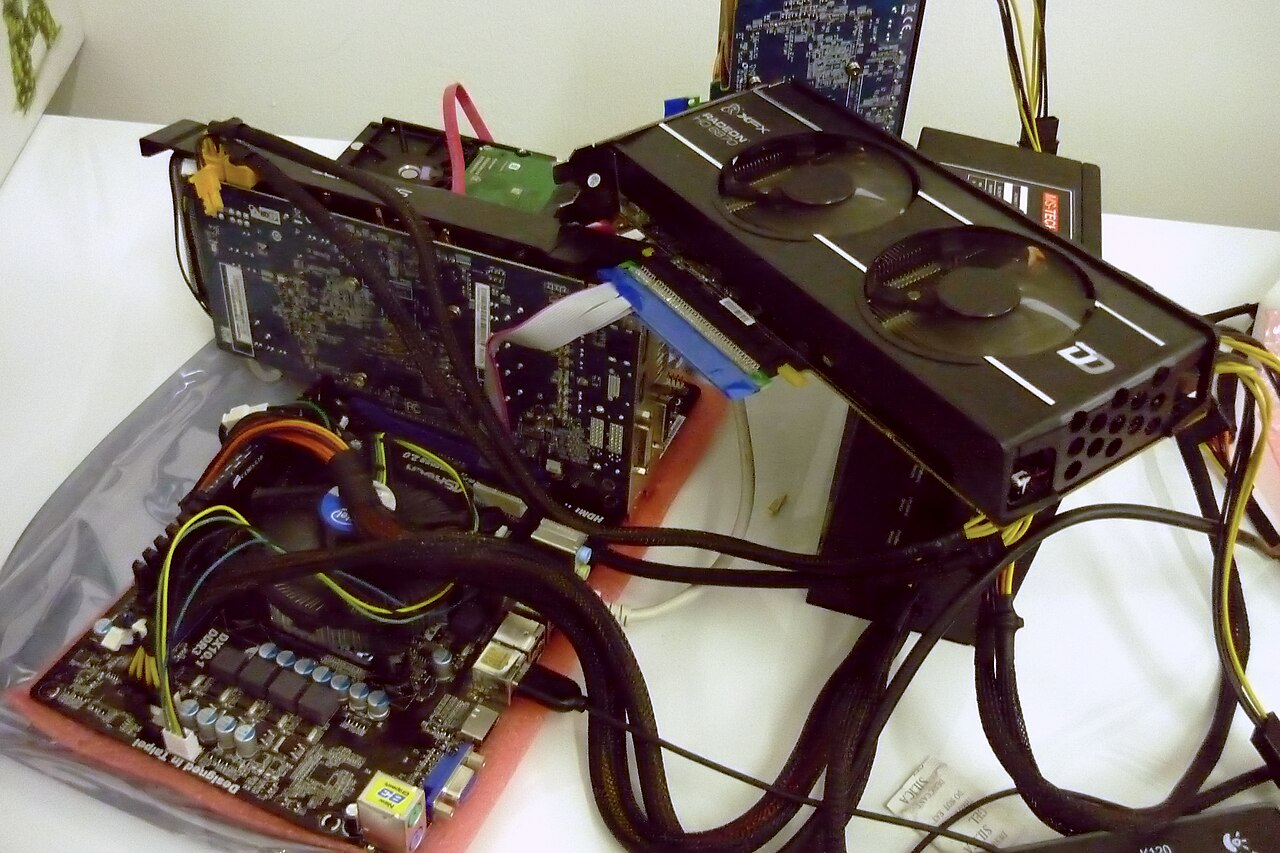
A Bitcoin mining rig in Austria, October 2012. The camera timestamp is October 22; Commons lists an April 2013 summary date. Photograph: Gastev / Mirko Tobias Schaefer · CC BY 2.0. Current Commons version includes November 2017 white-balance, noise and contrast adjustments by Till.niermann.
Source: Wikimedia Commons · CC BY 2.0

Image source, date and reuse rights
Gastev / Mirko Tobias Schaefer · October 22, 2012 (camera timestamp). Uploaded April 10, 2013. 1280px Commons derivative of the November 17, 2017 edited version; no additional crop, annotations or pixel edits by Monedial.
Original source record · Enlarge image ↗
Camera metadata and description support October 2012; summary date is April 2013. Source: Flickr, linked from Commons. This does not establish operator identity, revenue or profitability.
- Exposed circuit boards
- Graphics-card cooling fans
- Power and data cabling
Visible equipment, not evidence of revenue or profitability. Annotations remain outside the photograph.
An infrastructure field guide · Interpretive exhibit
From spare computing to purpose-built silicon
Four overlapping equipment generations; different skills, costs and dependencies. Read the sequence or inspect one generation.
01 / 04
CPU · The computer you already had
A normal computer could contribute hashing work. As more efficient competitors arrived, spare computing capacity became less competitive.
Operational tradeoff
- Flexibility
- A general-purpose processor
- Responsibility
- Run software; pay for power
- Competition
- Your share of total hashing work changes
02 / 04
GPU · The rig you assembled
Cards. Drivers.
Fans. Power.
Graphics processors could repeat hashing calculations efficiently. Builders worked with cards, open frames, power supplies, airflow and drivers. Cooling was an operating problem, not a decorative detail.
Inspect the October 2012 rig above ↑Laszlo’s 2010 prototype and the supplied 2011 cooling discussions are distinct records. No benchmark is generalized across machines. [30] [31] [28]
03 / 04
FPGA · Reconfigure the logic
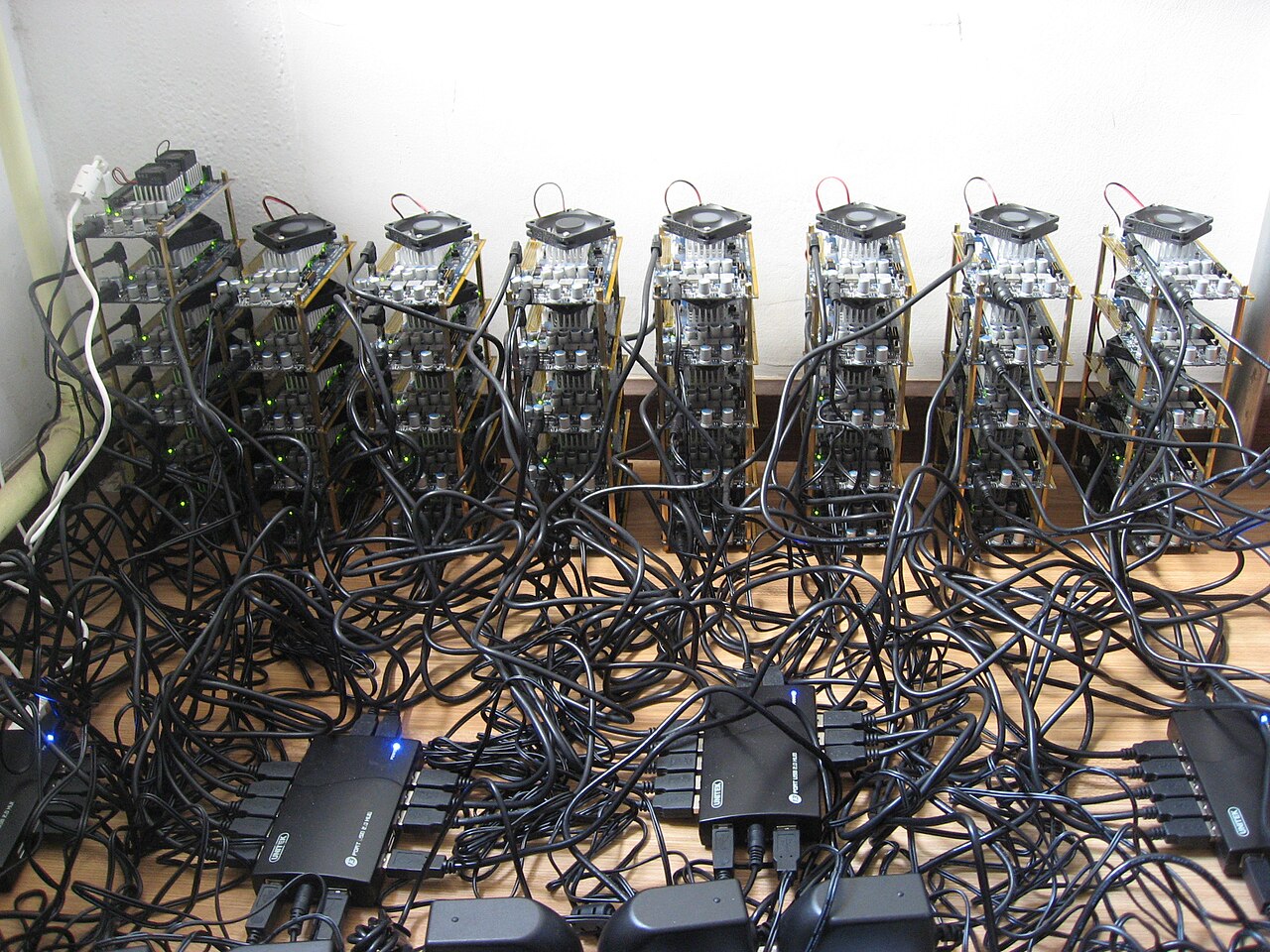
Icarus FPGA mining equipment, March 24, 2012. Photograph: Xiangfu · CC BY-SA 4.0. Uploaded to Commons July 27, 2015; shown as a 1280px derivative without local image edits.
Source: Wikimedia Commons · CC BY-SA 4.0

Image source, date and reuse rights
Xiangfu · March 24, 2012 (file record and camera timestamp). Uploaded July 27, 2015. Commons 1280px derivative; no local crop or pixel edits. The photograph retains its CC BY-SA 4.0 license.
Original source record · Enlarge image ↗
Capture and upload dates differ. The depicted Icarus equipment is FPGA-based; it is not evidence of a GPU rig or a particular mining return.
Field-programmable gate arrays offered another route to efficiency. Boards, firmware, power and airflow still mattered. An FPGA assembly is not a GPU rig.
The dated Icarus image and the separate December 2011 X6500 engineering discussion are distinct evidence. [52] [29]
04 / 04
ASIC · Buy a place in the delivery queue
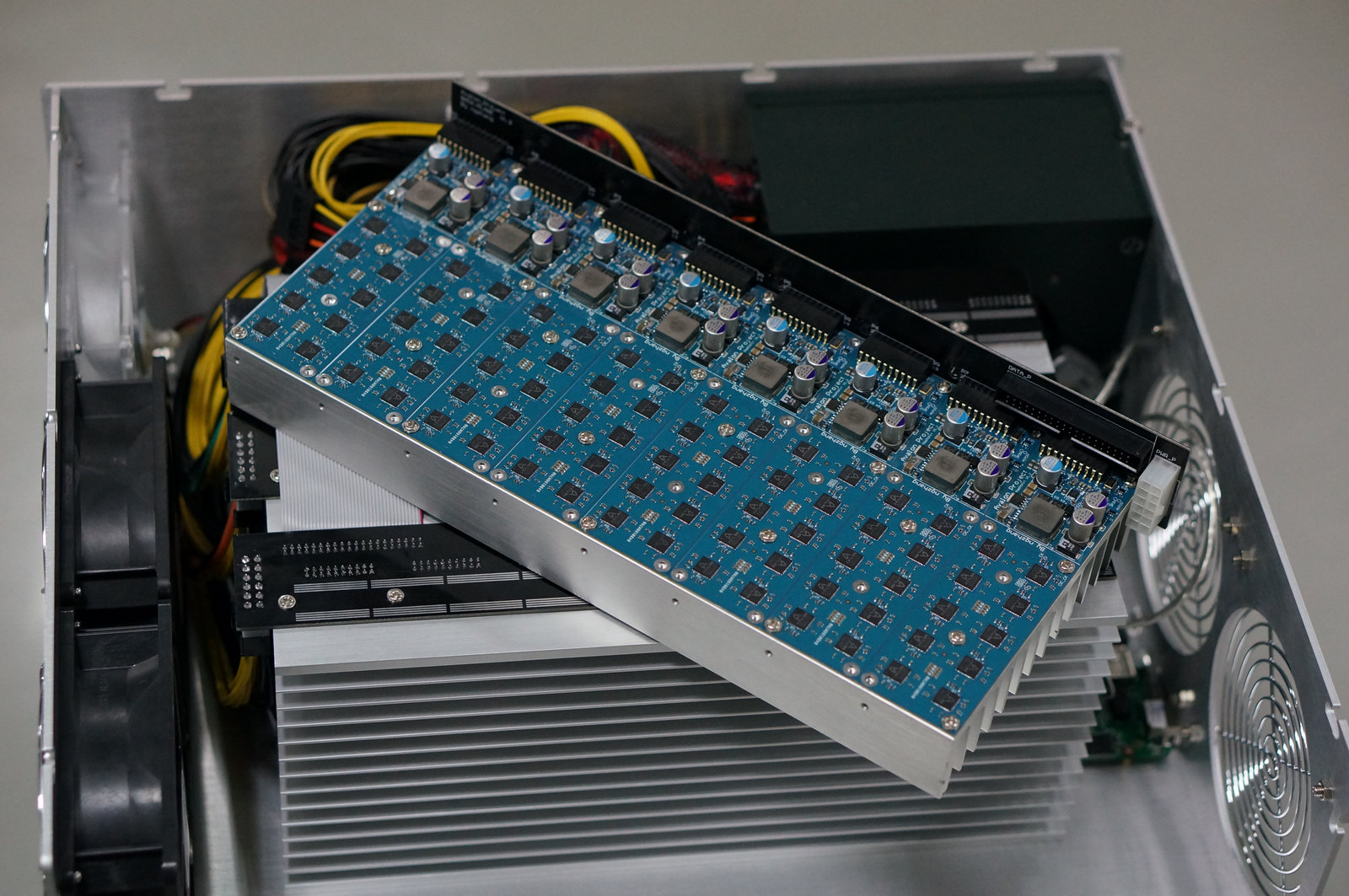
An early Avalon ASIC machine, documented by its September 2013 Commons upload. Photograph by Zhang Nangeng (张楠赓). Exact photographic date is not recorded; this image is not identified as a particular customer’s delivery.
Source: Wikimedia Commons · CC0 1.0

Image source, date and reuse rights
Zhang Nangeng (张楠赓) · 2013. Uploaded 2013-09-14. None. Original JPEG, resized for display without cropping.
Original source record · Enlarge image ↗
Source record and original image verified. SourceIds identify manuscript context; image provenance is given by this sourcePage.
Specialized SHA-256 silicon brought chip fabrication and delivery schedules into the competition. A machine’s opportunity could shrink while it was still in transit.
The photograph is not identified as Jeff Garzik’s unit. His January 2013 delivery is documented separately by the contemporary report. [9] [10]
When the Video Card Became a Mining Machine
In May 2010, a BitcoinTalk thread looked less like the beginning of a financial industry than the support forum for an experimental computer program. Laszlo Hanyecz had a prototype that redirected Bitcoin's repeated calculations to a graphics processor. He invited readers to report their operating systems and the video cards they owned. They answered as computer enthusiasts do: Windows 7, Ubuntu, Radeon HD 4870, GeForce 8300, and plans to upgrade to a Radeon HD 5850.
Laszlo's own measurements told the story. His overclocked Intel processor produced roughly 1.8 million iterations per second using two conventional mining threads; an NVIDIA 8800 GTS could produce around 3.3–3.8 million iterations per second in his test. This did not suddenly create more bitcoins for the whole network. It changed who could compete most effectively for them, until the network's difficulty adjusted.
There was no seamless installation wizard. A July participant with a MacBook Pro saw the program say it was generating, but could not tell whether the graphics card was actually doing the work. Others suggested reading the debug log. Laszlo later described backing away from mining on his laptop after seeing temperatures around 90°C. In September another user watched a passively cooled GT240 slow almost to a halt after a few minutes. The technical revolution arrived as drivers, command lines, overheated computers, and arguments about whose code to trust. [30] [31] [32]
09 / Late 2010–2014
Sharing the Odds
Mining pools converted unpredictable rewards into a steadier stream of payouts.
Solo mining posed a growing problem. Even a miner operating honestly could wait a long time before finding a block as aggregate network hash power increased. Marek Palatinus—known as Slush—introduced an early public mining pool in late 2010, enabling participants to combine work and share block rewards under an agreed accounting scheme.
Pooling did not merge participants into a single physical machine. It coordinated jobs, measured contributed work, and distributed income. In doing so it changed the business of mining. A small participant no longer needed to accept the same variance in rewards. Meanwhile, the pool's operator assumed responsibility for uptime, payout accuracy, and construction or distribution of mining work.
The shift mattered for decentralization. Hashing machines could remain geographically dispersed while coordination concentrated at a smaller number of pool servers. The operator who distributed block templates could exercise influence over transaction selection, even when the chips themselves belonged to thousands of customers. Pools supplied a practical solution, but their scale made new questions about decision-making important. [8] [33]
You found a share. You did not necessarily find a block.
A miner watched the words “Found Hash!” appear repeatedly and imagined something spectacular: had the computer just found five blocks, worth 250 bitcoins at the then-current 50-BTC block subsidy? A participant in Slush's pool explained why not. The software was registering shares: proofs of work at an easier pool-defined target, useful for measuring a miner's contribution. A share was not normally a Bitcoin block. If a pool found a valid block, its participating miners could divide the reward according to the pool's accounting rules.
The exchange captures a quiet but fundamental transition. Solo mining offered the possibility of an entire block reward, but unpredictable waits. Pool mining made revenue more regular by pooling uncertain outcomes among many participants. It also moved coordination and payout accounting into a service run by somebody else. [33]
In a detailed BitcoinTalk explanation published in May 2011, Meni Rosenfeld described the essential economic trade: pooled mining does not substantially increase the expected amount of reward, but it can dramatically reduce its variability. A contributor who might otherwise wait indefinitely for a solo block could instead receive smaller, more regular pool payouts according to the reward system used. [49]
That convenience made mining less solitary. It also concentrated some decision-making with pool operators, whose software distributed work and determined how rewards were calculated. The pool was a financial and coordinating institution layered on top of a decentralized protocol. [49]
“it can dramatically decrease their variance”
Meni Rosenfeld · May 26, 2011; edited June 23 [49]
An infrastructure field guide · Interpretive exhibit
The reward, and the waiting
Conceptual comparison, not a payout forecast. A share measures work for the pool; it is not automatically a network-valid block.
01 / 02
Solo miner
Rare, potentially large payout. Long, uncertain intervals. A solo miner waits to find a network-valid block.
02 / 02
Pool participant
Smaller, more frequent payments, governed by pool rules and fees. Pooling changes variability; it does not substantially increase expected reward.
Marks illustrate the distinction, not measured timing, amounts or a simulated earnings series. [49] [33]
Faster machines needed a better conversation
By September 2012, faster hardware was exposing the cost of the conversation between miners and pools. Repeated requests for work could burden servers and multiply connections. On September 10, BTC Guild operator eleuthria proposed a new protocol. The next day, Slush announced Stratum, describing an experimental service already running. Eleuthria withdrew his competing proposal in favor of the shared approach. The dated exchange records collaboration between operators, not a single proposal under two names. [62] [63]
Stratum gave the pool a persistent connection over which to send work updates, while miners could construct more of their search locally instead of repeatedly asking the server for another small assignment. It improved the practical communication layer as computing capacity expanded. It did not change Bitcoin’s consensus rules, and it did not make the pool’s reward ledger part of the blockchain. Faster coordination could support more independent machines while increasing the importance of the coordinator. [62] [63]
Modern explanatory diagram · Traditional pooled mining
Who chooses the next block?
- Independent minerOwns and operates equipment; chooses a pool.
- Pool work assignmentThe coordinator supplies candidate-block work.
- Submitted sharesEasier proofs measure contributions for pool accounting.
- A network-target resultOnly a qualifying result can complete a candidate Bitcoin block.
- Network verificationNodes independently enforce consensus rules.
Shares do not accumulate into a block. Pool coordination does not establish ownership of the machines.
Conceptual sequence, not a record of one pool’s internal implementation. Stratum improved work communication; it did not grant a pool authority to change Bitcoin’s issuance rules. [63] [33] [65]
Machines in many places, work from one pool
By 2014, owning mining equipment and directing its work had become distinct forms of control. A participant could buy an ASIC, pay the electricity bill and maintain the machine, yet use a pool to organize its search. The pool assembled work for independently owned devices. This arrangement reduced the uncertainty of mining alone, but the distribution of the hardware did not necessarily describe the distribution of decisions about candidate blocks. [65] [63]
In June, estimates of GHash.IO’s contribution approached or briefly exceeded half of Bitcoin’s hash power. The concern was about coordinated block production, not evidence that one corporation owned half the machines. A majority could attempt to reorganize recent history, reverse its own payments or exclude transactions. It could not make validating nodes accept newly created coins outside the consensus rules. Crossing an estimated threshold was a warning about capability, not proof that an attack had taken place. [65]
On June 16, a GHash.IO statement preserved in a forum repost rejected accusations of malicious intent and acknowledged the potential danger of majority control. It proposed discussion with other pools and Bitcoin organizations, including a possible roundtable. The statement is evidence of the company’s public response, not independent proof of its conduct. Its defense of the service and proposal for collective discussion placed a social negotiation beside a technical concentration problem. [64]
Participants could redirect their machines to another pool. That possibility mattered, but it required people to notice the concentration, decide that it justified changing services and actually reconfigure their equipment. A reliable pool was useful to each participant; enough participants making the same choice could produce a result that worried the wider network. Decentralization depended on choices made by operators and customers as well as on where the chips were installed. [64] [65]
10 / 2013
The ASIC Arrives
Purpose-built silicon changed mining from a computer activity into an equipment industry.
By 2013, the competitive frontier had moved beyond repurposed hardware. An application-specific integrated circuit was designed to perform Bitcoin's SHA-256 hashing work efficiently, without the flexibility of a normal CPU or GPU. The engineering required chip designs, fabrication, boards, firmware, cooling, and a production chain. It was expensive to enter and ruthless toward delay.
A contemporary January 31, 2013 report documented developer Jeff Garzik receiving and testing an Avalon miner, confirming that a consumer-delivered ASIC-based device was actually operating. The historical value of this report is not an unqualified claim that one company invented the first possible ASIC. It is contemporary confirmation that specialized hardware had crossed from announcement into customers' hands.
Companies and communities—including Avalon, ASICMINER, Butterfly Labs, and later Bitmain—pursued different organizational approaches. Some sold complete machines, some sold or deployed chips, and some combined manufacturing with their own mining exposure. China's role in engineering, assembly, and manufacturing would become increasingly important, but that geography needs to be explained through contemporary business evidence rather than presented as an inevitable shift.
A share in a manufacturer, or a machine of your own?
ASICMINER made the distinction especially visible. A thread opened by friedcat on August 9, 2012 described investor participation in Bitfountain’s ASIC business. In the first post as updated in March 2013, the plan combined mining with its own hardware and selling equipment, with investor returns tied to the operation’s results after costs. Buying that exposure was different from receiving a miner and deciding where to run it. The customer of a hardware seller acquired equipment; the investor depended on the enterprise’s accounting, execution and distributions. [68]
The manufacturing work also became visible in small physical products. On May 21, 2013, friedcat announced completion of a Block Erupter USB production batch, describing machine assembly, reduced heat and improved stability, and reporting the first 200 units shipped. These were the manufacturer’s claims, not independent benchmarks. They nevertheless show what industrialization involved beyond designing a hashing chip: putting boards together, managing heat, testing densely packed devices and getting finished objects out of the factory. [69]
Avalon’s independently reported arrival at Garzik’s door, ASICMINER’s combined investment and hardware activity, and Butterfly Labs’ advance orders belonged to the same transition without being the same business model. By late 2013, the Antminer S1 group buys added another concrete route: buyers paying bitcoins for machines dispatched from China. The trade joined specialized production to a forum-based international distribution system. [68] [67] [9] [10]
Delivery was only the beginning of operation. Cooling and power determined whether boards could keep working; firmware and configuration connected the hardware to its assigned work. Electricity remained a continuing expense, while the network’s changing difficulty altered the expected return on the same machine. The equipment price bought hardware, not a fixed future flow of coins. A fast shipment could preserve an opportunity without guaranteeing that the opportunity would remain profitable. [69] [67] [29]
The economic consequence was immediate: when more efficient hardware joined the network, difficulty could adjust upward, reducing the expected output of slower machines. A device's value therefore depended not only on its advertised hash rate but on exactly when it began operating. [9]
11 / 2012–2014
The Cost of Being Late
Hardware preorders turned production schedules into financial promises.
ASIC manufacturing created a speculative market for delivery dates. Customers paid ahead for performance that was often difficult to verify. An expected machine could become unattractive before it shipped, not because its circuits deteriorated, but because other miners had raised the total hash power competing for the same block subsidy.
The U.S. Federal Trade Commission's September 2014 action against Butterfly Labs captures this danger in unusually concrete terms. The agency alleged that customers prepaid substantial sums for mining machines that were delayed, unusable for profitable mining, or never delivered. The complaint reported that more than 20,000 purchasers remained without ordered devices at one point in 2013. These were allegations in a civil enforcement case; the company's subsequent procedural history should not be collapsed into an immediate 2014 finding of guilt.
Butterfly Labs therefore represents more than a scandal in the equipment trade. Its story exposes the industrial conditions of Bitcoin mining: technological obsolescence without physical wear, orders financed by advance customer payments, and rewards determined by a network whose competitive difficulty no seller could freeze. Hardware was becoming the infrastructure of monetary issuance, but access to hardware was itself a new source of economic risk. [10]
A seven-month wait, then a rattle in the box
In the summer of 2012, customers were already arguing over the rules for getting the first Butterfly Labs ASIC mining machines. The company described a distribution scheme split among order priority, trade-in customers, and randomized selections from early orders. The scramble was understandable: the profit from a miner depended on how much hashing capacity reached the network before everyone else's equipment arrived.
A November 2013 reviewer offered an especially tangible account. Their Butterfly Labs ‘Little Single’ had been ordered in March and arrived October 31. The reviewer wrote that the wait had undermined the prospects of a quick return on investment. When the box arrived, the sound of loose screws inside was immediately apparent. The reviewer opened the enclosure before powering the machine to avoid a possible short. The disappointment was not merely that a company had been late; specialized hardware was a depreciating competitive opportunity even before a customer took it out of the box. [37] [38]
The early ASIC race transformed a delivery date into an economic variable. A machine ordered when specialized Bitcoin mining was still scarce might arrive in a network where faster equipment had already multiplied the competition. The buyer could receive the exact product requested and still find that its opportunity had deteriorated. [50]
That was the strange urgency of the ASIC transition: every new generation made the previous generation less competitive. For a miner awaiting delivery, the calendar itself became a rival. [50]
One buyer’s account · 2013
The calendar became a rival
- OrderedMarch2013 · exact day not specified
- ReceivedOctober 312013
- ReviewedNovember 52013
“I could hear screws rattling & sliding around inside the case.”
sdczen’s Little Single review [50]
What changed during the wait?
More specialized equipment increased network competition. Difficulty and a machine’s share of the work could change before delivery; the buyer’s purchase price did not freeze those conditions. No profitability series is inferred.
One reviewer’s account, not a claim that every shipment contained loose screws. The later FTC allegations have separate legal sourcing. [10]
The 4.25-bitcoin machine
In November 2013, a BitcoinTalk group buy offered a sharply different delivery story. The Antminer S1 was advertised at 180 GH/s for 4.25 BTC. The organizer, sushi, maintained a public record of reservations, payments and shipping information. Buyers were arranging the purchase of specialized computing equipment from an overseas manufacturer through a community discussion thread. There was no conventional retail checkout separating the conversation from the order book. [66] [67]
The documented process asked participants to reserve a quantity, send bitcoins, then provide a transaction identifier and shipping details. A name on the list had to be matched to payment and to a destination for a physical parcel. The initial 30-unit arrangement expanded; the preserved dispatch thread contains revisions from 30 to 50 and then 65 units. Those edits matter: its final display is a record updated during the sale, not an untouched announcement of a single fixed batch. [66] [67]
A December update reported shipment from China on December 3 and delivery to most customers by December 6. That is the organizer’s account, not a verified arrival date for every buyer. Nor does an advertised 180 GH/s establish each machine’s tested output. Read beside the Butterfly Labs customer’s March-to-October wait, the record shows how different the experience could be when a promised machine was already near dispatch. [67] [50]
The apparent speed did not remove the trust decision. Buyers had to rely on the seller, the organizer’s reconciliation and international delivery, after a Bitcoin payment that offered no ordinary card chargeback. A reservation or a forum status was not possession of a working miner. The economic clock kept running between payment and first use, even for an order that arrived promptly. Here Bitcoin was both the money paying for the machine and the reward the buyer hoped the machine would earn. [66] [67]
Annotated order record · November–December 2013
A machine ordered through a thread
4.25 BTCListed price per unit
180 GH/sAdvertised, not independently tested here
Modern documentary reconstruction from the forum record, not a period screenshot or an offer to purchase.
Reserve
A participant posted the requested quantity.
A place on a list was not a machine in hand.Pay
The arrangement called for a Bitcoin payment.
No historical payment address is reproduced.Reconcile
The buyer supplied a transaction identifier and delivery details.
A blockchain payment still had to be matched to an order.Track
The organizer updated reservation, payment and dispatch status.
The preserved listing expanded beyond the original 30 units.Dispatch
The update reports shipment from China on December 3.
A reported dispatch is distinct from a customer’s receipt.Receive
The organizer reported most deliveries by December 6.
Neither every arrival nor every unit’s performance is independently verified.
Movement IV Keys, Code, And Commerce
12 / 2011–2013
Your Keys, Someone Else's Server
Ease of use and personal control did not always travel together.
The original Bitcoin client placed demanding responsibilities on its operator. A user needed software, local data, backups, and an understanding of how loss of a wallet file could mean loss of access to coins. Hosted services simplified the interface by keeping balances and, often, keys on behalf of customers. That convenience made Bitcoin approachable but reintroduced dependence on a custodian.
Early service failures such as MyBitcoin demonstrated the risk of making a website the apparent location of money. The question was not only whether a password was strong. It was whether the service's claims were backed by usable coins, whether records could be trusted, and who could sign transactions when a customer wanted to leave.
Other developers moved in a different direction. Electrum, created by Thomas Voegtlin in November 2011, offered a lightweight model that did not require every wallet user to operate a full validating node. Armory emphasized cold storage and stronger key isolation. These systems made tradeoffs: a lightweight wallet depends on external information for some tasks, while a more elaborate cold-storage workflow requires greater user discipline. Neither is equivalent to handing custody to an exchange. [11] [12]
A wallet was also a program to maintain
Downloading Bitcoin-Qt gave an early user a desktop program, not a bank login. Before its view of payments was current, the computer had to catch up with the blockchain. The February 2012 Windows screenshot below shows the ordinary controls: an overview, sending and receiving coins, transaction history, and an address book. Those controls made addresses and payments visible; the signing keys were a separate responsibility. [57] [58] [39]
For the Windows installation shown, the default data folder was under the user’s application-data directory, rather than simply beside the downloaded executable. The wallet.dat file held wallet data needed for spending; copying the program alone was not a wallet backup. A usable backup needed the relevant keys. If every copy of a necessary private key was lost, downloading the blockchain again could not recreate it. The later support experiences below show how easily software, transaction history and key storage could be confused. [59] [58] [41]
An original software interface · February 21, 2012
The wallet on your own computer
Bitcoin-Qt 0.5.2-win32 · Windows 7
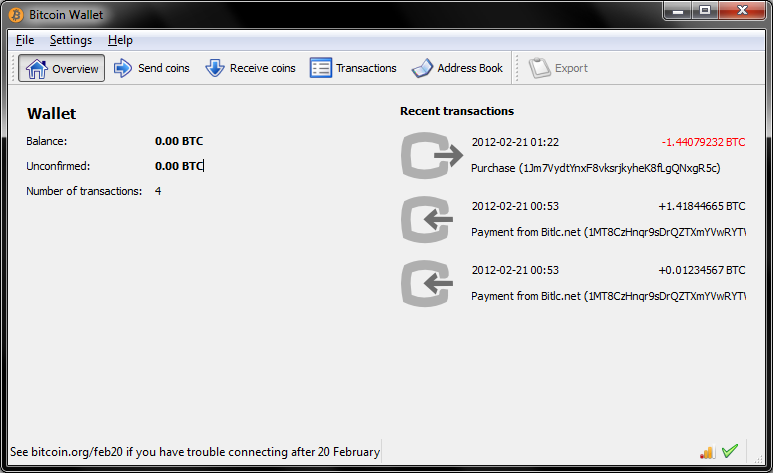
Bitcoin-Qt 0.5.2-win32 on Windows 7, February 21, 2012. Screenshot: JimNelin. Software: Satoshi Nakamoto et al., MIT / Expat. Original image, unmodified; explanatory notes appear below it.
Source: Wikimedia Commons · MIT / Expat

Image source, date and reuse rights
JimNelin (screenshot); Satoshi Nakamoto et al. (software) · 2012-02-21. Uploaded 2012-02-21. None. Original 773 × 473 PNG. No annotations or altered balances inside the historical screenshot.
Original source record · Enlarge image ↗
Copyright © 2009–2012 Satoshi Nakamoto et al. MIT / Expat permission notice is included below this image. One file-history upload on February 21, 2012; no later image revision recorded.
- Across the top
Sending, receiving, transaction history and an address book occupy separate controls.
- In the overview
A balance and recent transactions describe this wallet’s view. The pictured zero is not evidence of a lost-key incident.
- Outside this window
The default Windows data folder was
%APPDATA%\Bitcoin. The program and its wallet data were different things. [59]
Modern annotations, outside the original image. This 2012 screenshot is not a screenshot of either 2013 support case. Synchronizing history cannot recreate a missing private key. [57] [58]
MIT / Expat copyright and permission notice
Copyright © 2009–2012 Satoshi Nakamoto et al.
Permission is hereby granted, free of charge, to any person obtaining a copy of this software and associated documentation files (the “Software”), to deal in the Software without restriction, including without limitation the rights to use, copy, modify, merge, publish, distribute, sublicense, and/or sell copies of the Software, and to permit persons to whom the Software is furnished to do so, subject to the following conditions:
The above copyright notice and this permission notice shall be included in all copies or substantial portions of the Software.
THE SOFTWARE IS PROVIDED “AS IS”, WITHOUT WARRANTY OF ANY KIND, EXPRESS OR IMPLIED, INCLUDING BUT NOT LIMITED TO THE WARRANTIES OF MERCHANTABILITY, FITNESS FOR A PARTICULAR PURPOSE AND NONINFRINGEMENT. IN NO EVENT SHALL THE AUTHORS OR COPYRIGHT HOLDERS BE LIABLE FOR ANY CLAIM, DAMAGES OR OTHER LIABILITY, WHETHER IN AN ACTION OF CONTRACT, TORT OR OTHERWISE, ARISING FROM, OUT OF OR IN CONNECTION WITH THE SOFTWARE OR THE USE OR OTHER DEALINGS IN THE SOFTWARE.
An infrastructure field guide · Interpretive exhibit
What does the balance let you do?
Compare personal signing keys with an exchange’s account ledger. Convenience and responsibility move together; neither arrangement eliminates every risk.
01 / 03
Make a transfer
Personal wallet
- Authority
- Your private keys authorize spending
- Action
- Sign and broadcast a transaction
- Record
- The Bitcoin network validates the transfer
Exchange balance
- Authority
- The operator controls the exchange’s keys
- Action
- Request a withdrawal
- Record
- An internal trade need not be an on-chain transaction
A hosted account and a lightweight wallet are not automatically the same custody model. [11] [12]
02 / 03
Restore access
Personal wallet
- Dependency
- Correct key material and usable backups
- Limit
- A program executable cannot replace missing keys
- Caution
- A zero display does not establish permanent loss
Exchange balance
- Dependency
- Account access and the operator’s records
- Limit
- A password reset does not establish solvency
- Caution
- Displayed balances are claims on the service
The two 2013 support discussions do not establish a final recovery or loss outcome. Early wallet.dat management is not a universal modern seed-phrase workflow. [39] [41]
03 / 03
When the service stops
Personal keys
- Can you act?
- You can use compatible software if your keys remain usable
- Still needed
- Network access and a valid transaction
- Not protected from
- Lost keys, theft or compromised devices
Exchange claim
- Can you act?
- Withdrawal depends on the custodian
- If insolvent
- A displayed balance may become a legal claim
- Separate system
- Bitcoin can continue while the business cannot
Mt. Gox’s initial shortfall, recovered wallet and later criminal allegations are different evidence stages. [18] [19]
The Wallet File on the Deleted Drive
Self-custody could feel liberating because the bitcoins no longer depended on a trading venue's promise to honor a balance. But that freedom moved an unfamiliar burden onto the customer. A wallet was not an account that a company could simply unlock after a forgotten password. The private keys needed to spend the coins had to survive alongside the owner.
In November 2013, a BitcoinTalk participant wrote that they had purchased bitcoins in June 2011, withdrawn them from Mt. Gox to Bitcoin-Qt, and later deleted the Bitcoin directory—including wallet.dat. They had recovered an older wallet file but, after resynchronizing the blockchain, saw a zero balance. Other users offered troubleshooting advice. The forum post documents a person's fear and uncertainty, not a definitive record of lost bitcoins or final recovery.
This is why wallet backups, deterministic recovery phrases, and hardware signing devices were not just abstractions in the evolution of Bitcoin software. Each attacked a practical failure mode that an early user could experience personally. [39]
Your Bitcoins in Your Pocket
Bitcoin's earliest wallet experience often meant a desktop program and a computer that had to catch up with the blockchain. A mobile wallet promised a radically different relationship: bitcoins could accompany their owner into a cafe or shop.
A spring 2012 thread about Blockchain.info's mobile wallet offers a particularly candid snapshot. One iPhone tester liked the clean interface but complained that the application crashed and forgot its pairing with an account. The user also worried about what would happen if the phone were stolen or misplaced: shouldn't spending require another password? A developer responded with advice about the wallet's additional encryption controls and how to copy an address through its QR-code display. A different participant praised the app enthusiastically.
This was more than a software usability conversation. It revealed the competing expectations that would shape Bitcoin wallets: money had to be available conveniently enough to spend, yet protected against physical theft, device failure, and accidental disclosure. A wallet could lower the friction of paying while raising new questions about what was stored on the phone and what secrets remained under the user's control. [42]
13 / 2012–2014
Recovery and the Hardware Boundary
Wallet standards and dedicated devices made key ownership less fragile.
A basic problem of early self-custody was backup. Users could generate additional keys without realizing that an old backup might not include them. Hierarchical deterministic designs offered a structured way to derive many keys from a recoverable root. Pieter Wuille's BIP 32, assigned in 2012 and revised in 2013, documented one influential approach. Later seed-phrase and account-structure standards broadened this ecosystem, but their publication dates must not be confused with universal software adoption.
A second question was where to perform the signature. If an ordinary computer was infected, software protecting a wallet could still be compromised. The Trezor Model One, launched in July 2014 according to its developer, offered a dedicated device intended to keep signing keys separate from a general-purpose computer. Its importance was not that it made careless custody safe; backups, authenticity, and operational behavior still mattered. It made a different security architecture available to consumers.
Taken together, lightweight clients, cold-storage practices, deterministic backups, multisignature tools, and hardware wallets reveal a maturation invisible in a simple Bitcoin price chart. Infrastructure could move users toward intermediaries, but it could also make direct ownership more practical. [13] [14]
The File Named CHEESE.dat
A borrowed laptop, a flash drive, and a file with an improvised name: the ingredients of one Bitcoin user's November 2013 problem were ordinary enough. The bitcoins themselves were not. The user told BitcoinTalk that they had acquired bitcoins, synchronized Bitcoin-Qt on a laptop, sent the coins to that wallet, and copied what they believed was the backup onto a flash drive. For reasons the writer didn't explain, the file was called CHEESE.dat.
The original laptop had since been wiped. On other computers, restoring the file produced a balance of zero. The conversation that followed was part technical support, part lesson in what ownership of a decentralized asset actually required. Helpers asked about the receiving address, the exact location and filename of wallet.dat, hidden Windows application-data directories, and whether the software needed to rescan its transaction history. An empty balance on a screen might signify a synchronization or restoration problem; it might also mean that the backed-up file did not contain the right private key. The published discussion does not conclusively establish the fate of the coins.
The episode captures the burden concealed behind the slogan of financial self-sovereignty. Removing a bank or exchange from the custody relationship transferred responsibility for keys, backups, and recovery procedures to the user. An ordinary flash drive might serve as a vault—but only if it contained the correct information. [41]
The thread also contains a later, partial update. On November 28, SeansinWiscottle reported that a balance had appeared, but said 3 BTC were still missing and suggested a new address might have been created after the backup. That was the participant’s explanation, not a verified diagnosis. The record supports neither an uncomplicated recovery story nor a definitive claim that all the coins were permanently lost. [61]
14 / 2012–2014
A Payment That Ends in Dollars
Merchant processors let businesses accept Bitcoin without becoming currency traders.
A merchant considering Bitcoin in 2012 or 2013 faced a different problem from a person accumulating coins. The merchant needed prices, receipts, payment detection, accounting, refunds, and the ability to pay suppliers and staff in conventional money. A successful Bitcoin payment interface therefore required substantial work around the basic act of broadcasting a transaction.
Payment processors built gateways, integrations, merchant dashboards, and conversion services. BitPay was an important early participant. Coinbase also developed consumer access and merchant services. On January 9, 2014, Coinbase announced its integration with Overstock.com, explaining that merchants could price goods in dollars and lock the exchange rate for an incoming Bitcoin payment. This removed a central reason for a retailer to decline Bitcoin: unwanted exposure to day-to-day price swings.
A customer might spend bitcoins, the merchant might receive dollars, and a specialist intermediary absorbed or managed the conversion and settlement work. Bitcoin's use in commerce increasingly depended on software and financial arrangements that were not themselves part of its consensus protocol. [15]
The Checkout Behind the Button
A shopper clicking “Pay with Bitcoin” experienced a transaction that could appear effortless. The merchant faced a different problem. Its inventory was priced in dollars, the customer would send bitcoins, and the retailer needed to know how much bitcoin was due, whether payment had appeared, when it was safe to release goods, and how to account for the sale.
BitPay offered an answer by putting a payment-processing service between the merchant's checkout and the Bitcoin network. A February 2014 integration walkthrough described a checkout that generated a BitPay invoice, sent the customer to a payment screen, accepted coins from a wallet, and then tracked the invoice through payment and confirmation states. Merchants could make different risk decisions about how quickly to accept a payment. In a January 22, 2013 company announcement, BitPay said it had passed 10,000 merchant transactions; that is a contemporaneous company claim, not an independently audited market total.
For a merchant, the advance was not simply that someone could send bitcoins. It was that a familiar e-commerce application could communicate with a service that handled the unfamiliar details. Bitcoin's open network had gained a layer of specialized commercial software. That layer made the currency easier to accept, even for merchants that had little interest in operating a Bitcoin node or watching the blockchain themselves. [43] [44]
A checkout under construction · February 25, 2014
The invoice had a life after the button
Modern process reconstruction from Mark Johnson’s account of integrating BitPay for FrozenCPU. No period interface is reproduced. [43]
- MerchantCreate invoice
Priced in the shop’s currency.
- CustomerApprove payment
BitPay hosts or embeds the payment screen.
- ProcessorTrack status
Payment detection and confirmation policy are separate.
- MerchantFulfill the order
Use the chosen acceptance policy; settlement currency is another decision.
The edge case: an abandoned checkout
Johnson reported that the fifteen-minute expiry did not trigger the notification his integration needed. The team added a monitoring script to check older orders and cancel expired ones. A working payment button still required software for the customer who never paid.
One contemporary integration, not current BitPay instructions or a universal confirmation schedule.
15 / 2013
The Infrastructure Nobody Sees
Nodes, software releases, explorers, and reliable information made the network intelligible.
A functioning Bitcoin economy required more than a successful consumer app. Nodes had to validate blocks and relay transactions. Developers maintained software and coordinated releases. Block explorers made confirmations visible to merchants and customers. APIs allowed services to connect payments and account systems without building every tool from scratch. Market-data businesses collected prices, even though no single exchange could supply a universally authoritative value.
On March 11, 2013, a network split brought the importance of this maintenance infrastructure into focus. Bitcoin 0.8 accepted a block that some older software rejected because of an unexpected database-lock limitation. For a period, different groups of nodes followed different chains. Developers and mining operators coordinated a return to compatibility, and a post-mortem subsequently documented the problem.
The episode was not merely a curiosity of programming. Merchants and exchanges needed dependable confirmations, while miners needed assurance they were building on the chain other participants would accept. The community's response illustrated the human coordination operating around technical consensus. It also showed why neither the source code nor any single business alone could guarantee continuity: compatibility depended on implementations, operators, and shared decisions under pressure. [16]
A choice under pressure
The March 11 split forced operators to choose which chain to extend while their machines were still working. Version 0.8 used a different database implementation from earlier releases. A block accepted by the newer software exceeded an older implementation’s practical database-lock limit. Both groups were running software they expected to enforce the same rules, but they no longer agreed on the history. A full node was not simply displaying a shared ledger: it was independently deciding which blocks it could accept. [78]
BIP 50 records developers coordinating through IRC and reaching the operators of BTC Guild and Slush. BTC Guild’s Michael Marsee, known as eleuthria, and Slush’s Marek Palatinus helped move mining back to software compatible with the older chain. The decision was not to declare the newer software correct and leave older users behind. Major participants downgraded, sacrificing income from work on the branch they were abandoning so that the compatible branch could gain the accumulated work needed to become the common history. [78]
For a business watching confirmations, the consequences were immediate. Once the compatible branch overtook the other, newer nodes reorganized their view of recent blocks. A payment previously seen in a block on the abandoned branch needed to be evaluated again against the surviving history. Major exchanges paused deposits, and BitPay paused payment processing as a precaution. A deliberately demonstrated double-spend during the incident showed why the interruption was more than a confusing display, even though the experiment was not intended to steal. [78]
The repair extended beyond that night’s coordination. The post-mortem described temporary restrictions in version 0.8.1, changes for older software, and better testing and emergency communication. The network’s rules did not administer an exchange’s accounts; businesses still had to decide when it was safe to credit deposits or release goods. This March 2013 compatibility failure was separate from the transaction-identifier and bookkeeping problems debated during Mt. Gox’s withdrawal halt in February 2014. [78]
Waiting for the Chain
Installing the Bitcoin client did not mean it was instantly ready. Users choosing independent verification first had to download and process a history of previous transactions. The progress bar was an everyday expression of one of Bitcoin's most important principles: a participant could verify the history rather than accept an exchange's database as authoritative. [45] [46]
Making the ledger legible
An explorer made part of this technical world visible to people who did not run analysis software. On November 10, 2010, theymos announced Bitcoin Block Explorer, with pages linking blocks, transactions and addresses. A participant, TTBit, immediately described its value to a non-programmer and suggested using it to check payment to an address on an auction listing. The interface gave a customer something concrete to inspect beyond a seller’s assurance that money had arrived. [79]
The announcement also warned against reading an address page as a complete account balance: change and the use of multiple addresses complicated that inference. Public visibility did not disclose every obligation on an exchange’s private books. An explorer could help establish that a transaction appeared on-chain; it could not certify that a custodian held enough assets for all customers. Developer APIs brought the same distinction into business software. The merchant integration described earlier needed code for invoice status and abandoned checkouts, not merely a link to a transaction. [79] [43]
Movement V The Limits Of Intermediaries
16 / 2013
The Market Goes Global
New financial geographies developed faster than uniform rules or practices.
By 2013, Bitcoin's supporting industries were no longer centered on a small circle of English-language forums. Chinese exchanges, manufacturers, mining operators, and local investors became consequential. BTC China and other venues connected trading to renminbi liquidity, while hardware builders participated in Asia's deep electronics supply chains. The two activities should not be conflated: exchange trading volume and manufacturing dominance are distinct historical phenomena, each requiring separate evidence.
In December 2013, Chinese authorities published a notice defining Bitcoin as a particular virtual commodity rather than legal currency and restricting financial institutions' involvement. Individual participation was not simply outlawed by the notice. Restrictions on banking and payment support nevertheless affected the practical means through which customers funded exchanges. The policy event revealed the power of national financial systems over access to a borderless settlement network.
A comparable lesson appeared in the United States: money-transmission requirements applied to certain intermediaries even though sending a Bitcoin transaction did not require a conventional payment company. Global use of Bitcoin did not abolish national institutions. It created new points of contact with them. [17] [7]
A renminbi balance, a bank connection, a factory shipment
BTC China’s story connected Bitcoin to a specific domestic market. A contemporary October 2013 profile traced the service to a June 2011 launch and described Linke Yang’s involvement and Bobby Lee’s later role as chief executive. Renminbi access gave local customers a different route from sending money to a dollar-based venue abroad. Evidence of that growing business does not establish that it permanently determined the world price of Bitcoin. [80]
The official risk notice republished by China’s Ministry of Industry and Information Technology on December 6, 2013 treated Bitcoin as a virtual commodity. It restricted financial and payment institutions’ Bitcoin business while describing individual participation as an activity undertaken at the participant’s risk. The distinction became tangible on December 18: BTC China stopped accepting renminbi deposits after its third-party payment processor ended support, according to Bobby Lee’s account in contemporary reporting. Existing account activity and the ability to bring fresh bank money into the system were different operational questions. [82] [81]
Manufacturing followed another geography and another set of records. The Antminer group-buy update’s dispatch from China is evidence of an international equipment route. ASICMINER’s investment materials describe a business that combined manufacturing with mining on its own account. Neither record, by itself, measures how much of the world’s mining equipment operated inside China. Machines could be exported; a miner could join a pool based elsewhere. Exchange volume, factory location, local mining and pool coordination must be traced separately rather than collapsed into one claim of national control. [67] [68] [65]
Kraken’s euro market offers a useful comparison. Its launch excluded some jurisdictions even while its software connected international traders. BTC China’s deposit interruption and Kraken’s launch restrictions were different events, but both made the boundary between internet reach and financial access visible. Bitcoin packets could travel across a border more easily than a new exchange could acquire the banking, payment and regulatory arrangements needed on the other side. [74] [81]
Bitcoin steps out of the browser
By the end of 2013, the search for a usable way into Bitcoin had produced another kind of object: a machine that could stand in a public place. Compared with a cash payment made through a pharmacy's ordinary money-transfer equipment, a dedicated Bitcoin ATM offered a more legible idea. Here was a machine whose purpose was Bitcoin itself. [53]
A photograph attributed to Arto Alanenpää shows a Bitcoin ATM in Finland, identified in the Wikimedia Commons record as the country's first and dated December 17, 2013. Its historical importance is not a claim that such machines were suddenly common. It is the visible transition from makeshift connections to existing payment services toward purpose-built public-facing infrastructure. [53]
The reader who has already walked through BitInstant's red-phone procedure can recognize the contrast. In one story, Bitcoin was hidden behind the operating procedures of MoneyGram and a drugstore counter. In the other, Bitcoin had acquired a physical interface in its own name. [53]
17 / 2014 · Later evidence
The Failure at the Center
Mt. Gox's final crisis exposed the difference between network settlement and customer claims.
By early 2014, Mt. Gox was no longer merely a trading venue experiencing occasional delays. Withdrawal difficulties and customer frustration had become central to its public identity. In February, Bitcoin withdrawals were suspended, its website ceased normal trading, and the business sought bankruptcy protection in Japan. The reported shortfall included approximately 750,000 customer bitcoins and 100,000 company bitcoins. Those figures describe the initial disclosure, not a settled, final account of the loss.
From a withdrawal queue to a closed exchange
The earlier bank-withdrawal account shows why customers already had reason to distinguish a screen balance from money they could use. Eggshen’s 2013 journey had involved cancelled fiat requests and a different exchange before a reported bank receipt. On February 7, 2014, the new interruption concerned Bitcoin withdrawals themselves. Mt. Gox cited technical problems; on February 10 its explanation focused on transaction malleability. The banking queue and the Bitcoin withdrawal halt were connected through the same business, but they were not the same mechanism. [83] [84] [60]
Transaction malleability allowed some transactions to acquire a different identifier without necessarily changing the intended payment. A service that tracked a withdrawal only by an expected identifier could mistake a completed payment for a failed one. Bitcoin.org’s February 11 alert located the problem in how affected services handled these variants in their internal accounting, noted that some implementations were largely unaffected, and said no emergency change to the Bitcoin protocol was required. A confusing identifier did not give someone permission to choose arbitrary new recipients or amounts. [85]
Modern schematic · Not an actual transaction
A different identifier, not a different payment
Same intended inputs and outputs · Alternative representations of one spend
An identifier-only lookup can miss the confirmed variant. That does not justify sending a second payment without reconciling the first.
This schematic illustrates the accounting hazard, not the cause or amount of Mt. Gox’s complete shortfall. It does not give anyone authority to change arbitrary recipients, amounts or monetary rules. [85]
By February 25, the crisis had moved beyond a technical explanation. Reuters reported that trading had stopped and the website had gone dark, with a handful of protesters outside the Tokyo office. The customer’s problem was no longer simply which identifier to search for. It was whether an institution that held the keys and maintained the account records would resume honoring withdrawal requests at all. [86]
On February 28, Mt. Gox sought court protection in Japan. Contemporary reporting relayed the company’s estimate of roughly 850,000 missing bitcoins: 750,000 attributed to customers and 100,000 to the company. The filing was a disclosure at a particular moment, not a completed forensic explanation. Neither that total nor the earlier malleability statement established one cause for every missing coin. [87]
The chronology changed again with the company’s March 20 announcement, reported the following day: an older wallet held about 200,000 bitcoins. The company said it had identified the balance on March 7. Discovery, public announcement and news reporting were separate dates. Finding the wallet altered the inventory then known; it did not settle how the remaining shortfall had developed. [88]
The distinction became unavoidable when Mt. Gox reported recovering approximately 200,000 bitcoins from an old-format wallet in March. The recovery did not erase customer losses, but it undermined any simple description of the initial figures as fully reconciled. Later investigation introduced further complexity. A 2023 U.S. Department of Justice indictment alleged that attackers stole approximately 647,000 bitcoins over a period beginning in 2011. Those allegations may illuminate the earlier collapse; they must be labeled allegations rather than findings of guilt.
For users, the practical experience was stark. A balance displayed by an institution could become a claim in insolvency proceedings rather than a sum they could transfer with a private key. An exchange built to bridge decentralized Bitcoin and conventional money had become a single point of dependence for people who thought of themselves as participants in a decentralized system.
The story should resist retrospective inevitability. Mt. Gox had solved a real problem when there were few alternatives. Its weakness became historically consequential because it succeeded in attracting customers and trading activity. More substantial infrastructure did not appear by simply wishing Mt. Gox away; it required competitors, security practices, operational investment, and institutions able to withstand failures. [18] [19]
Documentary chronology · February–March 2014
What was known, and when
Bitcoin withdrawals halted
TIME reports Mt. Gox’s technical-problem explanation. [83]
Malleability explanation
Mt. Gox’s explanation is reported contemporaneously by Bitcoin Magazine. [84]
Technical distinction
Bitcoin.org identifies affected services’ accounting problems; no emergency protocol change is required. [85]
Trading stops
Reuters reports the dark website and protesters near the Tokyo office. [86]
Initial shortfall disclosed
Company figures reported by Reuters: about 750,000 customer BTC + 100,000 company BTC; court protection sought. [87]
Older wallet announced
March 20 company statement, reported March 21: about 200,000 BTC, said to have been identified March 7. [88]
Company disclosures and contemporary reports, not a final reconciliation. Banking delays, transaction identifiers, internal records, missing assets and later theft allegations require distinct evidence.
18 / 2014
After the Center
The collapse did not end Bitcoin's infrastructure project. It clarified what that project still lacked.
The most important result of early failures was not that Bitcoin's decentralized protocol had secretly depended on Mt. Gox to exist. The network continued validating transactions after the exchange stopped serving customers. What broke was a dense collection of private promises: account balances, withdrawal requests, payment relationships, corporate records, and the public assumption that an intermediary held what it said it held.
By late 2014, competing exchanges, wallet technologies, mining manufacturers, merchant processors, and regulatory practices were already developing in parallel. Kraken's work with the Mt. Gox bankruptcy trustee illustrates the uneasy connection between competitive business development and the obligations left by a failed institution. The next infrastructure era would involve compliance teams, institutional custody, more advanced trading, greater computing concentration, and continued debate over control. None of these developments can be treated as a complete solution to the earlier problems.
Proving more than a balance on a screen
On March 24, 2014, Kraken announced a Bitcoin reserve verification conducted with Stefan Thomas. Customers could check that their balances had been included in the cryptographic accounting, rather than merely accepting a company’s total. The technique attempted to connect the service’s claimed obligations to demonstrable Bitcoin holdings. It was a response to the problem Mt. Gox had made unavoidable: a trading interface could keep displaying balances after confidence in their backing had disappeared. [89]
The check had limits. It concerned Bitcoin reserves at a point in time, not every corporate liability, every asset or all future conduct. A customer’s inclusion check was useful evidence without being a promise that the business could never fail. Reserve verification, recovery proceedings and retaining one’s own keys addressed different parts of the trust problem; no single practice replaced the others. [89]
Mining raised a related question in another form. The June GHash.IO episode showed that owning one’s hardware did not mean independently choosing all of its work. A customer could leave an exchange, and a miner could leave a pool, but the act of leaving required usable alternatives and a decision to take responsibility. The infrastructure becoming visible after Mt. Gox was not simply larger. Its participants were beginning to ask what each institution could demonstrate, what it still controlled and how a user could withdraw from that dependence. [64] [65]
Bitcoin did not need a central company to define its supply or verify its ledger. But people needed ways to buy it, safeguard it, price it, spend it, and operate the machines that secured it. Between 2010 and 2014, those needs produced a network of businesses and tools that made Bitcoin more usable—and created new places where trust could fail.
The enduring question was not whether Bitcoin could function without intermediaries. It could. It was which intermediaries people would choose to use, what responsibilities those intermediaries assumed, and how much of Bitcoin's original promise remained under the user's own control. [20]
Sources & further investigation
Primary documents
- BitcoinMarket announcement and early trading, January–March 2010
Source provenance
Contemporary participant report; one experience, not a universal outcome. Forum posts may have later edits.
- Mt. Gox announcement, July 18, 2010
Source provenance
Contemporary participant report; one experience, not a universal outcome. Forum posts may have later edits.
- 2014 ecosystem descriptions in a registrant’s SEC filing
Source provenance
Registrant disclosure, not an independent ranking; individual company launch dates remain open.
- Braiins: hashing history
Source provenance
Operator retrospective. November/December launch-month conflict remains; manuscript uses late 2010.
- Electrum announcement · November 2011
Source provenance
Original announcement subsequently updated; distinguish later features.
- Armory developer’s account of wallet development
Source provenance
Starting development is not a public release date.
- BIP 32 · Hierarchical Deterministic Wallets
Source provenance
Assigned 2012; revised 2013. Specification is not universal adoption.
- Trezor Model One history
Source provenance
Manufacturer retrospective; July 2014 launch, no independent global first claim.
- Coinbase–Overstock merchant integration · January 9, 2014
Source provenance
Supplied development research; publication verification remains pending.
- BIP 50 · March 2013 Chain Fork Post-Mortem
Source provenance
Project technical record of database-lock incompatibility and coordinated response.
- Jed McCaleb correspondence with Gwern · 2014
Source provenance
Retrospective participant confirmation: online cards, reused domain, different Bitcoin code.
- Jed McCaleb interview: creating Mt. Gox
Source provenance
Retrospective interview, republished transcript.
- Charlie Shrem · Epicenter interview, January 8, 2020
Source provenance
Retrospective account of prefunding, founding and investment; not contemporary independent confirmation.
- Charlie Shrem · Pomp interview transcript
Source provenance
Retrospective testimony about Gareth Nelson, Roger Ver and BitInstant.
- Bitstamp offers BitInstant deposits and withdrawals · March 30, 2012
Source provenance
Contemporary company announcement; exchange funding and transfer options, not proof of every retail route.
- CVS red MoneyGram phone: customer report · May 23, 2012
Source provenance
Contemporary participant report; one experience, not a universal outcome. Forum posts may have later edits.
- CVS cash-deposit follow-up · May 23, 2012
Source provenance
Contemporary participant report; one experience, not a universal outcome. Forum posts may have later edits.
- Outdoor mining rig and condensation · August 2011
Source provenance
Contemporary participant report; one experience, not a universal outcome. Forum posts may have later edits.
- X6500 Custom FPGA Miner discussion · December 2011
Source provenance
Contemporary participant report; one experience, not a universal outcome. Forum posts may have later edits.
- Laszlo’s GPU mining prototype · May 2010
Source provenance
Contemporary participant report; one experience, not a universal outcome. Forum posts may have later edits.
- GPU setup, logs and temperature · July 2010
Source provenance
Contemporary participant report; one experience, not a universal outcome. Forum posts may have later edits.
- GPU overheating and trust discussion · September 2010
Source provenance
Contemporary participant report; one experience, not a universal outcome. Forum posts may have later edits.
- Separate direct-address cash route report · July 30, 2012
Source provenance
Contemporary participant report; one experience, not a universal outcome. Forum posts may have later edits.
- Mt. Gox credit-union wire problem · March 9, 2012
Source provenance
Contemporary participant report; one experience, not a universal outcome. Forum posts may have later edits.
- Varied Mt. Gox withdrawal experiences · June 2012
Source provenance
Contemporary participant report; one experience, not a universal outcome. Forum posts may have later edits.
- Butterfly Labs order priority · June 23, 2012
Source provenance
Contemporary participant report; one experience, not a universal outcome. Forum posts may have later edits.
- Little Single customer review · November 5, 2013
Source provenance
Contemporary participant report; one experience, not a universal outcome. Forum posts may have later edits.
- Wallet recovery after deleting Bitcoin directory · November 20, 2013
Source provenance
Unresolved support discussion; no definitive loss or recovery outcome.
- Vancouver gathering and Waves Coffee ATM · October 2013
Source provenance
Contemporary participant report; one experience, not a universal outcome. Forum posts may have later edits.
- 0 Balance when opening my wallet.dat file · 2013
Source provenance
Unresolved support discussion involving CHEESE.dat; no final fate of coins established.
- Blockchain.info mobile wallet discussion · April 2012
Source provenance
Android thread includes iOS experiences; distinguish device-specific reports.
- Accepting Bitcoin with BitPay · February 2014
Source provenance
Contemporary integration walkthrough; historical invoice workflow, not current product documentation.
- BitPay merchant transaction announcement · January 22, 2013
Source provenance
Company-reported total; not independently audited.
- Bitcoin.org full-node guide
Source provenance
Living documentation; supports the mechanism, not a dated 2013 user experience.
- Bitcoin developer guide: initial block download
Source provenance
Living technical context; 2014 Mastering Bitcoin edition verification remains open.
- MagicalTux chat archive · posted May 2, 2011
Source provenance
Preserved IRC excerpt posted by bitcoinBull; Mark Karpelès speaking as MagicalTux. Not McCaleb’s July 2010 announcement.
- BitInstant cash-deposit announcement · May 23, 2012
Source provenance
Contemporary company announcement, separate from customer reports. Do not treat location totals or service claims as independently audited.
- Meni Rosenfeld · Mining pool reward math FAQ
Source provenance
Posted May 26, 2011; edited June 23, 2011. Expected reward versus variability; dated numerical examples are not universal constants.
- Little Single review · November 5, 2013
Source provenance
sdczen’s contemporary report: ordered March, received October 31, loose screws. One account, not proof about every shipment.
- Austrian Bitcoin rig · image source and rights
Source provenance
Gastev / Mirko Tobias Schaefer; CC BY 2.0. Camera timestamp October 22, 2012, Commons summary April 2013; November 2017 tonal edits by Till.niermann. 1280px derivative of current version used.
- Icarus FPGA rig · image source and rights
Source provenance
Xiangfu; CC BY-SA 4.0. Photographed March 24, 2012; uploaded July 27, 2015. 1280px Commons derivative used.
- Finland Bitcoin ATM · image record, reproduction held
Source provenance
Record states December 17, 2013 and credits Arto Alanenpää under CC BY-SA 4.0. Uploaded January 16, 2018; EXIF names Timo Korhonen and has 2018 dates. Author conflict unresolved: photograph not reproduced.
- Gareth Nelson announces BitInstant · June 13, 2011
Source provenance
Original announcement and Shrem / Yankee reply. A venture under development, not evidence that every later retail route was already operating.
- Charlie and Gareth: service update · November 21, 2011
Source provenance
Contemporary founders’ announcement. Separates offered Mt. Gox deposits from planned features; company claims are not independently audited.
- Charlie Shrem portrait · image source and rights
Source provenance
Creator/uploader credited as Cshrem, own-work declaration, CC BY-SA 3.0. Capture May 29, 2013; original upload July 27, 2013. December 20, 2017 horizontal crop by Yeeno. No separately named camera operator is supplied.
- Bitcoin-Qt 0.5.2 on Windows 7 · February 21, 2012
Source provenance
Screenshot by JimNelin, uploaded on the stated capture date. Software copyright Satoshi Nakamoto et al.; MIT/Expat license. Original 773 × 473 PNG; annotations are outside the image.
- Bitcoin 0.5.2 · original README
Source provenance
Version-tagged documentation, not current wallet guidance. Users hold their own cryptographic keys; GUI and headless software are distinct executables.
- Bitcoin 0.5.2 · default data-directory code
Source provenance
GetDefaultDataDir: Windows application-data Bitcoin folder, macOS Application Support/Bitcoin, Unix .bitcoin; custom paths are possible.
- eggshen: Mt. Gox withdrawal account · August 7, 2013
Source provenance
Post #466, 06:42:56 forum timestamp, verified through topic=179586.460. June 15–19 requests, July 25 cancellation/credit, subsequent Bitstamp route and August 7 receipt. Participant testimony, not bank records; support response is reproduced by the participant.
- CHEESE.dat follow-up · November 28, 2013
Source provenance
SeansinWiscottle, post #15, edited 09:00:48 forum timestamp: reported a balance returning but 3 BTC still missing. Not independently reconciled; no verified permanent-loss conclusion.
- eleuthria: pooled-mining protocol proposal — September 10–11, 2012
Source provenance
BTC Guild operator’s proposal, posted September 10; edited September 11 to withdraw it in favor of Slush’s implementation. This is not Slush’s announcement.
- Slush: Stratum mining protocol — September 11, 2012
Source provenance
Original announcement, 03:07:01 forum timestamp; eleuthria’s reply accepts the common protocol. Experimental server described as running since the previous day.
- GHash.IO response to majority-hash concerns — June 16, 2014
Source provenance
Company statement preserved in a repost by LiteCoinGuy, not an independently authenticated company-hosted original. Denial of malicious intent and proposed industry roundtable are company positions.
- Antminer S1 group-buy reservations and status — November 2013
Source provenance
Contemporary forum record, including sushi’s reservation/payment/shipping lists. Historical payment details are not reproduced or offered as instructions.
- sushi: Antminer S1 group-buy dispatch update — November–December 2013
Source provenance
Opened November 30; first post edited December 8. Advertised 180 GH/s and 4.25 BTC; quantity revised from 30/50 to 65. Organizer reports December 3 shipment and delivery to most by December 6, not independent confirmation for all buyers.
- friedcat: ASICMINER project and financing — August 2012 / March 2013
Source provenance
Thread opened August 9, 2012; first post edited March 22, 2013. Investor participation in Bitfountain’s mining and hardware business; updated terms must not all be dated to the original post.
- friedcat: Block Erupter USB production and shipment — May 21, 2013
Source provenance
Manufacturer’s report of assembly, heat/stability improvements and first 200 units shipped. Claimed performance and shipment totals are not independent tests.
- Jered Kenna: TradeHill suspends trading — February 13, 2012
Source provenance
CEO announcement, edited February 14: licensing, closed bank accounts, Paxum withdrawal and disputed processor funds. Announced return of funds is not proof that every customer was repaid.
- Coinbase: purchases and sales through U.S. bank accounts — October 26, 2012
Source provenance
Contemporary company announcement: bank verification and approximately four business days for transfers. Do not project its later order-book exchange onto this retail service.
- kangasbros: LocalBitcoins launch — June 7, 2012
Source provenance
Launch thread edited August 18: location-based discovery, pricing and reputation. Later escrow arrangements are not assumed to have existed at the initial launch.
- Kraken opens for trading — September 10, 2013
Source provenance
Company launch announcement: euro, Bitcoin and Litecoin trading, with jurisdictional restrictions. Germany and most U.S. states were excluded at launch.
- Zhou Tong: Bitcoinica interface and order handling — November 29, 2011
Source provenance
Developer replies about insufficient-margin orders and cancellation/API handling. Product discussion, not an audited risk-control assessment.
- Zhou Tong: Bitcoinica incident report — May 11, 2012
Source provenance
Initial report and replies; first post edited May 28. Rackspace contacted to suspend servers; password-reset and email compromise discussed as hypotheses, not a verified provider vulnerability.
- BIP 50: March 2013 chain-fork post-mortem — original project record
Source provenance
Gavin Andresen’s public-domain post-mortem, assigned March 20, 2013. March 11 split, BTC Guild and Slush downgrade, service pauses, reorganization and compatibility fixes.
- theymos: Bitcoin Block Explorer — November 10, 2010
Source provenance
Original announcement, 02:33:29 forum timestamp, and TTBit’s replies on non-programmer access and payment verification. Address views are not complete personal account balances.
- Bitcoin.org: transaction malleability — February 11, 2014
Source provenance
Technical alert: identical economic transactions with different identifiers; deficient service accounting, some unaffected implementations, no emergency protocol change required.
- Kraken announces cryptographic reserve check — March 24, 2014
Source provenance
Company announcement of Stefan Thomas’s Bitcoin reserve verification and customer balance-inclusion checks. Not an audit of every corporate liability or a guarantee of future solvency; no independent “world first” claim adopted.

Government & legal records
- FIN-2013-G001 · March 18, 2013
Source provenance
Historical guidance: users, administrators and exchangers; not current legal advice.
- FTC action concerning Butterfly Labs · September 2014
Source provenance
Agency allegations; not an immediate judicial finding of guilt.
- Chinese agencies’ Bitcoin notice · December 2013
Source provenance
Original Chinese publication; careful translation and issue/dissemination date reconciliation remain open.
- DOJ indictment concerning Mt. Gox · June 9, 2023
Source provenance
Retrospective criminal allegations, not proof of guilt.
- Chinese Bitcoin-risk notice — MIIT republication, December 6, 2013
Source provenance
Verified official republication timestamp, December 6 at 18:03, not asserted to be the original issue date. Virtual-commodity status, restrictions on financial/payment institutions and individual participation at risk.
Contemporary reporting
- Compromised exchange and price disruption, June 2011
Source provenance
Supplied development research; publication verification remains pending.
- Bitcoinica theft reporting, May 2012
Source provenance
Separate March and May incidents; further incident-level documentation pending.
- Working Avalon ASIC confirmed · January 31, 2013
Source provenance
Contemporary delivery and testing report; no global first assertion.
- Mt. Gox reports recovery of 200,000 bitcoins · March 2014
Source provenance
Initial disclosure and later recovery are not final reconciled accounting.
- Kraken assistance with Mt. Gox bankruptcy · 2014 reporting
Source provenance
Reuters report; trustee/court primary documentation remains pending.
- Garratt and Hayes: Bitcoin—How Likely Is a 51 Percent Attack? — November 24, 2014
Source provenance
Federal Reserve Bank of New York research blog; retrospective account of the June episode. Pool coordination is not equipment ownership; incentive arguments are not guarantees against attack.
- Introducing the Exchanges: Bitstamp — February 2013
Source provenance
Period profile of Nejc Kodrič and Damijan Merlak, bank-transfer funding and dollar trading. Planned currency support must not be described as already available.
- Linode compromise affects Bitcoin services — March 2012
Source provenance
Contemporary report quoting Linode’s acknowledgement of a customer-support portal compromise affecting eight customers connected to Bitcoin. Separate from Bitcoinica’s May incident.
- BTC China and its operators — October 2013
Source provenance
Contemporary profile: June 2011 launch, Linke Yang and later CEO Bobby Lee. Headline and reported volumes are not evidence of permanent global price leadership.
- BTC China stops renminbi deposits — December 18, 2013
Source provenance
Michael Kan’s contemporary report: Bobby Lee attributes the interruption to the third-party processor ending service. This is distinct from a ban on individual Bitcoin ownership.
- Mt. Gox halts Bitcoin withdrawals — February 7, 2014
Source provenance
Contemporary report of the exchange’s technical-problem explanation; the halt precedes its February 10 malleability statement.
- Transaction malleability and Mt. Gox’s explanation — February 10, 2014
Source provenance
Contemporary reporting on the company’s explanation. Do not equate that explanation with an independently established cause of its complete shortfall.
- Reuters: Mt. Gox goes dark — February 25, 2014
Source provenance
Contemporary Tokyo/St. Louis report: trading stops, website goes dark and customers protest near the Tokyo office. Yahoo direct retrieval rate-limited; indexed Reuters report verified.
- Reuters: Mt. Gox seeks protection — February 28, 2014
Source provenance
Initial company disclosure: approximately 750,000 customer BTC and 100,000 company BTC. Court-protection application, not the later liquidation. Yahoo direct retrieval rate-limited; indexed report corroborated by period reporting.
- Mt. Gox’s old-wallet disclosure — reported March 21, 2014
Source provenance
Reports the March 20 company announcement and its claim of discovery on March 7. Approximately 200,000 BTC; neither a final reconciliation nor proof of the cause of earlier losses. Supplied Yahoo recovery URL could not be fetched.
Scholarship & later histories
- New Liberty Standard and early price discovery
Source provenance
Archive verification and Malmi recollection anchoring remain open. A quoted rate is not an executed trade.