Historical Current
2011–2018
The Proliferation of Altcoins
The Return of Trust
How did an invention intended to remove the need for trusted financial intermediaries give rise to an industry in which people were once again asked to trust promoters, founders, insiders, and promises of extraordinary returns?
Explore the history ↓Documents, experiments, unfinished possibilities.
Follow the narrative; open a document to look closer.
Movement I · Chapter 01
Another Use for the Chain
Could a shared ledger register names as well as transfer money?
The earliest alternative to Bitcoin's model did not begin with an advertisement promising greater wealth. It began with a different problem. In November 2010, participants in the Bitcoin forum debated whether the machinery behind a censorship-resistant currency could be used to register internet names. Domain names were a revealing target: they were useful precisely because people needed others to agree on their ownership, but established naming systems placed real authority in registrars and institutional hierarchies. A ledger in which strangers could establish an ordering of claims seemed to suggest another route.
The debate contained a design question that would recur for years. Should every new use be loaded onto Bitcoin, or should a separate network carry rules appropriate to that use? Putting everything onto one chain might concentrate security and attention; placing different applications on different chains created new security, coordination and adoption problems. This was a question about architecture before it became a business model.
On April 18, 2011, a developer using the name vinced announced Namecoin. The announcement carefully spelled out its difference: a new blockchain, separate from Bitcoin, could hold name-and-value records and reject conflicting claims under special transaction rules. Its prospective .bit domain system required much more than issuing coins. The author called for mining, DNS servers, browser integrations and other bridges between a blockchain and ordinary internet use.
In the replies, users immediately discussed rewards, compiling software, acquiring names and whether a proposed bounty should go to the developer. Here was a human picture of an early alternative network: not a glossy token-sale countdown, but a small technical community testing software and trying to make a new system intelligible and useful. Later speculation did not erase that beginning. [14] [15]
Movement I · Chapter 02
The Politics of a Fair Launch
Mining rules and advance notice shaped who could participate first.
By October 2011, the BitcoinTalk alternative-currency forum already had a history. The original Litecoin announcement by Charlie Lee, posting as coblee, was unexpectedly candid about it. The post named earlier alternatives and complained about premature launches, creator premines, insecure changes, weak community support and networks that had withered. It did not pretend Litecoin emerged into an empty field.
Litecoin modified Bitcoin's design in recognizable ways. Its blocks were intended to arrive about every two and a half minutes, with an eventual maximum supply four times Bitcoin's. It used scrypt for proof of work, then discussed as a way to make mining available to different equipment than Bitcoin's. The original argument was not that these changes were an unqualified improvement: the author acknowledged that shorter confirmation time did not automatically give equivalent security. What it offered was a different set of compromises.
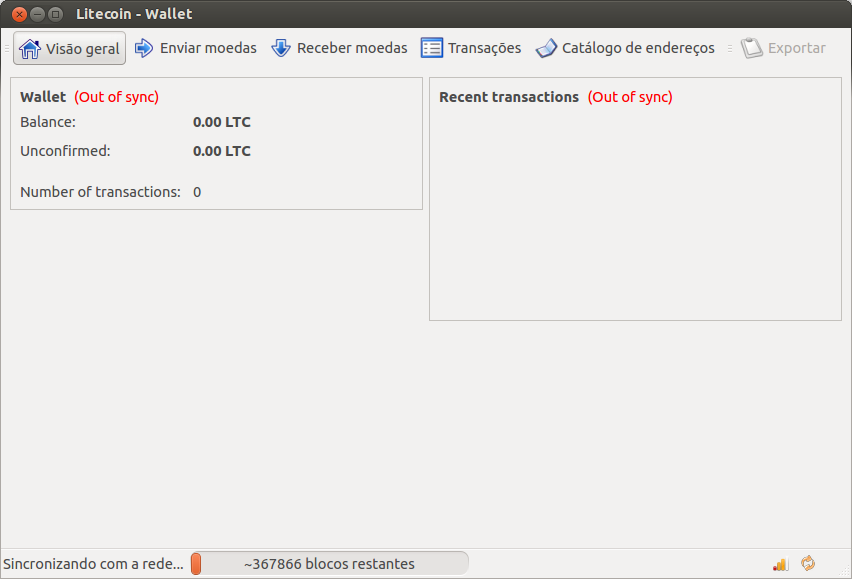
2013-07-03
The wallet was also an everyday interface
A screenshot of Litecoin for Linux 0.6.9.2, captured on July 3, 2013. A currency experiment reached users through familiar wallet controls—and the practical work of synchronizing a local copy of the ledger.
Litecoin Project; screenshot uploaded by Gabriel dos Santos · MIT / X11 · View original image & source
Enlarge image ↗
Source details & reproduction
This is a 2013 interface, not a capture of the 2011 launch.
Commons identifies the software as MIT/X11 licensed, copyright Litecoin Project. Screenshot capture date and Commons upload date are both July 3, 2013. Original 852 × 579 PNG reproduced without alteration. The visible out-of-sync status describes this captured session, not the health of the network.
Retrieved October 30, 2026. None; original file displayed at responsive size.
Copyright © Litecoin Project. Permission is hereby granted, free of charge, to any person obtaining a copy of this software and associated documentation files (the “Software”), to deal in the Software without restriction, including without limitation the rights to use, copy, modify, merge, publish, distribute, sublicense, and/or sell copies of the Software, and to permit persons to whom the Software is furnished to do so, subject to the following conditions: The above copyright notice and this permission notice shall be included in all copies or substantial portions of the Software. THE SOFTWARE IS PROVIDED “AS IS”, WITHOUT WARRANTY OF ANY KIND, EXPRESS OR IMPLIED, INCLUDING BUT NOT LIMITED TO THE WARRANTIES OF MERCHANTABILITY, FITNESS FOR A PARTICULAR PURPOSE AND NONINFRINGEMENT. IN NO EVENT SHALL THE AUTHORS OR COPYRIGHT HOLDERS BE LIABLE FOR ANY CLAIM, DAMAGES OR OTHER LIABILITY, WHETHER IN AN ACTION OF CONTRACT, TORT OR OTHERWISE, ARISING FROM, OUT OF OR IN CONNECTION WITH THE SOFTWARE OR THE USE OR OTHER DEALINGS IN THE SOFTWARE. Except as contained in this notice, the name of the Litecoin Project shall not be used in advertising or otherwise to promote the sale, use or other dealings in this Software without prior written authorization from the Litecoin Project.
File SHA-256: 1689f396dc05ce00183478499d5bc02a3a19dd008eb1e7bf82d6ce4c0a7a3646
Most illuminating was the attention paid to the launch. The developers described publishing code and binaries in advance so prospective participants could inspect and prepare. The announcement thread began on October 9, 2011; the network launch followed on October 13. The account explained how a start time and genesis information allowed miners to begin together. It also highlighted the concern that a developer who quietly created a large stock of units before anyone else could mine was asking future buyers to accept an unfair distribution from the outset. [78]
The launch record also shows the limits of a live archive. The announcement thread was opened on October 9, 2011, but its opening post was subsequently edited. It preserves the project's evolving public account, rather than an untouched record of launch-day wording. The timestamps distinguish an announcement from the history later written into it. That small archival problem points to a larger one: the appearance of fairness was easier to advertise than every participant's starting position was to verify. [16]
Movement I · Chapter 03
Who Secures the Ledger?
Different consensus mechanisms moved the costs and responsibilities of security.
Bitcoin's security recruited miners to spend real-world resources competing to propose blocks. To some observers, the expenditure was fundamental: anyone contemplating rewriting history would confront substantial external cost. To others it was a problem worth solving. In August 2012, Sunny King and collaborators introduced PPCoin, later known as Peercoin, with an energy-efficiency claim built around proof of stake.
Instead of basing every security decision on new computational work, the new model assigned an important role to coins already held in the system. Its published design described a hybrid, not an instant, complete replacement of proof of work. The original paper included centralized checkpointing, a crucial qualification to any simple claim that it solved the problem of decentralization more efficiently.
Proof of stake also exposed a question that code alone could not answer: why should existing holders possess influence over the next state of the ledger, and how should the distribution of those holdings be trusted? If a system avoided an expensive ongoing mining race but relied more directly on ownership of its own units, the origin and concentration of those units mattered. The question was not whether energy expenditure was morally good or bad; it was whether the substitute created security and incentives outsiders could verify.
Stake-based approaches had been discussed before PPCoin's launch; the concept did not originate with a single founder. PPCoin supplied an early operational implementation and a widely debated alternative security design. It also exposed the distance between a theoretical mechanism, a functioning experimental network, and evidence that an experiment had matched Bitcoin's assurances. [17] [18] [77]
Movement II · Chapter 04
Reinventing the Payment Network
Alternative settlement designs reopened questions of issuance, validation and control.
The word Ripple carries several histories that are often compressed into one. Ryan Fugger's earlier RipplePay idea organized mutual credit relationships rather than simply creating another proof-of-work money. Later, David Schwartz, Jed McCaleb and Arthur Britto developed a different distributed ledger influenced by the rise of Bitcoin. The modern XRP Ledger's own historical account dates its original development to 2011–12 and places the launch in 2012.
Its design replaced competitive mining with a different process of reaching agreement. It also made a different economic choice: all 100 billion XRP were created initially, and the founders allocated 80 billion to the company formed to develop uses for the ledger, retaining 20 billion. Bitcoin distributed new units through mining over time; this network began with a fixed quantity and large holdings assigned to identifiable organizers. That difference established distinct incentives without, by itself, proving dishonesty. [19] [51] [52]
For a reader in the early 2010s, both could be described as digital payments. But their governance structures, issuance histories and reliance on particular actors were not equivalent. Exchanges grouped these different arrangements under the convenient label of cryptocurrency, while price comparisons often obscured the different sources of authority beneath them. [19]
Movement II · Chapter 05
Assets Without Another Blockchain
A new asset could borrow an existing ledger without creating a new chain.
One strand of experimentation made the concept of an altcoin harder to define. Developers proposed colored coins, Mastercoin and Counterparty as ways to represent other assets or create functionality using Bitcoin's existing ledger. They were interested in ownership records, issuances and exchange-like functions that Bitcoin's original monetary transactions did not directly express in a user-friendly way.
The distinction was architectural. A separate blockchain had to recruit miners or validators to secure its own history. A Bitcoin-layer protocol used Bitcoin to order and confirm transactions, while separate software interpreted the additional messages and asset rules. Bitcoin secured publication of those records; it did not enforce every promise attached to an asset or assign it Bitcoin's monetary value. [71]
It also placed new power in the hands of issuers. The fact that a token issuance was recorded on Bitcoin did not guarantee that the issuer's promised goods existed, that an off-chain asset was redeemable, or that a speculative investment was sound. The base ledger could establish that a particular transaction had been recorded. It could not force a promoter to honor a commercial claim.
MasterCoin's version-0.5 proposal, attributed to 2012, described a trusted entity collecting bitcoin to finance implementation and receiving rewards over time. That funding design made the organizer's management of contributed funds part of the arrangement. The proposal's suggested dates and ratios describe a plan, not proof that every term was executed as written. [48]
Counterparty took a different distribution route. Its BitcoinTalk announcement was posted on January 2, 2014, and its XCP proof-of-burn issuance ran from January 2 through February 3, 2014. Participants sent BTC to a designated unspendable address; the protocol recognized the destruction and assigned XCP under its rules. Unlike an ordinary presale, the contributed bitcoin did not become a fund the organizers could spend. Burning BTC was an issuance mechanism, not payment into a founder-controlled treasury. [20] [70]
The announcement's opening post was later edited, and the current protocol specification describes a later version of the system. Those records establish the launch and explain the architecture without making every feature now listed a January 2014 offering. The underlying distinction remains: a ledger can verify an asset's issuance or transfer while obligations attached to it still depend on people and institutions. [20] [71]
Movement II · Chapter 06
When Internet Culture Became Currency
Humour, tipping and shared identity gave a currency social meaning.
Dogecoin emerged in December 2013 from internet humor as much as from monetary theory. Billy Markus and Jackson Palmer assembled a recognizable new coin around the Shiba Inu meme. Its very absurdity was an implicit response to the solemn claims surrounding other cryptocurrencies. Users could tip, share jokes, contribute to community projects and participate without pretending every transaction was an epochal advance in cryptography.
That culture also had economic consequences. A playful identity made the token easy to discuss and recognizable to people who had never read a blockchain paper. Social activity could create real demand for an asset whose technical foundation differed comparatively little from existing designs. A name, logo, forum and active community could be a kind of infrastructure too.
Yet the lesson was ambiguous. Dogecoin showed that monetary activity was social, not merely cryptographic; it also anticipated a world where branding and participation could be marketed as sufficient reasons to buy an increasingly large number of tokens. The difference between a genuinely shared joke and an engineered promotional campaign was not always obvious from the outside. [21]
In January 2014, supporters raised Dogecoin to help Jamaica's bobsleigh team reach the Sochi Winter Olympics. The project's later history remembers tipping and charitable campaigns as forms of participation. They gave a currency that began as a joke a practical social role that cannot be reduced to speculative unit bias. [21]
Contemporary reporting described roughly $30,000 in donations being converted into bitcoin before joining a wider crowdfunding campaign. Bitcoin served as a bridge from a new community currency to a payment the outside world could use; online identity and generosity had consequences beyond the screen. [67]
Movement III · Chapter 07
The Promise of a World Computer
General-purpose computation expanded the ambitions of the shared ledger.
In January 2014, Vitalik Buterin published a revealing explanation of Ethereum's origins. He described work on colored coins, smart property and decentralized exchange ideas, and his frustration at the repeated need for separate custom systems. His proposed answer was a general programming environment in which developers could write contracts rather than build a new blockchain or custom Bitcoin interpretation for every use case.
The differences were technical and political. Bitcoin's cautious scripting environment made tradeoffs in favor of a narrowly defined monetary system; Ethereum proposed more general programmable behavior. Its proponents expected applications ranging from asset registries to financial contracts. But a more expressive computer could also host more complex failures and harder-to-understand commitments. The distinction between enabling software and ensuring a good financial product would prove decisive.

2015-12-08
The platform idea meets a wider public
Vitalik Buterin at TechCrunch Disrupt London, December 8, 2015. The platform’s ambitions were being presented beyond the original cryptocurrency forums.
John Phillips / Getty Images for TechCrunch · CC BY 2.0 · View original image & source
Enlarge image ↗
Source details & reproduction
This photograph postdates both the 2014 sale and the 2015 network launch; it does not depict either event.
Original TechCrunch Flickr publication: https://www.flickr.com/photos/techcrunch/22987802684/ (photographed and uploaded December 8, 2015). Commons copy uploaded August 9, 2017; Flickr license review September 8, 2017 confirms CC BY 2.0, correcting the uploader’s earlier 2.5 label. Source file: 5760 × 3840 JPEG. The display copy is resized and encoded as WebP, without cropping, retouching or generative alterations. No endorsement implied.
Retrieved October 30, 2026. Display copy resized to 1440px wide and encoded as WebP on October 30, 2026. No cropping, retouching or generative alterations. The original is linked for full-resolution viewing.
File SHA-256: 0e6bce6faf4e045898c8305db011efae73dd7d45b4edd76c85a4b91f3a2db6f3
The project also developed a human geography: organizers and developers connected through Bitcoin communities, with public activity around Toronto and conferences. The original 2014 blog named early participants and sketched ambitious plans for funding and development. As a source, it is exceptionally useful because it reveals what participants hoped to build before outcomes were known. It is not evidence that every promised feature existed at the time.
When Ethereum's ether sale began in July 2014, prospective buyers participated using Bitcoin. The browser-based purchase process generated addresses and an encrypted wallet backup before payment was forwarded to the sale address. A project proposing to extend the possibilities of Bitcoin-related development was financing that work in BTC, while buyers acquired claims on a network still to be completed. [A03] [22]
The pre-sale was also a striking act of financial inversion. The new network did not yet exist as a working public blockchain, yet participants were asked to surrender already-liquid bitcoin in exchange for future ether. On July 22, 2014, Ethereum began a planned 42-day sale. Vitalik Buterin's August 8 statistical report said the first two weeks had attracted more than 25,000 BTC from sales of over 50 million ETH. His account did not disguise the central bargain: buyers were financing development and receiving claims on units of a system that the developers still had to finish. It was a credible engineering effort and a genuine financing risk at the same time. [1] [2]
Buterin's report also exposed the limits of treating a sale as decentralization. It described a Gini coefficient of approximately 0.832 for ether buyers in the examined snapshot—a measure of highly unequal purchases, though not a reliable measure of ultimate beneficial ownership. He acknowledged that exchange custody and smart-contract deposits could later make address-based concentration comparisons misleading. Here was unusually candid evidence from the founders: a public opportunity to purchase did not imply that participants purchased equal amounts or exercised equal influence. The distinction between access, allocation, and authority was visible before the first Ethereum block. [1]
Ethereum's proposed "gas" system was a response to a practical question Bitcoin's more constrained scripting system did not face to the same degree: how could a general-purpose machine prevent strangers from asking the network to perform limitless computation? Charging for execution established an economic boundary around programs. It also created a new kind of user experience. In Bitcoin, a participant primarily sought to transfer or encumber monetary outputs; in Ethereum, the transaction could ask all validating machines to execute a program whose rules—and defects—could outlive its author. This was a meaningful design departure, not proof that every program built on it deserved a separate speculative asset. [42] [2]
Ethereum supplied tools for creating applications and tokens, but those tools could not verify the business model or honesty of each issuer. Its technical achievement made new forms of experimentation easier; the same accessibility made speculative fundraising easier as well.
The project's later historical guide reports the completed 42-day presale at 31,591 BTC for approximately 60.1 million ether. Those totals differ from the preliminary August 8 snapshot. Financing created prospective stakeholders before a public chain existed, and allocated economic claims before those participants could evaluate the finished network. [50]
Movement III · Chapter 08
From Fundraising to a Working Network
Financing a proposed platform and delivering it required different kinds of trust.
Ethereum's Frontier network began on July 30, 2015. Its own history describes a barebones system aimed initially at technical users. That distinction matters after the grand language of the white paper and fundraising campaign. A developer could now deploy software and send transactions on a live network. This was a different kind of evidence from architectural promises.
The working chain made experiments possible, but not safe by default. Smart contracts turned code into an object of financial trust: contributors could put real money into a program whose behavior would be determined by written instructions and the broader network's rules. The early promise was that automated execution would replace some intermediaries. The open question was whether ordinary users could evaluate the code, dependencies and governance assumptions being offered.
Automated execution replaced some forms of discretion while introducing other dependencies: application logic, wallet software, data inputs and decisions about upgrades. Ethereum's general-purpose blockchain did not end the history of trust. It redistributed where trust had to be examined, before any particular application failure could settle the argument by hindsight. [23]
One project, dated evidence
Ethereum: changing purposes, changing claims
A proposal, a sale and an operating network provide different evidence. Expand a stage for its documents and context.
April 2014Fuel and an issuance planComputational fuel and an issuance plan.
The development post framed ether as computational fuel and proposed continuing annual issuance. This was a pre-launch plan, not a permanent supply guarantee or today’s monetary rules.
Sources: [79]
2015FrontierAn experimental public network begins operating.
A live network made deployment possible; operation was different evidence from a proposal.
Sources: [43]
2015Casper researchResearch precedes implementation by several years.
Introducing Casper “the Friendly Ghost”
Vlad Zamfir, August 1, 2015 · source title Zamfir’s August 2015 account dates his proof-of-stake research to September 2014, before the later transition was implemented.
Sources: [44]
2019 proposalLater monetary mechanism — outside 2011–2018Fee-market design adds base-fee burning.
EIP-1559 proposed burning a variable base fee to address fee-market problems. Burning fees is a rule; a permanently shrinking total supply or investment return does not follow automatically. Later scarcity narratives must be distinguished from the proposal’s stated technical motivation.
Sources: [80]
2022Retrospective — outside 2011–2018Proof of stake replaces proof of work.
The Merge reduced Ethereum's energy consumption by ~99.95%.
ethereum.org · present-day retrospective description The Merge changed consensus to proof of stake. Later environmental framing does not establish that ESG marketing caused the original technical choice.
Sources: [45]
Quoted titles and the labeled retrospective excerpt are source wording. The accompanying explanations are editorial paraphrases, not additional quotations.
Original Monedial explanatory treatment · not an archival reproduction.
Movement III · Chapter 09
The Search for Financial Privacy
Privacy techniques changed what observers could learn and what users had to trust.
Bitcoin made transactions visible to anyone running suitable software. Addresses were not necessarily real names, but transaction relationships could be followed, clustered and interpreted. Privacy-focused alternatives explored how to make those relationships harder to see. Monero grew from the CryptoNote family of designs in April 2014; its technical inheritance did not determine who would maintain the software or govern its development. [3]
Zcash came through an academically visible path: work on Zerocoin and zero-knowledge proofs sought to verify valid transfers while hiding selected details. Its October 28, 2016 launch announcement warned that the experimental software had not yet been shown safe and stable. The original deployment also relied on a trusted setup for cryptographic parameters, an engineering and governance tradeoff within its promise of privacy.
The privacy mechanisms addressed different disclosures. Monero used ring signatures to obscure the link between a spender and particular previous outputs, while Zcash's shielded transactions used zero-knowledge proofs to conceal selected transaction details while proving validity. Neither design erased every risk from wallet mistakes, network observation or unsafe use. Similar goals did not make the systems identical, or establish that Bitcoin had adopted either system's techniques. [3] [4] [5]
Monero's launch history conveys how privacy research became a struggle over community control. The CryptoNote ideas supplied an alternative to Bitcoin's publicly linkable transaction history, and a project called BitMonero emerged in April 2014. In the community's own retrospective, disputes with its initial maintainer, thankful_for_today, led participants to continue the software as Monero under a different group of maintainers. A privacy-focused cryptocurrency could therefore encounter a governance split even before it became widely used: no cryptographic technique can decide whom a community should follow when its developers disagree. [3]
Privacy also had several dimensions: concealing a recipient, obscuring the relationship between inputs and spenders, and hiding amounts. Monero's official roadmap dates a mandatory minimum ring size to March 2016, activation of Ring Confidential Transactions to January 2017, and their requirement for transactions to September 2017. These later properties cannot be projected backward onto its first launch. Cryptography also did not eliminate risks from malicious wallet software, network surveillance or operational mistakes. [4]
Zcash followed a related but distinct route. Its intellectual history involved academic work on Zerocoin and Zerocash, including researchers examining privacy extensions to Bitcoin. Zcash's public blockchain launched on October 28, 2016, offering a zero-knowledge approach to proving transaction validity without disclosing certain transaction details. It was a substantial cryptographic achievement, but the distinction between available shielded transactions and their real adoption was historically important. A privacy feature protects users only to the extent that they use it correctly and that the surrounding system does not disclose the information they hoped to conceal. [5] [6]
Zcash also made the economics of financing research explicit in its consensus rules. During its original four-year funding period, one fifth of new block rewards went to a founders' reward, amounting to one tenth of the eventual 21-million-unit supply. The arrangement supported founders, employees, advisors and investors rather than giving every newly generated coin to the miners who produced the blocks. It was publicly specified, not a concealed premine; whether it was justified remained an economic and governance question. That makes Zcash an especially instructive comparison with Monero's stated no-premine launch: two technically serious privacy efforts chose materially different ways to fund their development. [7] [8]
Movement III · Chapter 10
When the Code Wasn't Enough
A failed contract exposed a conflict between immutable rules and collective intervention.
The DAO captured the appeal of Ethereum's programming ambition: people could send ether to a set of contracts intended to coordinate investment decisions without a conventional management company. It also exposed a central weakness of slogans about code enforcing rules. A contract can execute as written and still behave disastrously when its authors have misunderstood an interaction.
In June 2016, an attacker exploited The DAO's contract behavior and diverted control over millions of ether into a child structure. The resulting debate was not simply about whether someone had taken funds. It was about who could legitimately change a public network's history, whose losses deserved intervention, and what promises of immutability meant when participants confronted a real crisis.
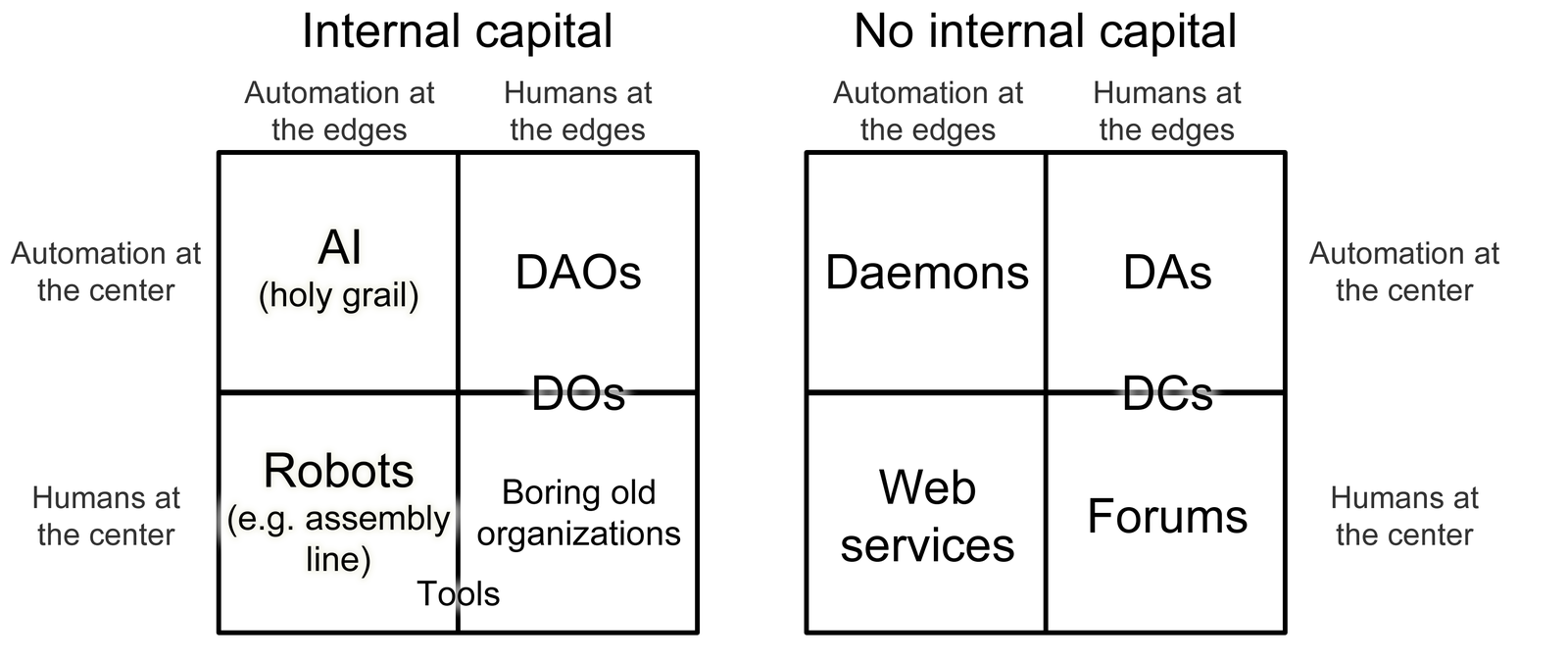
2014-05-06
Before “The DAO,” an argument about organizations
Buterin’s original May 6, 2014 illustration sorts organizations and automated agents by decision-making and internal capital. The classification shows how unsettled the vocabulary of autonomy remained.
Vitalik Buterin · CC0 1.0 · View original image & source
Enlarge image ↗
Source details & reproduction
It precedes the specific 2016 project called The DAO and is not a screenshot of its website.
Primary publication: https://blog.ethereum.org/2014/05/06/daos-dacs-das-and-more-an-incomplete-terminology-guide/ . Commons records the May 6, 2014 creation date, an August 13, 2014 upload and CC0 public-domain dedication. Source file: 3276 × 1379 PNG. The display copy is resized and encoded as WebP, without cropping, retouching or generative alterations. This is a reproduced period illustration, not a newly drawn Monedial diagram.
Retrieved October 30, 2026. Display copy resized to 1600px wide and encoded as WebP on October 30, 2026. No cropping, retouching or generative alterations. The original is linked for full-resolution viewing.
File SHA-256: 8787d5406a18139c6d895b0f81df66ffe20d095b60540bb7298b238c0766bc8b
On July 20, 2016, Ethereum adopted a hard fork that moved the affected funds to a recovery contract. Not everyone accepted the intervention. The dissenting chain became known as Ethereum Classic. Two different continuations of one earlier history existed because the communities enforced incompatible rules. The episode gives the Current its first fully developed case of a blockchain governance rupture with economic stakes.
Bitcoin's later scaling conflict also involved rule changes, competing public claims and rival continuations, but its causes and remedies differed from the DAO crisis. In each case, authority operated through developers, miners, node operators, holders and users making collective choices. Calling one network decentralized did not explain how those choices were coordinated. [26] [27]
The DAO's crisis was not a break in the cryptography protecting Ethereum's ledger. It arose from application logic controlling funds and interactions its designers had not safely anticipated. The distinction was unsettling: a blockchain could follow its implemented rules while the people who financed an application regarded the result as intolerable.
Ethereum participants confronted choices: accept the consequences, attempt a recovery intervention, or adopt changed rules while others continued the existing chain. Jeffrey Wilcke set out the fork choice publicly on July 15, 2016; Buterin reported its completion on July 20. The non-forked chain continued as Ethereum Classic. Neither continuation could mechanically settle which community had the stronger philosophical claim. [53] [54] [57]
The episode is not equivalent to an ordinary developer fixing an application bug, nor to an individual arbitrarily editing transaction history in secret. The intervention required software changes and participation by network operators, and its legitimacy was vigorously contested. Still, the conflict supplies a useful test of the word "immutable": an immutable-looking history is sustained by social decisions about which rules nodes choose to enforce. Bitcoin's own consensus disputes made related questions salient, but no direct equivalence follows from that resemblance. Different protocols, circumstances and proposed remedies matter.
The SEC's July 2017 investigative report then revisited the DAO from a different direction. The agency concluded that DAO tokens had been securities under U.S. law in the circumstances it analyzed, while choosing not to bring charges in that matter. Rather than evaluating whether smart contracts were technologically clever, it examined what purchasers contributed, what they expected to receive, and whose managerial efforts would produce any return. The document created a bridge between the governance crisis of 2016 and the regulatory reckoning of the ICO era. [9]
Movement IV · Chapter 11
Markets Within Markets
Trading pairs, exchanges and unit prices shaped the market for alternatives.
A marketplace originally built to help people buy Bitcoin with conventional money could become a venue where dozens of alternative assets traded against BTC. That arrangement made Bitcoin more than an investment or a payment instrument. It became an intermediary trading asset: a new coin might be unavailable to someone with dollars but available through an exchange offering an altcoin/BTC pair.
In the early environment, acquisition could involve forum announcements, downloaded wallets, mining instructions, exchange registrations, and substantial counterparty risk. The ability to quote a price did not guarantee deep liquidity, reliable custody, a credible supply distribution or legitimate underlying use. Exchange listings could create visibility, but they were not independent certification of a project's technical claims.
By July 2017, FinCEN described BTC-e as exchanging both conventional currencies and assets including Bitcoin, Litecoin, Namecoin and Peercoin. Its contemporary enforcement record establishes a market in multiple assets without supplying an exact listing date for each trading pair. The venue was an intermediary with its own accounts and obligations, not an extension of any coin's consensus rules. [76]
A price is only half the equation
The Cheap Coin Illusion
Illustrative numbers, not live prices or an investment forecast.
Both imply $10 million. Low price per coin does not mean low valuation.
Market capitalization is not cash invested, a reserve balance, or the amount holders could recover by selling every token.
Dogecoin began in 2013 with a joke, tipping and community participation. This later unit-bias explanation does not attribute speculative motives to its founders.
Original Monedial explanatory treatment · not an archival reproduction.
The wallets and forum records reveal one part of that experience: users installed software, synchronized a ledger and learned to move assets. Trading through an exchange introduced a separate decision about custody. Sending coins to a service could make trading convenient while leaving the customer dependent on the operator for an accurate account balance and eventual withdrawal. [15] [16]
Bitcoin often supplied the denominator in altcoin markets. A token could trade at a tiny fraction of one bitcoin, and a rise in its BTC pair could be understood as success even while its dollar value moved because bitcoin itself moved. That made the supposedly competing currencies economically dependent on Bitcoin's liquidity and public attention. A listing on an exchange did not merely accommodate preexisting demand. It could make the asset available to new purchasers, alter the ease of converting it into other assets, and create a visible market price that promoters could cite. Yet a quoted last trade is not evidence that every holder could sell at that price.
The phrase "market capitalization" also demands care. Multiplying the last quoted trading price by a circulating supply produces a useful standardized comparison, but not a cash balance or a guarantee of liquidation proceeds. When insider holdings were restricted, undisclosed, or not actively traded, headline capitalization could give a misleading impression of accessible wealth. Exchange depth, order books, withdrawal restrictions, and which tokens were genuinely circulating mattered just as much as the unit price.
Specialized venues created markets for technical experiments while earning fees from trading activity. Availability and visibility could therefore grow even when a project's delivery remained uncertain. That commercial incentive created a potential conflict, but it does not establish that a named exchange took a listing payment or endorsed a fraudulent asset. Specific misconduct requires its own evidence.
Cryptsy exposed the custody dependence behind an altcoin market. In January 2022, the Justice Department announced an indictment alleging that its operator Paul Vernon had diverted customer assets during 2013–2015 and misled customers about their funds. That later indictment is an allegation, not a conviction. It identifies a specific dependency that a coin's decentralized ledger could not remove: customers relied on the exchange's control of wallets and account records. [63]
There was also organized manipulation of quoted prices. A 2018 study identified 3,767 pump signals on Telegram and 1,051 on Discord during six months, promoting more than 300 cryptocurrencies. Those observations documented coordinated attempts to move markets, not a fraud rate for all coins or proof of complicity by every exchange. A conspicuous price surge could reflect a channel's buying campaign rather than broad demand for a working product. [64]
Movement IV · Chapter 12
Dollars on the Ledger
A token could move on-chain while redemption depended on an issuer.
A stablecoin differed from a speculative alternative monetary system. The point was to hold the value of an external unit, most often the U.S. dollar. Realcoin, announced in 2014 and renamed Tether, used the Omni layer on Bitcoin for its early issuance. A 2014 contemporary interview distinguished the product from an independent blockchain and described it as a token representing dollars.
A trader moving between volatile assets could use a digital dollar-denominated claim without completing a banking withdrawal after every trade. The CFTC's later record dates the use of tether tokens for deposits and withdrawals at Bitfinex to January 2015. The convenience added an issuer and a custodian to the user's chain of dependencies, rather than eliminating financial intermediaries. [62]
This was a sharp instance of the trust contradiction: decentralized settlement technology could circulate claims dependent on centralized banks, issuers and contracts. A token's transfer history was public, while the resources and obligations supporting its promised value remained elsewhere. [28] [29]
Yet a stablecoin has at least two ledgers in its economic structure. One records the digital tokens and their movements; the other consists of whatever bank balances, investments, rights of redemption or supporting collateral are supposed to make those tokens redeemable at the promised value. The public chain can demonstrate that a token moved from one address to another. It cannot, by itself, demonstrate that a custodian has the represented dollars, that a bank will honor withdrawals, or that every customer can redeem on the advertised terms. This was an especially direct return of trust inside an industry often defined by removing it.
A token trading near a dollar and a token redeemable for a dollar were not the same thing. A market price could reflect expectations of continued usefulness and liquidity without independently establishing reserves or each holder's redemption rights. The issuer's representations, the terms governing redemption and the market's willingness to accept the token were separate pieces of evidence. [10]
Other designs sought a stable value through pledged crypto collateral, liquidation rules or market incentives. They moved the points of failure rather than abolishing them: a custodian could fail, collateral could lose value, arbitrage could break down, or governance could change a rule. The dollar target was an economic commitment whose support had to be examined, not a property guaranteed by writing a token onto a blockchain.
Retrospective: investigations and settlements, 2019–2021
On April 25, 2019, New York's attorney general announced a court order obtained during an investigation involving Bitfinex and Tether. It was an investigative action, not a settlement. A settlement announced on February 23, 2021 required an $18.5 million payment and restrictions on New York trading. The signed agreement became effective on February 18; it recorded the attorney general's findings, which the respondents neither admitted nor denied. [72] [73] [10]
On October 15, 2021, the CFTC separately imposed a $41 million penalty on Tether concerning misleading reserve representations during June 2016–February 2019. Tether consented without admitting or denying the findings. In its response, the company disputed the implication that tokens had lacked adequate overall backing, distinguishing reserves held in cash in its own accounts from other assets. These later regulatory records illuminate earlier representations; they were not information a trader could have read in 2014 or 2015. [62] [74] [75]
Movement IV · Chapter 13
Who Gets the First Coins?
Issuance, founding allocations and fundraising distributed opportunity and control.
In the early forum debates, premining was already a charge that could destroy credibility. Litecoin's announcement openly criticized earlier creators whose initial allocations looked unfair. Ripple's development chose an entirely different approach, creating the supply at the outset and allocating a very large block to the operating organization. Ethereum combined fundraising, initial distribution and a different long-term issuance model. Peercoin posed questions about the security role of existing wealth.
These choices cannot be reduced to a single numerical test. A network could have a founder allocation and produce important technology; another could claim a fair launch while concealing advantages in mining or software access. What matters historically is the path by which control and incentives were established, what was disclosed, what participants could verify, and whose continuing cooperation the system required.
Work performed, an initial allocation, a Bitcoin-funded sale and a continuing reward stream created different relationships between a network and the people obtaining its units. The mechanism mattered because it set rights, obligations and asymmetries before later price comparisons made unlike assets appear interchangeable.
A new network's initial distribution is not a technical footnote. It is a statement of who had the opportunity to become economically important before others could assess the system. Bitcoin began with coins issued through mining under public rules. Other networks used premines, founding allocations, sales, proof-of-burn mechanisms, or continuing development rewards. None of those choices automatically establishes fraud. Each creates a different relationship between the people who built a network, the buyers who financed it, and the users who later depend on it.
Ethereum's 2014 offering offers unusually rich evidence because its own organizer published contemporaneous sale statistics and explicitly discussed unequal purchasing. The sale was financed in BTC and preceded the network's 2015 public launch. That means a buyer was purchasing participation in a possible future system, not receiving a currently functioning payment service. Later public financial disclosures describe the initial ether allocation as approximately 60 million sold in the crowd sale and 12 million distributed through foundation, contributor and developer-related arrangements. These are described categories, not proof of undisclosed enrichment; their economic implications still merit scrutiny. [1] [11]
Zcash chose a different arrangement: a continuing share of mined rewards for defined early beneficiaries. Monero advertised the opposite principle, emphasizing the absence of premine or special miner-independent founder allocation. XRP's distribution history differed again, because the original quantity was created at inception and the company received a large allocation. These contrasts show why the same simple diagram—"coins created, coins purchased"—cannot explain the economics of every project. [3] [7] [51]
The denominator and date changed the meaning of an allocation. Ten percent might describe all units ever to be issued, the supply already circulating, or rewards during a particular funding period. Vesting governed release over time, not necessarily every form of influence an early holder could exercise. Nor did an exchange wallet's balance identify its beneficial owners. A percentage without those qualifications concealed as much as it explained.
Distribution is part of the design
Who Gets the First Coins?
Compare mechanisms, dates and denominators—not a “good coin / bad coin” score.
Mined / open issuance
Coins emerge over time
Block → reward → further blocks
Protocol rules award newly issued coins for mining. Open rules do not mean equal access to equipment or rewards.
Initial supply / founding allocation
Distribution begins before circulation
80bn to Ripple / 20bn to creators
The original 100 billion XRP allocation differs from ongoing mining. Later escrow is a separate history.
Presale / crowdsale
Finance before a live network
Contribute BTC → allocation → launch
The 2014 ether sale financed a proposed network. Purchaser allocation must be distinguished from endowments and later issuance.
Founders’ reward
Funding from future issuance
New rewards → miners + founders’ reward
Zcash’s original reward redirected part of new issuance over four years. A stream of rewards is not the same mechanism as a premine.
Proof of burn
Destruction instead of treasury funding
BTC destroyed → XCP issued
Counterparty’s January 2–February 3, 2014 issuance assigned XCP for BTC sent to an unspendable address. Organizers did not receive that BTC to spend.
Illustrative distribution — not a historical project
- 60% participants
- 20% team
- 15% treasury
- 5% advisors
These are invented proportions for explanation only. Vesting, lockups, circulating supply and future issuance are unspecified; an allocation diagram cannot establish them.
Proof of work — issuance through time
Bitcoin issues new coins through mining under public rules. Access to mining, equipment and early participation are separate questions from a fixed initial allocation.
XRP — original allocation, not current circulating ownership
100 billion XRP created initially
- 80 billion allocated to Ripple
- 20 billion retained by creators
This describes the original allocation. Later transfers, escrow, ownership and circulating supply are not shown; later lockups must not be projected backward.
Ethereum — project-reported 42-day sale, 2014
31,591 BTC contributed
≈60.1m ether sold
The Homestead historical guide reports these sale totals. Ether sold is not the total genesis allocation. The live public chain followed in 2015; this sale financed a proposed network.
Read the allocation denominator
The maintained white paper models 100 units sold plus 9.9 for early contributors and pre-genesis expenses and 9.9 for a long-term reserve: 119.8 in total. These are relative units, not percentages of the final total. This document model does not identify current owners, actual vesting or realized insider proceeds.
Zcash — original four-year funding period
The founders’ reward took 20% of newly mined rewards during the original four-year period: 10% of the eventual 21-million-unit supply. Those are different denominators. It was disclosed, not a hidden premine.
Counterparty — January 2–February 3, 2014
The bitcoin was destroyed, rather than delivered to organizers as spendable presale proceeds. This funded no treasury of contributed BTC. The announcement's launch timestamp and the documented burn period do not make every feature in its later-edited opening post a launch-day capability.
Innovation in the technology does not establish equality in its distribution. Who gets coins, who can sell and who can change the rules require separate scrutiny.
A disclosed founding allocation is not proof of fraud. Ask what was promised, what was implemented, who could sell and when.
Original Monedial explanatory treatment · not an archival reproduction.
Movement V · Chapter 14
The White Paper Becomes a Sales Document
Technical proposals became instruments for raising money and selling expectations.
By the token-sale boom, the technical paper had acquired another job: persuading strangers to finance products that had not yet been built.
Satoshi's paper described a particular monetary problem, proposed a mechanism, and explained the assumptions on which it depended. It was followed by software anyone could inspect and, eventually, by an open network. Later cryptocurrency white papers performed many different functions. Some were genuine research contributions. Others resembled business plans, investment brochures or catalogs of promised future uses. A paper's formatting and mathematical vocabulary gave it an aura of technical authority even when it proved little about product feasibility, governance or investor rights.
The ICO boom made that ambiguity commercially useful. A project could describe a future ecosystem, introduce an invented token as essential to it, and ask buyers to acquire units before the promised infrastructure existed. Readers without the technical background to test the claims might rely on founders' credentials, diagrams, exchange prospects or excitement among other buyers.
Not every white paper was deceptive. Some explained genuine technical mechanisms; others marketed participation in an economic future. The decisive questions concerned implementation and enforceable commitments: what already worked, who issued the units, where sale proceeds went, and which claimed benefits depended on a founder's future performance.
The document examination room
The White Paper Examination Room
Read a proposal, an administrative finding and a comparative study as different kinds of evidence.
Ethereum · technical proposal, 2014
Technical proposal
2014 · maintained editionLinked original / reading notesOriginal Monedial layout, not a facsimile
- Claim to examine
- A programmable ledger for contracts and applications.
- Economic proposition
- Ether pays for computation; the paper also sets out an issuance and endowment model.
- Substantive evidence
- A described execution model is a substantive technical proposal.
- Limit of the record
- A proposal is not evidence that a specific later token has a necessary role or an enforceable claim on revenue.
2014 proposal · maintained web edition viewed 29 October 2026
Read the maintained white paper and its original-PDF link ↗
The white paper proposes general smart-contract and decentralized-application functionality. Proposed capability is not proof that each later token requires its own financial asset.
- What computation does the system perform?
- What role does the native asset serve?
- Which claims describe a proposal rather than delivered software?
Sources: [42]
Munchee · administrative order, December 2017
Administrative findings
11 December 2017Linked original / reading notesOriginal Monedial layout, not a facsimile
- Claim to examine
- The SEC order examines representations about a proposed token ecosystem.
- Economic proposition
- App use, token appreciation and secondary trading were different parts of the proposition.
- Substantive evidence
- Read the actual order and the distinction between an existing app and work still to be done.
- Limit of the record
- Do not treat the order as a criminal conviction or as a finding about every token offering.
11 December 2017 · administrative findings, not a criminal fraud conviction
The SEC examined the proposed token economy and representations about appreciation and secondary trading. Munchee halted the offering and returned funds; it consented without admitting or denying the findings.
- What already existed in the restaurant-review app?
- What still depended on the company’s future work?
- What economic expectation was sold with the token?
Coin-Operated Capitalism · later comparative research
Comparative research
2019 · examining 2017 offeringsLinked original / reading notesOriginal Monedial layout, not a facsimile
- Claim to examine
- The study compares written commitments with implemented token code.
- Economic proposition
- Allocation, lockups and the power to change rules affect what buyers receive.
- Substantive evidence
- Document-to-code comparison tests whether a promise is implemented.
- Limit of the record
- Its selected sample does not establish that all offerings made or broke the same promises.
2019 publication examining 2017 offerings
The study compares documents and code from fifty high-grossing 2017 ICOs. Its questions distinguish a written promise from an executable restriction.
- Who controls the initial supply?
- Does deployed code enforce the stated lockup?
- Can the rules change after buyers contribute?
Sources: [39]
The question across all three records
Does useful software require this token—and what rights, restrictions or obligations does the holder actually receive? These are annotated reading questions, not invented quotations from the documents.
Sources: [31]
Original Monedial explanatory treatment · not an archival reproduction.
Movement V · Chapter 15
A Token for Every Promise
Financing a useful product did not establish the need for a separate asset.
An app could be imagined for restaurant reviews, advertising, data sharing, real estate, entertainment or almost any other human activity. In the token-sale era, promoters increasingly argued that these imagined environments required their own units of exchange. The question usually left unasked was whether the project needed a blockchain, an independently tradable token, or merely a functioning product and conventional accounting.
Munchee is a concrete example. The company proposed to expand a food-review application and develop an economy around its tokens. In December 2017, the SEC reported that the company had halted its offering and refunded proceeds after the agency intervened, and issued an order finding the token sale was an unregistered securities offering. The regulator did not need to declare token technology worthless to examine what purchasers were being offered and encouraged to expect.
The vocabulary of utility became particularly slippery when a token sold as necessary for future consumption was being marketed with the prospect of increasing resale value. That tension matters more historically than any blanket claim that every token was fraudulent. The same technology could be offered as a functional payment instrument, a fundraising claim and an object of speculation. The promoter's assertions did not determine which economic relationship investors were actually entering. [30]
Movement V · Chapter 16
The Blockchain Does Not Need Your Coin
Technical necessity, sustained token demand and investment value are separate questions.
When people first encountered Bitcoin, the coin and the system appeared inseparable. Bitcoin was not a company's shareholder certificate or an optional reward attached to a financial application. It was the unit recorded and transferred by a monetary ledger, the object whose ownership and transfer the network's rules settled. The practical success of Bitcoin as money would therefore be directly connected to whether people wanted to acquire, hold, and transact in bitcoin. Even there, a market price could move for reasons beyond actual use. But the relationship between product and asset was unusually plain.
The later cryptocurrency industry frequently presented a different proposition. A team proposed a payment service, data marketplace, social application, decentralized identity system, game, exchange, or network for commercial records. Its white paper would explain the usefulness of the application, then introduce a newly issued token as if it naturally followed from the engineering. Readers were asked to accept two claims at once: the proposed system might someday be useful, and purchasing the issuer's token today was an intelligent way to participate in that future. Yet these were distinct propositions. A business can sell useful software without creating a freely traded currency. A network can keep records without enriching holders of a separate promotional asset. And a blockchain may use an asset for a narrow operational purpose without needing users to hold that asset in amounts remotely comparable with the entire speculative market's valuation.
The distinction becomes particularly important where the company selling the product is not the same entity as the ledger's participants, or where the product can be operated with other assets. Ripple provides a revealing early example. The name referred, over time, to an older mutual-credit experiment, a company selling payment technology, the XRP Ledger, and the XRP digital asset. Collapsing these into one object made it possible for very different claims to travel together. Ripple could pursue business partnerships and payment infrastructure while the XRP Ledger continued to have its own independent technical requirements and the market placed an independent price on XRP.
The technical point must be stated precisely. The XRP Ledger does require XRP for ordinary transaction fees, and an account generally must maintain an XRP reserve. Fees are destroyed rather than paid to a company. This means it would be false to say XRP has no operational role on the XRP Ledger. But the fact that the ledger needs an asset for anti-spam and reserve functions does not demonstrate that institutional adoption of Ripple's commercial payment products must make speculative holdings of XRP valuable. An enterprise customer's use of payment software, the XRP volume actually required to settle a transaction, an individual's long-term holdings, and the market capitalization of the circulating asset are different measurements. [35] [36]
That distinction also demands careful treatment of transaction cost. If a system permanently charged one-tenth of a token and the token appreciated one hundredfold, the dollar cost of each transaction would rise one hundredfold. But fee design is not always fixed. The XRP Ledger changes its effective fee requirements with network load and permits validator-approved base-fee adjustments; some other blockchains vary gas prices or subsidize fees through intermediaries. A rising native-token price does not mathematically guarantee that using its network becomes impractical. The more revealing question is how much economic exposure users must retain, whether that exposure grows with adoption, and who captures the value created by the system. [35]
A design is not a valuation
The Blockchain Does Not Need Your Coin
A useful ledger does not automatically require a separately marketed asset. Some protocols do require a native asset: examine technical necessity, retained demand and valuation separately.
- 01 / The serviceIs the network useful?What can people actually do?
- 02 / The assetWhat does the token do?Fees, reserves, stake—or no required role?
- 03 / The investmentWhat gives holding it value?Rights, retained demand and supply need their own case.
A useful network does not automatically make its associated token a useful investment.
XRP Ledger · documented technical role
01 / Does the protocol require it?
Yes. XRP pays transaction fees and meets account reserve requirements on the XRP Ledger. Ripple’s commercial payment products are a separate object of analysis.
02 / Does use require lasting holdings?
Fees and reserves create operational demand. How much XRP users need to retain depends on the actual rules and activity; commercial adoption alone does not establish proportional holdings.
03 / Does this justify a valuation?
The protocol’s operational need does not determine a market price. Supply, retained demand and the rights held by buyers require separate examination.
Hypothetical enterprise ledger · illustrative
01 / Does the protocol require it?
A permissioned database can charge customers through ordinary contracts without a publicly traded token.
02 / Does use require lasting holdings?
In this example, customers pay for access in conventional money; a promotional token creates no technical holding requirement.
03 / Does this justify a valuation?
A useful business does not automatically confer revenue rights or value on a separate token.
Hypothetical public fee / stake chain · illustrative
01 / Does the protocol require it?
This example requires a native asset for network fees and validator stake exposed to penalties.
02 / Does use require lasting holdings?
Staking and fees can create demand, but the amount retained depends on participation, turnover and protocol rules.
03 / Does this justify a valuation?
Technical necessity supplies no automatic valuation. This illustration makes no investment recommendation.
Original Monedial explanatory treatment · not an archival reproduction.
Consider three imaginary systems. In the first, validators require a scarce native asset as a stake exposed to penalties, and users pay network fees with it. Both functions can create operational demand, although neither provides an automatic valuation. In the second, a company maintains a private distributed database and sells access through ordinary contracts; a publicly traded coin introduced beside it may be unnecessary. In the third, a public network does require a small fee token, but users purchase just enough to complete each transaction and immediately dispose of excess balances. The network may be busy while lasting demand for large token inventories remains modest. These scenarios are not a ranking of real projects; they show why an investor must study the precise mechanism.
The 2017 Munchee offering made the disconnect unusually visible. The company already operated a restaurant-review iPhone app. Its plan was to raise money by selling MUN tokens, then use the proceeds to improve its app and create a wider ecosystem in which users could receive and spend those tokens. The proposed economic circuit was not yet an established operating business. Munchee's promotional material emphasized that the token could appreciate as the company built that future. The SEC intervened in 2017, concluded that the token offering was an unregistered securities offering, and reported that the company stopped and refunded purchasers before issuing tokens. Munchee consented without admitting or denying the findings. The record does not prove the designers had no sincere product ambitions. It demonstrates how a functioning software application could become a platform for selling future token value before the claimed token economy existed. [37] [38]
The economic question was precisely what the buyer had purchased. A token can be necessary to run a protocol without providing rights to an issuer's profits. A company can become profitable without rewarding token holders. An exchange listing can provide a price and a place to trade without establishing genuine utility. A white paper can accurately describe cryptography while making a logically unsupported leap from network adoption to asset appreciation. None of these facts alone proves criminal deception. Together they expose a commercial arrangement that Bitcoin's early vocabulary sometimes helped obscure: a technological description was being used to sell an economic expectation.
This is where the story returns to trust. Bitcoin's rules offered a way to verify ownership and monetary issuance without relying on promises from a promoter. The new token buyer often had to trust that the promoter would build a product, that people would use it, that users would need the token, that insiders would not overwhelm buyers with their allocation, and that this complex chain of assumptions would translate into higher market prices. A decentralized database could not verify those promises. To a substantial extent, the promised revolution in trust had become a market for trusting promises again.
Movement V · Chapter 17
The Machinery of Selling a Coin
Promotion and distribution could reach buyers before a product reached users.
The first impression of an ICO could be impressive: a white paper with diagrams, a countdown clock, an online community, a public sale address, and exchange-trading projections. These materials gave investors observable signs of activity. But evidence of promotion is not evidence of product adoption. The crucial questions often appeared elsewhere: who created the supply, how much they retained, what rights investors received, when insiders could sell, and what had to happen before the advertised network could operate.
Token distribution was never merely a technical footnote. A supply allocation determined which participants received ownership or use rights at negligible cost, which participants paid cash or cryptocurrency, and who could sell in the future. A large allocation to a team might fund maintenance and create long-term incentives. It might also concentrate control and permit early beneficiaries to capture value before broader holders could evaluate the product. What mattered was the documented arrangement: vesting, lockups, discretionary treasury powers, undisclosed side agreements, and whether the code governing transfers matched the public description.
A particularly valuable study, later published as Coin-Operated Capitalism, collected documents and code from fifty of the highest-grossing 2017 ICOs. Its authors compared legal and marketing commitments with how token-sale software actually operated. Their findings highlighted protections against insider self-dealing that were missing even from many projects' promises. The investigation gives the Current an empirical foundation for examining the gap between white paper and executable code without claiming that every ICO concealed an identical scheme. [39]
The exchange then changed the stakes. Listing made a token visible to buyers who had never read its code or distribution documents. A displayed market price encouraged a comparison with older cryptocurrencies even when circulating supplies and rights were radically different. If only a small fraction of issued tokens traded, the last trading price multiplied across the entire supply could suggest a market capitalization that did not correspond to the amount of money that could be realized from large-scale sales. A professional-looking trading interface was evidence that orders could be matched, not that the underlying project had been examined and endorsed by an impartial authority.
Exchanges had their own commercial incentives. More listed assets could generate more transactions and fees, while buyers might mistake availability for quality. The conflict did not establish a uniform practice of paid listings, wash trading or favored allocations. It exposed a question of intermediation: what did a trading platform actually verify about the assets through which it earned revenue?
Academics studying the period did not uniformly regard token fundraising as meaningless. In 2018 research, Adhami, Giudici, and Martinazzi analyzed 253 offerings and found fundraising success associated with published source code and tokens giving access to a service or profit-sharing rights. Another 2018 study described ICOs as a potentially viable form of early-stage finance while noting how issuers tried to signal quality and reduce information asymmetry. Those findings complicate the story usefully: the question was not whether every entrepreneur was a liar, but how buyers could identify credible entrepreneurs when persuasive publicity and unverifiable promises looked so similar. [40] [41]
A subreddit or Telegram channel could supply urgency; an allocation diagram could distract from future selling pressure; and a listing countdown could stand in for product readiness. A low unit price could suggest undiscovered value while concealing a supply measured in billions. Multiplying price by supply exposed the implied valuation, but neither that calculation nor a rising last-trade price established how much cash holders could recover by selling.
The 2017–18 boom could finance real software or projects whose main achievement was persuasive publicity, using superficially similar tools. Distributed technology made tokens easier to issue without making their promises easier to verify. At its most optimistic, the industry broadened access to entrepreneurial capital. At its worst, it lowered the cost of selling strangers an invented financial future.
Ethereum's Changing Technical and Monetary Narratives
Ethereum's original proposal is unusually explicit about its purpose: general smart-contract and decentralized-application functionality, in contrast to narrower Bitcoin-based experiments. The contemporaneous technical work was real. Ethereum launched Frontier in July 2015, and its own archived upgrade chronology shows an experimental live platform intended for developers. The future need for consensus redesign was also real and early: Ethereum developers discussed proof-of-stake well before the COVID era, including Vlad Zamfir's August 2015 Casper introduction describing work since September 2014. [42] [43] [44]
The 2022 Merge replaced Ethereum's proof-of-work consensus with proof of stake. The Ethereum Foundation later emphasized its estimated energy reduction. That retrospective framing does not date the origin of the technical plan: Casper research was already public in 2015. Engineering intentions, delivered changes and later descriptions belong to different moments; a later marketing advantage does not by itself establish an earlier motive. [44] [45]
Ethereum's maintained white-paper page warns that the original proposal no longer describes every feature of the network. That notice records technological change, not an admission of deceptive marketing. Dated proposals, running software and later monetary interpretations provide different evidence about how both the system and its public explanation evolved. [42]
The machinery operated through several links that were individually familiar but became powerful in combination. A paper described a project that did not yet exist; a token sale converted that description into funding; social communities made attention visible; an exchange listing gave the token a quoted price; and rising prices were then presented as evidence that the project itself had become more important. The feedback could be self-reinforcing even if software delivery and real user demand were lagging behind.
The SEC's Munchee order offers a comparatively clean illustration. Munchee already had a restaurant-review application but proposed a token ecosystem to reward reviews and participation. The regulator evaluated not only the claimed utility but also how the promoters described token appreciation and planned secondary-market trading. After SEC intervention, the issuer halted the offering and refunded purchasers. It would be wrong to label the case a criminal fraud conviction; it is a documented regulatory case involving the economic substance of a purported utility token. [38] [12]
Promotion could describe a working demonstration, an uncertain roadmap or something entirely fabricated. Centra Tech illustrates the last category. In the criminal case culminating in co-founder Sohrab Sharma's 2021 sentence, the record documented fictitious executives and false claims of banking partnerships used during the 2017 fundraising campaign. That adjudicated fraud differs from a genuine technical experiment that failed, and from an administrative case concerning registration. [56]
Unit bias supplied a different selling device. A fraction-of-a-dollar token could seem an affordable counterpart to a bitcoin worth thousands, even though its supply was vastly larger. Comparing unit prices without supplies obscured the implied valuations. Dogecoin's earlier joke and tipping culture were a different history from the later use of cheap-looking units to sell speculative expectations.
Movement V · Chapter 18
When Claims Met Evidence
Documents and outcomes made particular promises testable.
In July 2017, the U.S. Securities and Exchange Commission published its report on The DAO. Its conclusion was narrower and more consequential than a slogan that all cryptocurrencies were securities. The agency explained that the legal characterization of an offer depended on the transaction's facts and economic realities, not merely whether a promoter called its instrument a token or created it using a blockchain.
Centra Tech provides a documented case of criminal fraud. Its promoters claimed a cryptocurrency debit-card business and misrepresented its executives and commercial relationships. Co-founder Sohrab Sharma pleaded guilty and, on March 4, 2021, received an eight-year sentence for a scheme that had raised more than $25 million in digital funds. The later criminal record established deception during the 2017 campaign, rather than merely a sincere venture failing to deliver.
In November 2018, Airfox and Paragon settled SEC charges over their 2017 token offerings, accepting investor-remedy and registration obligations without admitting or denying the findings. Those registration cases did not establish the same criminal deception as Centra. Administrative findings, negotiated settlements and criminal convictions provided different kinds of evidence about what purchasers had been sold. [33]
This is the movement's core answer. The promise that an electronic ledger could reduce reliance on intermediaries did not guarantee that a human selling an asset was honest, that a product existed, that a smart contract was secure, or that the buyer's legal and economic rights matched the advertising. A new verification mechanism in one part of a transaction could coexist with old-fashioned reliance on people everywhere else. The story is not that cryptocurrency technology caused every fraud. It is that the industry's vocabulary of decentralization created a particularly potent environment in which crucial points of trust could be hidden in plain sight. [31] [32] [33]
The boundary that remains
The Return of Trust
A verified ledger entry and a verified promise are different things.
The question that runs through this Current
How did an invention intended to remove the need for trusted financial intermediaries give rise to an industry in which people were once again asked to trust promoters, founders, insiders, and promises of extraordinary returns?
Follow the layers. Each adds a different question; they are not a ranking of projects or a claim that every system contains every layer.
01 / Software verification
A transaction can be valid while its sales pitch is false.
Checking signatures and implemented rules is a narrower task than checking every service built around an asset. Bitcoin’s trust-minimizing design is the starting point for this comparison.
- Check rules and signatures
- Protocol verification does not prove custody, reserves or promised future delivery.
02 / Governance-dependent
Who decides when the rules should change?
The DAO fork is a historical example of collective intervention. A running protocol and a community’s decision to adopt changed rules are different sources of authority.
- Examine the change process
- Founders, foundations and participants may influence upgrades; influence is not identical across networks.
03 / Contractually promised
An on-chain token can depend on an off-chain obligation.
A redemption promise depends on the issuer and its terms. Exchange custody adds another party between the user and control of keys.
- Read the obligation
- A recorded transfer alone does not establish reserves, enforceability or access to withdrawals.
Sources: [28]
04 / Asserted or marketed
A future platform is not a delivered platform.
Promotion, funding plans, partnership claims and vesting descriptions need evidence outside a token transfer. The SEC’s Munchee record shows why actual representations matter.
- Follow the supporting records
- A claim must be tested against documents, delivered software and accountable parties; allegations are not interchangeable with findings.
Sources: [38]
Cryptography can verify a rule-bound action. Governance chooses rules; contracts promise performance; promotion asks for belief. Ask which one supports the claim you are being asked to accept.
Protocol verification
What the rules can check
- Valid authorization under the protocol
- Recorded balances and transfers
- Issuance allowed by the implemented rules
- Execution of the deployed contract
These checks depend on the actual protocol and implementation. They do not make application code infallible.
Off-chain promises
What the ledger cannot establish alone
- Issuer reserves and redemption rights
- Promoter claims about a working product
- Corporate funding and future delivery
- Exchange custody and access to withdrawals
- Claimed partnerships and endorsements
Independent records and accountable parties remain necessary. This distinction does not imply that every issuer is dishonest.
Original Monedial explanatory treatment · not an archival reproduction.
Movement VI · Chapter 19
One History, Two Rulebooks
A shared transaction history could diverge when participants rejected common rules.
By 2015–17, arguments about Bitcoin transaction capacity, fees, user experience and the proper means of changing consensus rules had become defining conflicts. Some participants favored ways to increase transaction throughput without permanently increasing the block-size limit in the same manner; others argued that larger blocks were necessary for Bitcoin to function as everyday electronic cash. The quarrel involved engineering and governance as much as branding.
On August 1, 2017, Bitcoin Cash separated from Bitcoin's shared history. Coins on the two incompatible continuations were not created by the familiar process of launching an unrelated new chain. At the moment of separation, the chains inherited earlier ledger history, but subsequent blocks obeyed divergent consensus rules. An IRS technical explanation identifies the last common block and makes the distinction unusually clear.
The dispute also revealed an intangible form of power. Whoever controlled the meaning of 'Bitcoin' controlled no central trademark in the protocol itself, yet exchanges, wallet providers, media outlets, developers and users still had to choose which chain to call by which name. Hashrate, economic acceptance, software compatibility, historical continuity and public narratives all mattered. A split could not be reduced to a vote in a company's boardroom, but neither did market and social coordination disappear.
The split carried an existing ledger into incompatible futures. It differed from copying software to launch an unrelated currency, and from proposing a rule change that never activated. Shared ancestry did not supply a single authority able to compel everyone to accept the same continuation. [34]
Movement VI · Chapter 20
After the Fever
Experiments in software had also become experiments in finance, governance and trust.
The alternative-currency landscape of 2011 had been small enough that developers could criticize individual competitors by name in a launch thread. By the end of 2018 it included specialized privacy networks, general-purpose programmable systems, dollar-denominated claims, memes, competing histories of Bitcoin, exchanges with enormous lists of tradable units, and token promotions for products that had not yet been built.
There had been genuine engineering advances, sometimes originating in attempts to change what Bitcoin could do. There had also been real communities, new market structures and new experiments in governance. Alongside them came economic opportunities for founders and promoters that did not depend on producing a durable technological contribution. The speculative reversal of 2018 exposed how different those projects were from one another—and how little many purchasers had known about the rights they held.
For Bitcoin, this growth created a persistent public-language problem. The single asset and network became increasingly grouped with an industry whose other projects varied radically in architecture and purpose. Bitcoin served as an ancestor, a quoted trading asset, a source of developers and ideas, a foil for competing marketing, and eventually a contested name itself.
The reversal was not merely an unfortunate ending appended to a success story. It changed the evidentiary value of many earlier claims. During the boom, a high token price could make an unfinished roadmap appear commercially credible. Once speculative financing contracted, developers had less money to hire staff, subsidize usage, support exchanges, or sustain publicity. The projects that continued to produce useful software could now be distinguished more readily from those whose primary activity had been marketing future delivery.
The European Commission's 2018 financial-stability review recorded aggregate crypto-token capitalization rising from about $18.3 billion on January 1, 2017 to $832 billion on January 7, 2018. Its category included Bitcoin, rather than measuring altcoins alone, and it noted more than 1,500 listed crypto-tokens by late February. These were price-derived valuations, not cash paid into the market. The same report described Bitcoin's sharp decline by early February, showing how quickly valuations could reverse. [13]
A falling price could not establish that a founder had lied, that every holder had realized a loss, or that an experiment had ceased to matter. It did weaken the habit of treating an expanding paper valuation as proof of delivered value. Liquidity, continuing development and what holders could actually enforce became harder to ignore.
Regulatory action supplied a second form of sorting, although it was neither immediate nor universally consistent. The SEC's 2017 DAO report argued that calling something a token or a decentralized organization did not exempt an investment arrangement from securities law. In 2018, enforcement actions against issuers including Airfox and Paragon made clear that the agency would continue examining whether securities had been offered without registration. Other projects persisted, moved jurisdictions, changed their funding arrangements, or remained outside particular enforcement cases. The existence of an investigation should never be written as a conviction. [9] [33]
The historical question after the fever is therefore not whether the market was full of "good" and "bad" coins that can be sorted by hindsight alone. It is what the boom had revealed about incentives. Software can be open while its launch is uneven. A network can process transactions while its promoters misstate adoption. A token can be technically necessary without being worth the price asked for it. And an invention made to reduce trusted intermediaries can finance an astonishing new class of people whom purchasers are asked to trust. Bitcoin remained the measure against which those claims were made—and, often, the asset used to finance them.
Sources & further investigation
Primary documents
- Vitalik Buterin, Ether Sale: A Statistical Overview (Aug. 8, 2014)
Source provenance
Vitalik Buterin, Ether Sale: A Statistical Overview (Aug. 8, 2014): https://blog.ethereum.org/2014/08/08/ether-sale-a-statistical-overview — contemporaneous sale and inequality metrics, explicitly preliminary.
- Monero project, historical roadmap
Source provenance
Monero project, historical roadmap: https://www.getmonero.org/resources/roadmap/ — implementation chronology for ring sizes and RingCT.
- Zcash Community, Founders Reward Transfers Begin (Dec. 19, 2016)
Source provenance
Zcash Community, Founders Reward Transfers Begin (Dec. 19, 2016): https://www.zcashcommunity.com/2016/12/19/founders-reward-transfers-begin/ — contemporary discussion of funding and first reported movement.
- Satoshi Nakamoto Institute, 2010 BitDNS forum archive
Source provenance
Satoshi Nakamoto Institute, 2010 BitDNS forum archive: https://satoshi.nakamotoinstitute.org/posts/bitcointalk/threads/244/ .
- vinced, Namecoin announcement, Apr 18 2011
Source provenance
vinced, Namecoin announcement, Apr 18 2011: https://bitcointalk.org/index.php?topic=6017.0 .
- Sunny King, PPCoin launch, Aug 19 2012
Source provenance
Sunny King, PPCoin launch, Aug 19 2012: https://bitcointalk.org/index.php?topic=101820.0 .
- XRP Ledger, official history
Source provenance
XRP Ledger, official history: https://xrpl.org/about/history .
- Counterparty original BitcoinTalk announcement, January 2, 2014; opening post edited May 5, 2015
Source provenance
Counterparty original BitcoinTalk announcement, January 2, 2014; opening post edited May 5, 2015: https://bitcointalk.org/index.php?topic=395761.0 — launch timestamp; feature list is not an untouched launch-day record.
- Dogecoin, project history
Source provenance
Dogecoin, project history: https://dogecoin.com/dogepedia/articles/history-of-dogecoin/ .
- Vitalik Buterin, Ethereum: Now Going Public, Jan 23 2014
Source provenance
Vitalik Buterin, Ethereum: Now Going Public, Jan 23 2014: https://blog.ethereum.org/2014/01/23/ethereum-now-going-public .
- Ethereum project historical forks/launch timeline
Source provenance
Ethereum project historical forks/launch timeline: https://ethereum.org/ethereum-forks/ .
- Original Bitmonero thread
Source provenance
Original Bitmonero thread: https://bitcointalk.org/index.php?topic=563821 .
- Electric Coin Company, Zcash Begins, Oct 28 2016
Source provenance
Electric Coin Company, Zcash Begins, Oct 28 2016: https://zodl.com/zcash-begins .
- Ethereum project DAO fork explanation
Source provenance
Ethereum project DAO fork explanation: https://ethereum.org/ethereum-forks/ .
- XRP Ledger, Transaction Cost
Source provenance
XRP Ledger, Transaction Cost: https://xrpl.org/docs/concepts/transactions/transaction-cost
- XRP Ledger, Reserves
Source provenance
XRP Ledger, Reserves: https://xrpl.org/docs/concepts/accounts/reserves
- Ethereum whitepaper, original 2014 text and present-day editorial notice
Source provenance
Ethereum whitepaper, original 2014 text and present-day editorial notice: https://ethereum.org/whitepaper/
- Ethereum forks and early release chronology
Source provenance
Ethereum forks and early release chronology: https://ethereum.org/ethereum-forks
- Vlad Zamfir, Introducing Casper, Ethereum Foundation, Aug. 1, 2015
Source provenance
Vlad Zamfir, Introducing Casper, Ethereum Foundation, Aug. 1, 2015: https://blog.ethereum.org/en/2015/08/01/introducing-casper-friendly-ghost
- J. R. Willett, MasterCoin: A Second-Generation Protocol on the Bitcoin Blockchain (2012 draft)
Source provenance
J. R. Willett, MasterCoin: A Second-Generation Protocol on the Bitcoin Blockchain (2012 draft): https://github.com/bitsblocks/mastercoin-whitepaper/blob/master/index.md
- Vitalik Buterin, Ether Sale: A Statistical Overview (August 8, 2014)
Source provenance
Vitalik Buterin, Ether Sale: A Statistical Overview (August 8, 2014): https://blog.ethereum.org/2014/08/08/ether-sale-a-statistical-overview
- Ethereum Homestead documentation, History of Ethereum
Source provenance
Ethereum Homestead documentation, History of Ethereum: https://github.com/ethereum/homestead-guide/blob/master/source/introduction/history-of-ethereum.rst
- XRP Ledger, History
Source provenance
XRP Ledger, History: https://xrpl.org/about/history
- XRP Ledger, What Is XRP and Why Is It Valuable?
Source provenance
XRP Ledger, What Is XRP and Why Is It Valuable?: https://xrpl.org/docs/introduction/what-is-xrp
- Jeffrey Wilcke, To Fork or Not to Fork (July 15, 2016)
Source provenance
Jeffrey Wilcke, To Fork or Not to Fork (July 15, 2016): https://blog.ethereum.org/2016/07/15/to-fork-or-not-to-fork
- Vitalik Buterin, Hard Fork Completed (July 20, 2016)
Source provenance
Vitalik Buterin, Hard Fork Completed (July 20, 2016): https://blog.ethereum.org/2016/07/20/hard-fork-completed
- Ethereum Homestead guide, History of Ethereum (project historical documentation)
Source provenance
Ethereum Homestead guide, History of Ethereum (project historical documentation): https://github.com/ethereum/homestead-guide/blob/master/source/introduction/history-of-ethereum.rst
- Ethereum, Ethereum Whitepaper (2014 original proposal, currently hosted)
Source provenance
Ethereum, Ethereum Whitepaper (2014 original proposal, currently hosted): https://ethereum.org/whitepaper/
- Counterparty, What is XCP?
Source provenance
Counterparty, What is XCP?: https://docs.counterparty.io/docs/basics/what-is-xcp/ — project documentation for proof-of-burn issuance January 2–February 3, 2014, not founder receipt of presale proceeds.
- Counterparty, Protocol Specification
Source provenance
Counterparty, Protocol Specification: https://docs.counterparty.io/docs/advanced/protocol/ — architecture; current specification explicitly distinguishes itself from historical protocol versions.
- QuantumMechanic, Proof of stake instead of proof of work, July 11, 2011
Source provenance
QuantumMechanic, Proof of stake instead of proof of work, July 11, 2011: https://bitcointalk.org/index.php?topic=27787.0 - contemporaneous proposal before PPCoin; not evidence of a deployed system.
- Joseph Lubin, The Issuance Model in Ethereum
Source provenance
April 10, 2014 development proposal; accessed October 29, 2026. Link only; no image reproduction permission established.
- EIP-1559: Fee market change for ETH 1.0 chain
Source provenance
Created April 13, 2019; specification viewed October 29, 2026. Outside core period. CC0 specification; linked, not reproduced as a period screenshot.
- Taylor Gerring, Background on the mechanics of the ether pre-sale
Source provenance
Taylor Gerring · 2014-07-09 · Contemporary explanation of the proposed HTML/JavaScript sale module and purchase workflow. Linked original; no launch-day screenshot or archival-capture date established. No screenshot reproduction permission is established.
- The wallet was also an everyday interface — image source and license
Source provenance
Litecoin Project; screenshot uploaded by Gabriel dos Santos · 2013-07-03 · Commons identifies the software as MIT/X11 licensed, copyright Litecoin Project. Screenshot capture date and Commons upload date are both July 3, 2013. Original 852 × 579 PNG reproduced without alteration. The visible out-of-sync status describes this captured session, not the health of the network.
- The platform idea meets a wider public — image source and license
Source provenance
John Phillips / Getty Images for TechCrunch · 2015-12-08 · Original TechCrunch Flickr publication: https://www.flickr.com/photos/techcrunch/22987802684/ (photographed and uploaded December 8, 2015). Commons copy uploaded August 9, 2017; Flickr license review September 8, 2017 confirms CC BY 2.0, correcting the uploader’s earlier 2.5 label. Source file: 5760 × 3840 JPEG. The display copy is resized and encoded as WebP, without cropping, retouching or generative alterations. No endorsement implied.
- Before “The DAO,” an argument about organizations — image source and license
Source provenance
Vitalik Buterin · 2014-05-06 · Primary publication: https://blog.ethereum.org/2014/05/06/daos-dacs-das-and-more-an-incomplete-terminology-guide/ . Commons records the May 6, 2014 creation date, an August 13, 2014 upload and CC0 public-domain dedication. Source file: 3276 × 1379 PNG. The display copy is resized and encoded as WebP, without cropping, retouching or generative alterations. This is a reproduced period illustration, not a newly drawn Monedial diagram.
Government & legal records
- Zcash-related public filing, 2023 SEC-filed annual report
Source provenance
Zcash-related public filing, 2023 SEC-filed annual report: https://www.sec.gov/Archives/edgar/data/1720265/000095017024019126/zcsh-20231231.htm — retrospective initial issuance and slow-start details.
- Zcash-related SEC correspondence, founder allocation description (2022)
Source provenance
Zcash-related SEC correspondence, founder allocation description (2022): https://www.sec.gov/Archives/edgar/data/1720265/000119312522184153/filename1.htm — retrospective legal description of 20% block reward and 10% total supply.
- SEC, Report of Investigation on The DAO (Jul. 25, 2017)
Source provenance
SEC, Report of Investigation on The DAO (Jul. 25, 2017): https://www.sec.gov/newsroom/press-releases/2017-131 — original regulatory findings and no-charges decision.
- New York Attorney General, signed iFinex/Tether settlement, effective February 18, 2021
Source provenance
New York Attorney General, signed iFinex/Tether settlement, effective February 18, 2021: https://ag.ny.gov/sites/default/files/2021.02.17_-_settlement_agreement_-_execution_version.b-t_signed-c2_oag_signed.pdf — 17-page execution version; respondent signatures February 17; paragraph 79 effective date; paragraph 5 neither admit nor deny. Distinct from the 2019 investigative proceeding.
- SEC-filed Ethereum trust annual report, initial ether distribution
Source provenance
SEC-filed Ethereum trust annual report, initial ether distribution: https://www.sec.gov/Archives/edgar/data/1725210/000095017025029411/ethe-20241231.htm — later report describing historic allocation.
- Congressional Research Service, Securities Regulation and Initial Coin Offerings (2018)
Source provenance
Congressional Research Service, Securities Regulation and Initial Coin Offerings (2018): https://www.everycrsreport.com/reports/R45301.html — explanatory legal account of Munchee's offering and SEC response; subordinate to original SEC order [R4].
- European Commission, European Financial Stability and Integration Review 2018
Source provenance
European Commission, European Financial Stability and Integration Review 2018: https://finance.ec.europa.eu/system/files/2018-06/european-financial-stability-and-integration-review-2018_en.pdf — contemporary aggregate market figures and methodological warning.
- SEC, Munchee, Dec 11 2017
Source provenance
SEC, Munchee, Dec 11 2017: https://www.sec.gov/newsroom/press-releases/2017-227 .
- SEC, The DAO report, Jul 25 2017
Source provenance
SEC, The DAO report, Jul 25 2017: https://www.sec.gov/newsroom/press-releases/2017-131 .
- DOJ, Centra founder sentencing, Mar 4 2021 (clearly retrospective)
Source provenance
DOJ, Centra founder sentencing, Mar 4 2021 (clearly retrospective): https://www.justice.gov/usao-sdny/pr/leading-co-founder-cryptocurrency-company-sentenced-8-years-prison-ico-fraud-scheme .
- SEC, Airfox/Paragon, Nov 16 2018
Source provenance
SEC, Airfox/Paragon, Nov 16 2018: https://www.sec.gov/newsroom/press-releases/2018-264 .
- IRS technical description Bitcoin Cash 2017 chain split
Source provenance
IRS technical description Bitcoin Cash 2017 chain split: https://www.irs.gov/pub/irs-wd/202114020.pdf .
- SEC, Company Halts ICO After SEC Raises Registration Concerns (Dec. 11, 2017)
Source provenance
SEC, Company Halts ICO After SEC Raises Registration Concerns (Dec. 11, 2017): https://www.sec.gov/newsroom/press-releases/2017-227
- SEC, Munchee Administrative Order (Dec. 11, 2017)
Source provenance
SEC, Munchee Administrative Order (Dec. 11, 2017): https://www.sec.gov/litigation/admin/2017/33-10445.pdf
- SEC, The DAO report, July 25, 2017
Source provenance
SEC, The DAO report, July 25, 2017: https://www.sec.gov/newsroom/press-releases/2017-131
- SEC, The DAO Investigative Report (July 25, 2017)
Source provenance
SEC, The DAO Investigative Report (July 25, 2017): https://www.sec.gov/newsroom/press-releases/2017-131
- US DOJ, Centra Tech Founder Sentenced (March 4, 2021; later judicial outcome for 2017 conduct)
Source provenance
US DOJ, Centra Tech Founder Sentenced (March 4, 2021; later judicial outcome for 2017 conduct): https://www.justice.gov/usao-sdny/pr/leading-co-founder-cryptocurrency-company-sentenced-8-years-prison-ico-fraud-scheme
- IRS, technical chain-split description of Bitcoin Cash (2021 retrospective describing Aug 1 2017)
Source provenance
IRS, technical chain-split description of Bitcoin Cash (2021 retrospective describing Aug 1 2017): https://www.irs.gov/pub/irs-wd/202114020.pdf
- CFTC, In the Matter of Tether Holdings Limited et al. (2021 retrospective regulatory findings)
Source provenance
CFTC, In the Matter of Tether Holdings Limited et al. (2021 retrospective regulatory findings): https://www.cftc.gov/media/6646/download
- U.S. Department of Justice, Cryptsy operator indicted (2022; allegations, not a conviction)
Source provenance
U.S. Department of Justice, Cryptsy operator indicted (2022; allegations, not a conviction): https://www.justice.gov/usao-sdfl/pr/ceo-major-online-cryptocurrency-exchange-company-indicted-defrauding-company-s
- SEC, The DAO report (2017 investigative report)
Source provenance
SEC, The DAO report (2017 investigative report): https://www.sec.gov/newsroom/press-releases/2017-131
- New York Attorney General, Court Order announcement, April 25, 2019
Source provenance
New York Attorney General, Court Order announcement, April 25, 2019: https://ag.ny.gov/press-release/2019/attorney-general-james-announces-court-order-against-crypto-currency-company — investigative action, not a settlement.
- New York Attorney General, Bitfinex/Tether settlement announcement, February 23, 2021
Source provenance
New York Attorney General, Bitfinex/Tether settlement announcement, February 23, 2021: https://ag.ny.gov/press-release/2021/attorney-general-james-ends-virtual-currency-trading-platform-bitfinexs-illegal — payment and New York restrictions.
- CFTC, Orders Tether and Bitfinex to Pay Fines, October 15, 2021
Source provenance
CFTC, Orders Tether and Bitfinex to Pay Fines, October 15, 2021: https://www.cftc.gov/PressRoom/PressReleases/8450-21 — separate orders; Tether penalty $41 million; reserve representations examined June 2016–February 2019.
- Tether, Response to CFTC settlement, October 15, 2021
Source provenance
Tether, Response to CFTC settlement, October 15, 2021: https://tether.io/news/statement-on-tethers-settlement-with-the-cftc/ — company response, not an independent reserve audit.
- FinCEN, BTC-e enforcement announcement, July 27, 2017
Source provenance
FinCEN, BTC-e enforcement announcement, July 27, 2017: https://www.fincen.gov/news/news-releases/fincen-fines-btc-e-virtual-currency-exchange-110-million-facilitating-ransomware — contemporary list of currencies exchanged, not dates of first pair listings.
Contemporary reporting
- CoinDesk, Realcoin/Tether contemporaneous interview, Nov 20 2014
Source provenance
CoinDesk, Realcoin/Tether contemporaneous interview, Nov 20 2014: https://www.coindesk.com/markets/2014/11/20/realcoin-rebrands-as-tether-to-avoid-altcoin-association .
- Alex Hern, Jamaican team raises Dogecoin (Guardian, 20 Jan 2014)
Source provenance
Alex Hern, Jamaican team raises Dogecoin (Guardian, 20 Jan 2014): https://www.theguardian.com/technology/2014/jan/20/jamaican-bobsled-team-raises-dogecoin-winter-olympics
- TechCrunch, Cryptocurrency crowdfunding and Jamaica's bobsled team (26 Jan 2014)
Source provenance
TechCrunch, Cryptocurrency crowdfunding and Jamaica's bobsled team (26 Jan 2014): https://techcrunch.com/2014/01/26/how-cryptocurrency-crowdfunding-and-a-little-internet-altruism-saved-the-olympics-for-jamaicas-bobsled/
Scholarship & later histories
- Ethereum Foundation historical fork and launch chronology
Source provenance
Ethereum Foundation historical fork and launch chronology: https://ethereum.org/ethereum-forks/ — project retrospective for White Paper, Yellow Paper, sale, Frontier and fork dates.
- Monero project, About Monero
Source provenance
Monero project, About Monero: https://web.getmonero.org/resources/about/ — participant retrospective on April 2014 launch and early maintainer dispute.
- Zcash, Who Created Zcash?
Source provenance
Zcash, Who Created Zcash?: https://z.cash/learn/who-created-zcash/ — project retrospective on Zerocoin, academic antecedents and October 2016 launch.
- coblee, Litecoin announcement, Oct 9 2011 (later edited)
Source provenance
coblee, Litecoin announcement, Oct 9 2011 (later edited): https://bitcointalk.org/index.php?topic=47417.0 .
- Sunny King and Scott Nadal, PPCoin: Peer-to-Peer Crypto-Currency with Proof-of-Stake, 2012
Source provenance
Sunny King and Scott Nadal, PPCoin: Peer-to-Peer Crypto-Currency with Proof-of-Stake, 2012: https://decred.org/research/king2012.pdf .
- Ethereum Classic project history (participant retrospective)
Source provenance
Ethereum Classic project history (participant retrospective): https://ethereumclassic.org/knowledge/history/ .
- Tether retrospective origins, original Omni issuance
Source provenance
Tether retrospective origins, original Omni issuance: https://tether.io/news/eight-years-of-stability-and-innovation/ .
- Cohney et al., Coin-Operated Capitalism, Columbia Law Review (2019)
Source provenance
Cohney et al., Coin-Operated Capitalism, Columbia Law Review (2019): https://columbialawreview.org/content/coin-operated-capitalism/
- Adhami, Giudici, Martinazzi, Why Do Businesses Go Crypto? (2018)
Source provenance
Adhami, Giudici, Martinazzi, Why Do Businesses Go Crypto? (2018): https://papers.ssrn.com/sol3/papers.cfm?abstract_id=3046209
- Boreiko and Sahdev, To ICO or Not to ICO (2018)
Source provenance
Boreiko and Sahdev, To ICO or Not to ICO (2018): https://papers.ssrn.com/sol3/papers.cfm?abstract_id=3209180
- Ethereum Foundation, The Merge (retrospective)
Source provenance
Ethereum Foundation, The Merge (retrospective): https://ethereum.org/roadmap/merge/
- Howell, Niessner, Yermack, Initial Coin Offerings, NBER working paper (2018; revised 2019)
Source provenance
Howell, Niessner, Yermack, Initial Coin Offerings, NBER working paper (2018; revised 2019): https://www.nber.org/papers/w24774
- Ethereum, DAO fork historical specification (retrospective)
Source provenance
Ethereum, DAO fork historical specification (retrospective): https://eips.ethereum.org/EIPS/eip-779
- Dogecoin, The History of Dogecoin (project-authored retrospective)
Source provenance
Dogecoin, The History of Dogecoin (project-authored retrospective): https://dogecoin.com/dogepedia/articles/history-of-dogecoin/
- Hamrick et al., The Economics of Cryptocurrency Pump and Dump Schemes (2018 research)
Source provenance
Hamrick et al., The Economics of Cryptocurrency Pump and Dump Schemes (2018 research): https://cepr.org/publications/dp13404
- XRP Ledger, What Is XRP? (project-authored retrospective)
Source provenance
XRP Ledger, What Is XRP? (project-authored retrospective): https://xrpl.org/docs/introduction/what-is-xrp
- Monero, About Monero (project-authored retrospective)
Source provenance
Monero, About Monero (project-authored retrospective): https://web.getmonero.org/resources/about/
- Litecoin Foundation, A Decade of Resilience, October 2021
Source provenance
Litecoin Foundation, A Decade of Resilience, October 2021: https://litecoin.com/news/litecoin-a-decade-of-resilience - retrospective distinguishing the forum announcement from the October 13, 2011 network launch.