Historical Current VIII
2020–2022
The Corporate Treasury Era
Bitcoin Meets the Balance Sheet
Explore the history ↓The public record · Exhibit 99.1
2020
A reserve decision.
A public commitment.
MicroStrategy Adopts Bitcoin as Primary Treasury Reserve Asset
- Bitcoin acquired
- 21,454 BTC
- Capital allocated
- $250 million
“principal holding in its treasury reserve strategy”
MicroStrategy designated Bitcoin a principal treasury reserve asset. This was a public-company allocation of capital, beyond accepting Bitcoin as payment.
August 11, 2020 announcement of completed purchases; $250 million included fees and expenses.
Read the original SEC exhibit ↗Editorial excerpt and transcription in an original Monedial layout. Not an original scan or SEC-page screenshot.
Documents, experiments, unfinished possibilities.
Follow the narrative; open a document to look closer.
Prologue / Opening
An Unusual Place for Bitcoin
The new monetary experiment enters an old financial document.
A balance sheet places a company’s resources beside the claims against them: what the business owns, what it owes, and what remains for shareholders. Behind the figures are immediate obligations—wages, suppliers, interest, taxes—and uncertain future demands. Corporate cash is valued first for its availability. It can meet a bill when it comes due, even if the opportunity to earn a higher return lies elsewhere.
Bitcoin offered something different: a transferable monetary asset with no central issuer, an issuance schedule enforced by software, and a market price determined outside any corporate treasury department. Its advocates saw protection against monetary expansion and discretionary control. Its critics saw an unusually volatile instrument whose value could decline sharply just when liquidity was needed. Both features mattered when the buyer was not a private individual but a corporation responsible to shareholders, employees, creditors, and customers.
In August 2020, a Virginia software company made that tension public. MicroStrategy announced that it had purchased 21,454 bitcoin for $250 million and adopted Bitcoin as its primary treasury reserve asset. The acquisition did not invent corporate Bitcoin ownership, but it transformed an idea that had circulated through Bitcoin businesses and investment circles into an explicit strategy of a Nasdaq-listed operating company. The money had been corporate money. The justification was corporate. The risks would appear in public filings. [1] [2] [3]
The following two years tested several versions of the proposition. Square invested alongside an existing payments business. Tesla combined a larger investment with a short-lived payment experiment. MassMutual took an institutional investment-and-custody route. Companies in Asia, Europe, and Latin America made smaller or differently structured commitments. MicroStrategy moved beyond cash to debt and share issuance. What first appeared to be a single corporate trend was, in practice, a series of distinct decisions about risk and control.
By the end of 2022, the consequences could be read in the same type of document that had announced the experiment: a balance sheet. The period asks an enduring question. Did Bitcoin change corporate finance—or did corporate finance create new ways to package, finance, and control exposure to Bitcoin?
01 / Chapter 1
Before the Reserve
Businesses already touched Bitcoin; treasury policy was something else.
Companies handled Bitcoin long before 2020. Exchanges maintained inventories and customer balances. Payments firms converted merchants' receipts. Mining businesses produced bitcoin and chose whether to sell newly earned coins. Investment companies and funds acquired it as their business. These forms of exposure established that corporate entities could own or handle Bitcoin; they did not establish that ordinary operating businesses had made it their enduring reserve asset.
That distinction matters. A merchant accepting Bitcoin in exchange for goods can convert it into dollars in seconds and finish the day with no Bitcoin exposure. An exchange may control private keys associated with customer property without owning the economic claim to those coins. A miner holding production is retaining the output of its operating business, not necessarily choosing Bitcoin over conventional treasury securities. The same word—holdings—can hide very different claims, purposes, risks, and beneficiaries.
The earlier record contains a particularly useful counterexample. Overstock.com began accepting Bitcoin for retail orders in January 2014, initially converting receipts into dollars. Patrick Byrne said in a December 2013 interview that the company did not intend to hold Bitcoin. By 2017, however, the publicly traded retailer's position had changed: on its second-quarter earnings call Byrne said it had increased the proportion of cryptocurrency receipts retained from 10 percent to 50 percent, with board authorization to retain Bitcoin or other crypto assets. This was more than a payment processor's fleeting exposure. It was a documented pre-2020 corporate decision to preserve a portion of receipts in a volatile digital asset. It still differed from MicroStrategy's later decision to redirect a large block of existing reserve capital toward Bitcoin. [25] [26] [27] [28]
The history also includes mining companies whose retained bitcoin was the output of production, and companies whose very business was investing in digital assets. Those holdings cannot be counted as though each represents an ordinary operating-company treasury making the same decision. An accurate account makes the category boundary visible rather than declaring an absolute first.
MicroStrategy's innovation was not that a company could buy bitcoin. It was the stated reason for doing so, the scale of a deliberate capital-allocation decision, and the willingness to report Bitcoin as an enduring reserve asset of a publicly traded software business. The historical comparison is between economic roles, not a contest over who was first. [1] [2] [3]
02 / Chapter 2
The Year Money Changed
Emergency policy sharpened a monetary argument without resolving it.
In March 2020, the pandemic struck both commerce and markets. Equities fell, credit conditions tightened, businesses searched for liquidity, and Bitcoin plunged alongside other risk assets. Contemporary reporting on March 12 described a violent decline across cryptocurrency markets. The event complicated any simple claim that Bitcoin already behaved as a reliable short-term safe haven. [4]
The Federal Reserve responded to the economic emergency by cutting its policy-rate target to 0–0.25 percent and expanding support for Treasury and mortgage-backed securities markets. For firms holding large reserves, low short-term yields became a powerful fact of financial life. The emergency measures also gave Bitcoin proponents a language of currency dilution, monetary scarcity, and protection of purchasing power. [5]
But a narrative is not proof of causation. An interest-rate decision did not mechanically require businesses to buy Bitcoin, and the pandemic did not produce a single corporate response. Many companies strengthened conventional liquidity. Others accumulated short-term government obligations. Some sought growth investments or returned capital to shareholders. The relevant historical fact is that an unusually turbulent environment made the purpose of corporate cash open to debate, and Bitcoin entered that debate with a fundamentally different risk profile.
03 / Chapter 3
A Software Company Reconsiders Its Capital
The operating business remained; the capital-allocation argument changed.
MicroStrategy had built its identity around enterprise analytics and business-intelligence software. It was not a Bitcoin miner, exchange, or custodian. Its July 28, 2020 capital-allocation framework included deploying a portion of excess capital and returning another portion to shareholders. The distinction is important because the decision began as a question about resources the company already possessed, not as the fully developed securities-financing strategy that would follow. [2]
On August 11 the company announced its $250 million purchase and, separately, a tender offer to repurchase up to $250 million of its common shares. Bitcoin and shareholder capital return were presented as two parts of a broader decision about excess funds. By September 14, MicroStrategy had completed another purchase: 16,796 bitcoin for $175 million. The two acquisitions brought its stated aggregate to 38,250 bitcoin acquired for $425 million. [1] [2] [3]
The company's public explanation placed scarcity, long-term purchasing power, and confidence in the Bitcoin network against the perceived limitations of cash. That was management's investment thesis, not a demonstrated guarantee. For a shareholder, the trade created a different investment proposition: the value of an enterprise analytics business would now be affected materially by the market for Bitcoin.
04 / Chapter 4
A Treasury Policy Becomes a Public Commitment
The board's decision outlives the first transaction.
The initial announcement attracted attention, but the deeper turn lay in the treasury policy formally adopted in September 2020. MicroStrategy's later annual filing described reserve assets as cash needed beyond working-capital needs together with Bitcoin as the primary treasury reserve asset, subject to business conditions. It also stated that during the first quarter of 2021 the company added a corporate strategy of acquiring and holding Bitcoin while, from time to time, raising debt or equity capital to purchase more. Those are two distinct stages. [6]
At the first stage, the board had to judge what cash the business could spare. At the second, management had to determine whether securities issuance for Bitcoin accumulation itself served shareholders. The debate was immediate and public. On December 8, 2020, following MicroStrategy's announcement of a proposed convertible-note issue to finance additional Bitcoin, Citi analyst Tyler Radke downgraded the stock to sell. Contemporary coverage characterized the plan as aggressive and questioned whether software-company investors were being made to underwrite a concentrated Bitcoin strategy. This was a criticism of shareholder mandate and risk concentration, not a prediction that Bitcoin could never appreciate. [29]
The critical question for a software shareholder was whether the company's management had begun offering a different investment than the shareholder had originally purchased. A security that combined Bitcoin exposure with operating-company obligations, financing decisions, and potential share dilution could not be evaluated as though it were direct ownership of bitcoin.
Saylor also sought to make the decision replicable. In February 2021, MicroStrategy organized a “Bitcoin for Corporations” program on treasury strategy and institutional procedures. In a contemporary interview he described extraordinary attendance and presented Tesla’s entry as a turning point in how business leaders discussed Bitcoin. Those were Saylor’s assessments, not measured proof of how many participants actually adopted the policy. The distinction between an educational audience and completed purchases mattered. [43]
For investors who wanted Bitcoin exposure but could not or did not wish to hold it directly, MicroStrategy shares offered an indirect route. Yet shares were not bitcoin: they were claims on an operating enterprise with management decisions, expenses, debt, taxes, and possible dilution. A corporate security could transmit Bitcoin’s price risk without giving its owner custody of any coins.
Interlude / Treasury dissent
The Treasurers Who Said No
Corporate caution was a contemporaneous position, not a verdict invented after the crash.
The press coverage of prominent buyers created an impression of a widening corporate stampede. The contemporary evidence was more divided. A February 2021 Gartner survey of 77 finance executives found that approximately 5 percent intended to hold Bitcoin as a corporate asset during 2021, while roughly 84 percent said they did not plan to do so at any point. The survey was small and should not be projected mechanically onto all companies, but it demonstrates that enthusiasm among highly visible executives was not the prevailing view of this sample of finance leadership. [30]
In March 2021, Reuters interviewed finance executives and treasury advisers who emphasized the traditional purpose of corporate reserves: preserving principal and liquidity so a business can meet obligations when markets are difficult. A treasurer can admire Bitcoin's long-run monetary thesis while reasonably rejecting its short-run volatility for funds needed to pay employees or refinance debt. Those are different questions. [31]
A 2021 HSBC international risk-management survey similarly found treasurers more cautious than chief financial officers about cryptocurrency's near-term usefulness. Its comparison was about prospective business use cases, not a measurement of actual Bitcoin balance-sheet adoption; treated on its own terms, it exposes a wider gap between digital-asset ambitions and the operational conservatism of treasury teams. [32]
05 / Chapter 5
The Payments Company's Allocation
Square made a Bitcoin purchase serve an existing corporate identity.
On October 8, 2020, Square announced that it had purchased approximately 4,709 bitcoin for $50 million, about one percent of total assets measured at the end of the prior quarter. Its announcement linked the investment to economic empowerment and potential broader participation in a monetary system. Unlike MicroStrategy's primary-reserve declaration, this was a limited allocation by a company already offering Bitcoin-related financial products. [7]
Square's chief financial officer, Amrita Ahuja, presented the decision as disciplined participation and learning rather than a commitment to replace the company's liquid holdings with Bitcoin. In February 2021, Square made another $170 million purchase. Its annual report later described the two acquisitions and the possibility of reassessing the investment relative to its balance sheet. The company's product ecosystem and treasury investment reinforced a shared interest in Bitcoin, but they were not equivalent businesses. [8]
This contrast should remain visible throughout the Current. The headline that two public companies bought Bitcoin cannot explain whether their boards approved the same level of concentration, expected the same holding period, faced the same liquidity needs, or served the same shareholders.
06 / Chapter 6
An Insurer Enters the Room
Investment accounts and institutional custody made another route visible.
MassMutual's December 2020 Bitcoin purchase did not resemble a software company's decision to reshape its treasury. According to the contemporaneous NYDIG announcement, Massachusetts Mutual Life Insurance Company acquired $100 million of Bitcoin for its general investment account and took a $5 million minority equity stake in NYDIG. The coins were held on NYDIG's custody platform. [9]
A life insurer manages assets in relation to long-dated obligations to policyholders. Its decision therefore raised different questions about investment mandates, risk controls, custodial arrangements, and diversification. The purchase represented an institutional allocation and a commercial relationship with a Bitcoin specialist. Neither feature should be confused with making Bitcoin the principal reserve of an ordinary operating corporation.
This episode revealed an important paradox. Bitcoin can be controlled directly through cryptographic keys. Institutions operating with audits, internal approvals, insurance considerations, and division of responsibility often preferred a professional intermediary. Adoption of a decentralized monetary asset could increase demand for familiar financial services: custody, risk reporting, authorized execution, and contractual assurance.
07 / Chapter 7
The Car Company and the Currency Experiment
Tesla bought an asset, offered to receive it as payment, and reconsidered both.
Tesla's annual filing for 2020, published in February 2021, disclosed that its audit committee had approved a revised investment policy in January. The policy permitted alternative reserve assets including digital assets and gold; Tesla subsequently invested $1.5 billion in bitcoin. This was not a Bitcoin-only company-wide treasury mandate. It was a broad policy authorizing particular alternatives to conventional cash investment. [10]
The timing placed one of the world's most visible manufacturing businesses into the corporate Bitcoin story. Tesla's plans extended beyond holding: during the first quarter of 2021 it began accepting Bitcoin in certain regions for purchases of its products. Its quarterly report also disclosed $272 million of Bitcoin sales during that quarter. A business could be buying, selling, and accepting Bitcoin while maintaining a public view that it intended to hold a portion longer term. [11]
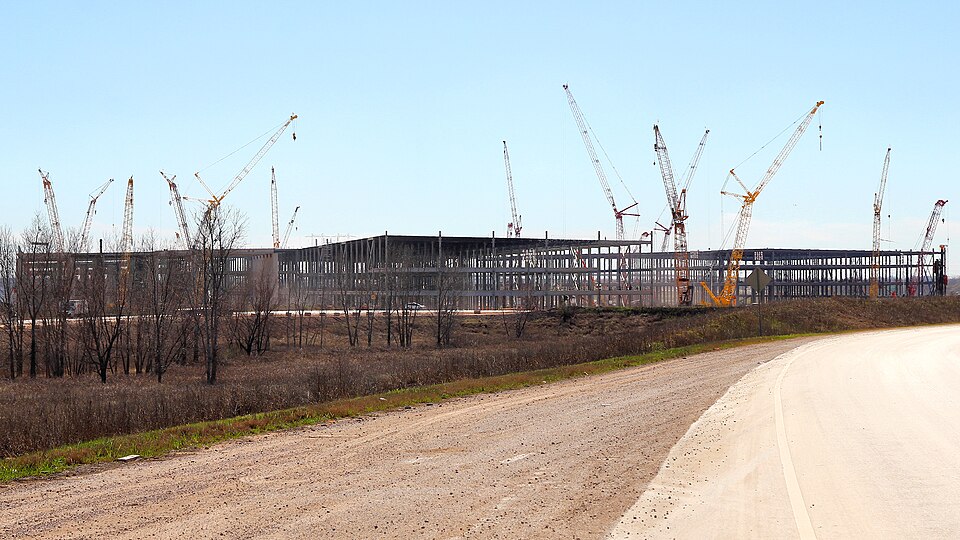
A company building factories · February 1, 2021
Gigafactory Texas under construction, photographed February 1, 2021. Industrial expansion formed the backdrop to Tesla’s treasury experiment. This is not a photograph of the Bitcoin purchase, the May payment-policy announcement, or the later China factory shutdowns.
Photo © 2021 Larry D. Moore, CC BY 4.0, via Wikimedia Commons. Reduced size; no crop or color changes.

Photograph provenance
Created 2021-02-01; uploaded 2021-02-02. Wikimedia-provided 960px reduction; no crop, recoloring, watermark removal or compositing. Displayed at original aspect ratio. The original file page identifies the photographer and the file-specific license.
Reviewed source revision ↗
On May 12, 2021, Musk publicly announced a suspension of Bitcoin vehicle payments, citing increased fossil-fuel use in mining and transactions. His statement also said Tesla would retain its Bitcoin and might resume transactions under different energy conditions. The public debate concerned both Bitcoin’s electricity use and the fit between an electric-vehicle manufacturer’s environmental identity and a proof-of-work payment instrument. Contemporary reporting documented an immediate market reaction, but a single announcement cannot explain every movement in a volatile trading session. Suspending payment acceptance was not the same as selling the investment. [12] [44]
Tesla revealed an ambiguity in the phrase 'Bitcoin adoption.' Holding a reserve and receiving Bitcoin at checkout require different operational decisions. The former changes exposure on a balance sheet. The latter creates a payment workflow involving pricing, payment confirmation, refunds, tax treatment, and the choice whether to retain or convert receipts. An enterprise could adopt one without committing to the other.
08 / Chapter 8
Beyond the American Boardroom
Modest allocations and different reporting systems complicated the image of a movement.
In the first quarter of 2021, Mercado Libre reported a $7.8 million Bitcoin purchase as part of its treasury strategy, classified among indefinite-lived intangible assets. The Latin American commerce and payments company had a business footprint and financial context different from the American pioneers. Its investment was small relative to the balance sheets that dominated the headlines, but historically relevant as a disclosed treasury allocation outside the United States. [13]
On April 28, Japanese video-game publisher Nexon disclosed a purchase of 1,717 bitcoin for approximately $100 million. Its announcement emphasized purchasing power, liquidity, and protection of shareholder value while noting that the investment represented less than two percent of cash and cash equivalents at the prior year-end. The same scarcity language could therefore support a bounded position rather than a concentrated corporate transformation. [14]
Hong Kong-listed Meitu followed yet another pattern. By April 2021 its group had invested approximately $100 million in cryptocurrencies, including both Bitcoin and Ether. A July exchange announcement identified 940.88522604 bitcoin purchased for roughly $49.5 million, alongside approximately 31,000 Ether for roughly $50.5 million. Calling that a $100 million Bitcoin treasury would double the actual Bitcoin component and erase the multi-asset character of the strategy. [15]
The international examples do not yield one standard corporate doctrine. They show companies experimenting with allocations under different markets, accounting practices, currencies, and governance structures. Their differences are part of the story, not exceptions to be buried in footnotes.
The international record also requires corporate-entity precision. On March 8, 2021, the Norwegian industrial group Aker established Seetee AS, initially capitalized with NOK 500 million. Aker chairman Kjell Inge Røkke set out an unusually expansive rationale in a shareholder letter, acknowledging substantial criticisms of Bitcoin while describing plans for Bitcoin ownership, mining-related activity, and investments in the broader ecosystem. Seetee was an explicitly Bitcoin-oriented subsidiary, not proof that every liquid reserve of the wider Aker industrial group had been converted into Bitcoin. [33] [34]
In the United Kingdom, Mode Global Holdings plc announced on October 21, 2020 that it had allocated up to 10 percent of its cash reserves to Bitcoin. The announcement framed the allocation as an attempt to protect against currency debasement. It was an example of a UK-listed fintech adopting the vocabulary of corporate reserves, but its position differed from a diversified industrial company turning its primary treasury toward Bitcoin. Mode later announced a wind-down of several customer-facing subsidiaries in January 2023 after failing to obtain funding. That later business distress illustrates why a company's entire operating and financing condition must be assessed, but it does not, without evidence, prove that its 2020 Bitcoin allocation caused the wind-down. [35] [36]
Meitu provides a particularly valuable international accounting contrast. Its 2022 annual-results statement said that, under its applicable IFRS cost model, the company recognized approximately RMB 198.2 million of Bitcoin impairment losses for 2022. Unlike a simplistic account that assigns all global companies the same accounting model, its Hong Kong reporting framework requires the reader to distinguish jurisdiction, choice of measurement model, and the point in time being reported. In a clearly labeled later consequence, Meitu disclosed that it disposed of its remaining Bitcoin and Ether by December 2024; that outcome should not be silently transplanted into the 2022 narrative. [37] [38]
09 / Chapter 9
Beyond the Cash Drawer
Borrowed money changes the nature of a reserve.
On December 9, 2020, MicroStrategy announced pricing of a $550 million convertible senior note offering, with an option for additional notes; its full-year reporting later recorded $650 million of notes issued that December. The crucial change was that the company was no longer simply allocating excess balance-sheet cash. It was financing additional Bitcoin exposure through securities sold to investors. [16] [6]
A convertible note begins as debt. The issuer promises obligations set by its terms; under defined conditions, the investor can convert into shares or receive other treatment provided by the agreement. Low contractual interest can make the financing attractive to the issuer, but the principal does not disappear. Conversion features also connect future shareholder dilution and stock performance to the financing decision.
A Bitcoin purchase financed from spare operating cash exposes an asset pool to volatile prices. A purchase financed with debt overlays those prices with payment and maturity obligations. If the bitcoin falls in value, the debt generally remains. Whether that mismatch becomes dangerous depends on leverage, repayment schedule, cash flows, collateral terms, covenants, and refinancing capacity—not merely on the direction of Bitcoin's price.
10 / Chapter 10
The Company as a Bitcoin Exposure Vehicle
Public equity made indirect ownership available, but not identical.
MicroStrategy's later filings documented a series of financing steps: $1.05 billion of zero-coupon convertible notes issued in February 2021, $500 million of senior secured notes issued in June, and an equity issuance program. The 2021 annual report described the financing program as part of a strategy to buy and hold Bitcoin. [6]
The economic proposition to shareholders began to change. Some investors could value the operating software business and accept Bitcoin as an adjunct treasury position. Others could purchase shares primarily for indirect sensitivity to Bitcoin, accepting the management and capital structure as part of that wager. The stock could diverge sharply from a simple mark-to-market valuation of bitcoins held because share prices also reflect debt, enterprise value, future financing expectations, liquidity, investor enthusiasm, and dilution.
This is where the question at the center of the Current becomes most visible. A decentralized asset was entering the portfolios of investors through conventional corporate securities. Bitcoin did not require a stock exchange to exist, but the stock exchange could create new forms of exposure to it. Corporate finance was not merely adopting Bitcoin; it was building a second financial structure around Bitcoin ownership.
11 / Chapter 11
Trust Does Not Disappear; It Moves
Custodians, key management, and reporting became core corporate problems.
Direct Bitcoin ownership depends on controlling the keys necessary to authorize transactions. A corporation must also control who can act, how access survives personnel changes, how transactions are approved, and how balances can be demonstrated to auditors. A misplaced key could become a loss, while concentrated authority could create fraud or governance risk. The enterprise cannot resolve these problems by treating a cryptocurrency wallet like a petty-cash drawer.
MassMutual's announced NYDIG custody relationship provides a documented institutional example. MicroStrategy's exact early trade execution and custody logistics were not fully disclosed in its August announcement, and contemporary reporting specifically said the company declined to share those details. A historical account must not fill that silence with invented custodian names, private-key procedures, or cold-storage diagrams. [9] [3]
The tension was not a defect unique to Bitcoin. It was the problem of combining a bearer-like digital asset with corporate institutions that rely on delegated power and independently documented controls. Ownership on a public blockchain and legally enforceable claims through custodians are related but different arrangements. Each moves risk to a different location.
12 / Chapter 12
The Collateralized Coin
Bitcoin becomes not only a reserve but security for a loan.
In March 2022, MicroStrategy subsidiary MacroStrategy obtained a $205 million term loan through Silvergate's SEN Leverage program, secured by bitcoin in a collateral account with an authorized custodian. The disclosed purposes included purchasing Bitcoin and meeting related loan expenses or corporate needs. This was a materially different form of exposure from an unencumbered cash-funded purchase. [17]
Collateral gives a lender recourse to specified assets under the loan agreement. When collateral prices fall, lenders can require the borrower to restore agreed coverage through additional assets or repayment. Those requirements depend on the actual loan documents and collateral ratios; they should not be inferred from a public Bitcoin price chart alone. The 2022 public debate about potential margin calls showed how easily a contractual risk could be mistaken for proof that a particular liquidation had already occurred.
Collateralized borrowing is an important hinge in the story because it introduces a second clock. Bitcoin holders can choose their preferred investment horizon; debt agreements impose dates, ratios, and conditions that do not care how long an investment thesis takes to work. That is not evidence that leverage must fail. It is evidence that the company's liquidity and collateral policy becomes as historically significant as its Bitcoin thesis.
13 / Chapter 13
The One-Way Mirror
Old accounting rules could recognize a fall but not an unrealized recovery.
Under the U.S. accounting model applied by these companies during 2020–2022, Bitcoin was generally treated as an indefinite-lived intangible asset. If its fair value fell below the recorded carrying amount, the company had to recognize an impairment loss. A later rebound did not permit the company simply to write the holding back up while it remained unsold. Gains from recovery could be recognized through relevant sale accounting, not by symmetric quarterly marking to market. [8] [18]
Imagine a company acquires one bitcoin for $40,000. Its price falls to $25,000 and the company records a $15,000 impairment. The market subsequently rises to $45,000. Under this historical model, the company's carrying amount remains at $25,000 while the asset is held, even though its observable market value is higher. An investor who confuses carrying value with current market value will misunderstand the company's exposure. The reverse confusion—treating every impairment as a forced sale—is equally serious.
Square's 2021 annual filing offered a sharp real example. Its $220 million total Bitcoin purchase cost stood against a year-end carrying value of $149 million and a disclosed fair value of $371 million. The company had recognized impairment charges, yet the market value of the remaining asset exceeded its original cost. Different numbers answered different financial questions. [8]
An unusually revealing dispute unfolded before the bear market fully arrived. In October 2021, SEC staff asked MicroStrategy to explain both the reporting treatment of particular Bitcoin transactions and its decision to exclude Bitcoin impairment charges from non-GAAP measures. In a December 3 follow-up, SEC staff objected to removing Bitcoin impairment losses from those adjusted measures, and on December 16 MicroStrategy said it would revise future presentation. The underlying GAAP accounting remained in force. The disagreement concerned how much of its Bitcoin-related losses the company could omit when presenting an alternative picture of performance to investors. [39] [40] [41]
This was not merely a mathematical curiosity. A corporate owner could hold the same bitcoins through an appreciation and drawdown, yet report impairment expenses that made the software business's financial results harder to interpret. Management wanted supplementary measures that emphasized a different economic perspective. The regulator insisted that a non-GAAP presentation should not simply remove an expense integral to the company's publicly stated strategy. Both sides were debating what investors deserved to see.
14 / Chapter 14
The Audit of an Unfamiliar Asset
Accounting met cryptography, and governance had to catch up.
A bank balance can be confirmed through established relationships and statements. Bitcoin requires evidence about the quantity held, the relevant entity's control or custodial claim, transaction history, valuation methodology, segregation of customer assets, and the effectiveness of private-key controls. Public blockchain data alone does not necessarily prove that a named corporation controls a particular address, and a custodian's representation of assets requires its own scrutiny.
Financial reports also made the consequences of concentration visible. MicroStrategy's 2020 annual filing warned that concentration in Bitcoin reduced the benefits of diversification and that holdings could be less useful as liquidity than cash and cash equivalents. The warnings belonged in the same corporate record as the favorable investment thesis. Treating them as boilerplate would erase the board's actual risk disclosure. [19]
The same report could contain management’s ambitious account of Bitcoin’s monetary future and explicit warnings about concentration, liquidity, and custody. Neither side erased the other. The accounting statements recorded what the company owned under the rules of the time; the risk disclosures reminded shareholders that ownership did not eliminate operating obligations.
15 / Chapter 15
The Choice to Sell
Tesla's 2022 liquidity decision contradicted the idea of one universal holding strategy.
In the second quarter of 2022, Tesla converted approximately 75 percent of its Bitcoin purchases into fiat currency. Its shareholder update reported that the conversions added $936 million of cash. During the July earnings call, Elon Musk explained that uncertainty about the duration of COVID-related factory shutdowns in China had led the company to maximize cash liquidity. The explanation came from Tesla’s own management; it is stronger evidence of the company’s stated motive than an inference drawn from the Bitcoin price chart. [20] [45]
The payment suspension concerned how customers could settle a purchase; the 2022 sale concerned how the company funded and protected its operations. Those decisions were separated by more than a year and answered different questions. The sale also should not be read as a full retreat: Tesla continued to hold some Bitcoin, and Musk said the company remained open to increasing its holdings later. [45]
The distinguishing feature was not the percentage sold in isolation. It was the ability of a vehicle manufacturer to reverse a treasury position when production uncertainty increased its preference for cash. An individual holder can choose a personal horizon. A public company must also account for payroll, supply chains, capital spending, and the conditions in which it can continue operating.
16 / Chapter 16
The Cost of Staying
MicroStrategy's reported loss was not identical to liquidation.
MicroStrategy's 2022 annual report placed the extent of the market decline into unusually clear accounting terms. At December 31 it held approximately 132,500 bitcoin. Their original aggregate cost basis was about $3.993 billion, their reported market value about $2.194 billion, and their impaired carrying value about $1.840 billion. Cumulative impairment losses had reached about $2.153 billion. Those figures describe three different measurements of one holding: acquisition cost, observed market value at a date, and the asset's carrying amount under the applicable accounting rules. [21]
The company had not sold all its Bitcoin. It disclosed a December 22 sale of approximately 704 bitcoin for roughly $11.8 million, followed by another purchase two days later. Its filing identified the potential use of capital losses for tax purposes. That limited transaction was not the same as a forced unwinding of the treasury strategy. [22]
MicroStrategy / 2022 Form 10-K / Holdings ledger
What stayed on the balance sheet
Measurement: December 31, 2022. Annual-report disclosure: 2023.
Original Monedial data layout from the filing’s holdings tables, rounded to billions. Carrying value reflects $2.153bn of cumulative impairment. The market figure uses the company’s year-end quoted-price calculation; it is not guaranteed sale proceeds.
These measurements are not a margin-call threshold or evidence of forced liquidation. The existing collateral-loan record and limited-sale disclosure describe separate obligations and transactions.
Inspect the holdings and market-calculation tables ↗Its long-term debt had more than one form. The 2022 annual filing described the 2020 and 2021 convertible issues, 2021 secured notes, and a separate $205 million Silvergate loan made to its subsidiary MacroStrategy in March 2022. At year-end, the company reported bitcoin pledged as collateral under separate financing arrangements. These obligations could not be reduced to a single publicized “margin-call price.” Debt terms, pledged collateral, cash reserves, and the ability to add collateral mattered individually. The filing did not report a forced liquidation of the Bitcoin treasury in 2022. [21]
Tesla sold a large portion to raise liquidity; MicroStrategy retained an overwhelmingly large position, made a limited tax-related sale and purchase, and continued operating with financing commitments. This was the core 2022 contrast: one company prioritized liquidity in its underlying business, while the other maintained Bitcoin accumulation as a central corporate strategy. Neither result alone proved Bitcoin’s future value.
17 / Chapter 17
The Business of Producing Bitcoin
Mining-company distress illustrated why operating models cannot be conflated with treasury choices.
Bitcoin miners sat at the intersection of infrastructure, energy, equipment finance, and treasury management. Their business produced bitcoin as revenue, while expenses such as electricity, labor, debt service, and equipment could require cash. Holding production exposed them to market appreciation, but declining prices and rising costs could turn a reserve into working-capital pressure.
On December 21, 2022, Core Scientific and certain affiliates filed for Chapter 11 protection in the Southern District of Texas. Its SEC filing identified an actual bankruptcy proceeding rather than simply a fall in a share price. The case belongs here as a contrasting corporate operating model: a miner's capital-intensive economics and obligations were not identical to those of a software company purchasing Bitcoin with excess cash or securities proceeds. [23]
The bankruptcies of intermediaries elsewhere in the digital-asset industry sharpened questions about custody, lending, and the legal rights of customers and creditors. They did not mean that every corporate holder faced the same exposures. Core Scientific’s bankruptcy was a real operating-company failure; a decline in MicroStrategy’s stock or impairment in its financial statements was not. The difference between economic stress and a legal insolvency proceeding is essential.
Shareholder dissent reaches the formal record
A formal 2022 shareholder proposal submitted to Tesla by Sumtris ehf, an Icelandic entity, asked Tesla to liquidate newly acquired cryptocurrency holdings rapidly and divest existing cryptocurrency assets within a year, citing financial volatility and environmental costs. Tesla sought permission to exclude the proposal. On May 6, 2022, SEC staff indicated that it would not recommend enforcement action if Tesla omitted the proposal under the ordinary-business/micromanagement rule. This was a shareholder proposal and a staff no-action response—not a shareholder vote adopting the proposed divestment policy, and not an SEC ruling that Bitcoin was environmentally or financially improper. [42]
It provides a human counterweight to executive speeches. A shareholder could support Tesla's electric-vehicle business while objecting to management's purchase of an asset that, in the shareholder's account, introduced unrelated risk and conflicted with the company's environmental identity. The conflict reveals how corporate Bitcoin adoption could redraw the boundary between executives' discretion and investors' understanding of a company's mission.
18 / Chapter 18
What Remained
Bitcoin survived as an asset; the corporate structures around it were still being tested.
By the close of 2022, the contrast was unmistakable. Square had linked a limited Bitcoin investment to a payments mission. Tesla had monetized most of its position in response to operating uncertainty. MassMutual had demonstrated an institutionally intermediated route; Nexon and Mercado Libre had taken bounded positions; Aker had pursued a dedicated subsidiary; and Meitu had disclosed sizeable impairment under its own reporting framework. MicroStrategy had preserved a concentrated position while navigating debt, pledged collateral, and impairments. For miners such as Core Scientific, the combination of power costs, equipment investment, debt, and volatile Bitcoin income posed a separate survival test.
Ownership had broadened, but the word adoption now covered unlike activities: reserving a share of cash, borrowing to buy, holding assets for policyholders, taking payment from customers, mining new coins, and acting through a specialized subsidiary. Corporate finance gave Bitcoin visibility and access to conventional investment channels. In return, Bitcoin forced corporate finance to confront its own assumptions about liquidity, financial reporting, custody, and concentration.
Bitcoin’s issuance schedule did not change when a corporation bought it. The contracts written around those coins did. The test of 2022 revealed how much of the corporate experiment depended on obligations outside the Bitcoin network.
Epilogue / Retrospective context
The Other Side of the Ledger
Later changes did not erase the original experiment.
In December 2023, the Financial Accounting Standards Board issued ASU 2023-08, requiring a fair-value model for qualifying crypto assets in financial years beginning after December 15, 2024, with early adoption permitted. This was a later response to the accounting asymmetry visible in earlier financial statements—not the rule under which the corporate investments of 2020–2022 were originally reported. [24]
Subsequent years brought more Bitcoin-focused public-company structures and financing techniques. Those developments belong chiefly to later history. Their connection to this Current is the precedent established between 2020 and 2022: a company could use Bitcoin as a reserve, as an instrument of strategic identity, and as an asset against which conventional securities and obligations were organized.
Bitcoin did not begin promising to repay creditors or meet quarterly earnings expectations. Corporations did. The original experiment was never simply whether Bitcoin could sit on a balance sheet. It was whether the institutions that put it there could live with the consequences.
photograph · 2021-02-01
Gigafactory Texas, February 2021
Gigafactory Texas under construction, photographed February 1, 2021. Industrial expansion formed the backdrop to Tesla’s treasury experiment. This is not a photograph of the Bitcoin purchase, the May payment-policy announcement, or the later China factory shutdowns.
Explore the artifact ↗Larry D. Moore, CC BY 4.0, via Wikimedia Commons · CC BY 4.0. Reduced-size reproduction.
Sources & further investigation
Primary documents
- S02 · MicroStrategy August 11 press release Exhibit 99.1
Source provenance
MicroStrategy August 11 press release Exhibit 99.1 — https://www.sec.gov/Archives/edgar/data/1050446/000119312520215604/d921849dex991.htm Source key S02.
- S03 · MicroStrategy September 15, 2020 8-K
Source provenance
MicroStrategy September 15, 2020 8-K — https://www.sec.gov/Archives/edgar/data/1050446/000119312520245835/d42524d8k.htm Source key S03.
- S04 · Reuters March 12, 2020 contemporaneous market report
Source provenance
Reuters March 12, 2020 contemporaneous market report — https://ca.investing.com/news/technology-news/bitcoin-plummets-as-cryptocurrencies-suffer-in-market-turmoil-2087878 Source key S04.
- S07 · Square October 8, 2020 corporate announcement
Source provenance
Square October 8, 2020 corporate announcement — https://squareup.com/us/en/press/2020-bitcoin-investment Source key S07.
- S09 · NYDIG / MassMutual December 10, 2020 announcement
Source provenance
NYDIG / MassMutual December 10, 2020 announcement — https://www.prnewswire.com/news-releases/institutional-bitcoin-provider-nydig-announces-minority-stake-purchase-by-massmutual-301190811.html Source key S09.
- S13 · Mercado Libre Q1 2021 results
Source provenance
Mercado Libre Q1 2021 results — https://investor.mercadolibre.com/download-uspr?path=%2Fnews-and-events%2Fmercadolibre-inc-reports-first-quarter-2021-financial-results Source key S13.
- S14 · Nexon April 28, 2021 Bitcoin acquisition announcement
Source provenance
Nexon April 28, 2021 Bitcoin acquisition announcement — https://pdf.irpocket.com/C3659/BbNL/qYha/Sr9r.pdf Source key S14.
- S15 · Meitu July 6, 2021 HKEX announcement reporting prior purchases
Source provenance
Meitu July 6, 2021 HKEX announcement reporting prior purchases — https://www1.hkexnews.hk/listedco/listconews/sehk/2021/0706/2021070601779.pdf Source key S15.
- S16 · MicroStrategy December 9, 2020 convertible debt announcement
Source provenance
MicroStrategy December 9, 2020 convertible debt announcement — https://www.strategy.com/press/microstrategy-announces-pricing-of-offering-of-convertible-senior-notes_12-09-2020 Source key S16.
- S17 · Silvergate / MacroStrategy March 29, 2022 financing announcement
Source provenance
Silvergate / MacroStrategy March 29, 2022 financing announcement — https://silvergate.com/uncategorized/silvergate-bank-issues-205-million-loan-to-macrostrategy-collateralized-by-bitcoin/ Source key S17.
- S18 · FASB ASU 2023-08 retrospective explanation of previous standards
Source provenance
FASB ASU 2023-08 retrospective explanation of previous standards — https://storage.fasb.org/ASU%202023-08.pdf Source key S18. Later accounting standard; the same document appears under both keys.
- S24 · FASB Accounting Standards Update No. 2023-08
Source provenance
FASB Accounting Standards Update No. 2023-08 — https://storage.fasb.org/ASU%202023-08.pdf Source key S24. Later accounting standard; the same document appears under both keys.
- R01 · Overstock January 9, 2014 company announcement
Source provenance
Overstock January 9, 2014 company announcement — https://investors.beyond.com/news-events/press-releases/news-details/2014/Overstock.com-First-Online-Retailer-to-Accept-Bitcoin-01-09-2014/default.aspx Source key R01.
- R09 · Aker March 8, 2021 original Seetee announcement
Source provenance
Aker March 8, 2021 original Seetee announcement — https://news.cision.com/aker-asa/r/aker-asa-launches-seetee-to-invest-in-bitcoin-and-blockchain-technology%2Cc3301475 Source key R09.
- R10 · Kjell Inge Røkke March 8, 2021 shareholder letter
Source provenance
Kjell Inge Røkke March 8, 2021 shareholder letter — https://www.seetee.io/blog/2021-03-08-shareholder-letter/ Source key R10.
- R11 · Mode Global Holdings plc October 21, 2020 exchange announcement
Source provenance
Mode Global Holdings plc October 21, 2020 exchange announcement — https://www.investegate.co.uk/announcement/rns/mode-global-holdings--mode/mode-adopts-bitcoin-as-treasury-reserve-asset/6349237 Source key R11.
- R12 · Mode Global Holdings plc January 26, 2023 wind-down announcement (retrospective)
Source provenance
Mode Global Holdings plc January 26, 2023 wind-down announcement (retrospective) — https://www.investegate.co.uk/announcement/rns/mode-global-holdings--mode/mode-prepares-for-wind-down/7230359 Source key R12.
- R13 · Meitu 2022 annual results, relevant Bitcoin impairment figures
Source provenance
Meitu 2022 annual results, relevant Bitcoin impairment figures — https://corp-static.meitu.com/corp-new/20251009/2022%E5%B9%B4%E5%BA%A6%E4%B8%9A%E7%BB%A9en.pdf Source key R13.
- R14 · Meitu December 4, 2024 complete cryptocurrency disposal announcement (retrospective)
Source provenance
Meitu December 4, 2024 complete cryptocurrency disposal announcement (retrospective) — https://corp-static.meitu.com/corp-new/20241204/2024120402120%20%28E%29.pdf Source key R14.
- Gigafactory Texas construction, February 2021
Source provenance
Government & legal records
- S01 · MicroStrategy August 11, 2020 Form 8-K
Source provenance
MicroStrategy August 11, 2020 Form 8-K — https://www.sec.gov/Archives/edgar/data/1050446/000119312520215604/d921849d8k.htm Source key S01.
- S05 · Federal Reserve March 15, 2020 implementation note
Source provenance
Federal Reserve March 15, 2020 implementation note — https://www.federalreserve.gov/newsevents/pressreleases/monetary20200315a1.htm Source key S05.
- S06 · MicroStrategy 2021 Form 10-K (treasury-policy and financing evolution)
Source provenance
MicroStrategy 2021 Form 10-K (treasury-policy and financing evolution) — https://www.sec.gov/Archives/edgar/data/1050446/000156459022005287/mstr-10k_20211231.htm Source key S06.
- S08 · Block/Square 2021 Form 10-K
Source provenance
Block/Square 2021 Form 10-K — https://www.sec.gov/Archives/edgar/data/1512673/000162828022003825/sq-20211231.htm Source key S08.
- S10 · Tesla 2020 Form 10-K published February 2021
Source provenance
Tesla 2020 Form 10-K published February 2021 — https://www.sec.gov/Archives/edgar/data/1318605/000156459021004599/tsla-10k_20201231.htm Source key S10.
- S11 · Tesla Q1 2021 Form 10-Q
Source provenance
Tesla Q1 2021 Form 10-Q — https://www.sec.gov/Archives/edgar/data/1318605/000095017021000046/tsla-20210331.htm Source key S11.
- S12 · Tesla Q2 2021 Form 10-Q
Source provenance
Tesla Q2 2021 Form 10-Q — https://www.sec.gov/Archives/edgar/data/1318605/000095017021000524/tsla-20210630.htm Source key S12.
- S19 · MicroStrategy 2020 Form 10-K risk and liquidity disclosures
Source provenance
MicroStrategy 2020 Form 10-K risk and liquidity disclosures — https://www.sec.gov/Archives/edgar/data/1050446/000156459021005783/mstr-10k_20201231.htm Source key S19.
- S20 · Tesla Q2 2022 investor update (SEC exhibit)
Source provenance
Tesla Q2 2022 investor update (SEC exhibit) — https://www.sec.gov/Archives/edgar/data/1318605/000156459022026048/tsla-ex991_130.htm Source key S20.
- S21 · MicroStrategy 2022 Form 10-K
Source provenance
MicroStrategy 2022 Form 10-K — https://www.sec.gov/Archives/edgar/data/1050446/000156459023002012/mstr-10k_20221231.htm Source key S21.
- S22 · MicroStrategy December 28, 2022 Form 8-K
Source provenance
MicroStrategy December 28, 2022 Form 8-K — https://www.sec.gov/Archives/edgar/data/1050446/000119312522313098/d398241d8k.htm Source key S22.
- S23 · Core Scientific December 21, 2022 Form 8-K (Chapter 11)
Source provenance
Core Scientific December 21, 2022 Form 8-K (Chapter 11) — https://www.sec.gov/Archives/edgar/data/1839341/000119312522310173/d366482d8k.htm Source key S23.
- R15 · SEC October 7, 2021 comment letter, official PDF
Source provenance
SEC October 7, 2021 comment letter, official PDF — https://www.sec.gov/Archives/edgar/data/1050446/000000000021012200/filename1.pdf Source key R15.
- R16 · SEC December 3, 2021 comment letter (text reproduction; verify official EDGAR document before publication)
Source provenance
SEC December 3, 2021 comment letter (text reproduction; verify official EDGAR document before publication) — https://secprobe.io/filings/0001050446/0000000000-21-014605/ Source key R16.
- R18 · SEC May 6, 2022 Tesla shareholder proposal/no-action file, incorporating Sumtris proposal
Source provenance
SEC May 6, 2022 Tesla shareholder proposal/no-action file, incorporating Sumtris proposal — https://www.sec.gov/divisions/corpfin/cf-noaction/14a-8/2022/sumtristesla0506221-14a8.pdf Source key R18.
Contemporary reporting
- R02 · Patrick Byrne December 2013 interview (contemporaneous)
Source provenance
Patrick Byrne December 2013 interview (contemporaneous) — https://fortune.com/2013/12/24/overstock-ceo-i-dont-own-bitcoin-but-im-a-fan/ Source key R02.
- R03 · Overstock second-quarter 2017 earnings-call transcript (secondary transcript; check issuer archive if reused as direct quotation)
Source provenance
Overstock second-quarter 2017 earnings-call transcript (secondary transcript; check issuer archive if reused as direct quotation) — https://www.roic.ai/quote/OSTKO/transcripts/2017-year/2-quarter Source key R03.
- R04 · Yahoo Finance interview on Overstock retaining half its Bitcoin receipts in 2017
Source provenance
Yahoo Finance interview on Overstock retaining half its Bitcoin receipts in 2017 — https://finance.yahoo.com/news/overstock-deals-bitcoins-wild-price-swings-145542616.html Source key R04.
- R05 · The Block, December 8, 2020, Citi analyst downgrade and convertible-note objection
Source provenance
The Block, December 8, 2020, Citi analyst downgrade and convertible-note objection — https://www.theblock.co/amp/linked/87054/citi-microstrategy-stock-downgrade-bitcoin Source key R05.
- R06 · Decrypt, February 16, 2021, Gartner 77-executive survey
Source provenance
Decrypt, February 16, 2021, Gartner 77-executive survey — https://decrypt.co/57903/only-5-of-financial-execs-would-hol Source key R06.
- R07 · Reuters, March 8, 2021, interviews with corporate treasurers and advisers
Source provenance
Reuters, March 8, 2021, interviews with corporate treasurers and advisers — https://www.investing.com/news/cryptocurrency-news/rush-to-bitcoin-not-so-fast-say-keepers-of-corporate-coffers-2439653 Source key R07.
- R08 · HSBC 2021 Corporate Risk Management Survey
Source provenance
HSBC 2021 Corporate Risk Management Survey — https://www.gbm.hsbc.com/-/media/media/gbm-global/pdf/campaign/hsbc-2021-corporate-risk-management-survey.pdf?download=1 Source key R08.
- R17 · MicroStrategy CFO Phong Le, February 2022 earnings-call transcript acknowledging agreed non-GAAP adjustment
Source provenance
MicroStrategy CFO Phong Le, February 2022 earnings-call transcript acknowledging agreed non-GAAP adjustment — https://www.fool.com/earnings/call-transcripts/2022/02/02/microstrategy-mstr-q4-2021-earnings-call-transcrip/ Source key R17.
- R19 · TIME, March 2021 contemporary interview with Michael Saylor discussing Bitcoin for Corporations and Tesla
Source provenance
TIME, March 2021 contemporary interview with Michael Saylor discussing Bitcoin for Corporations and Tesla — https://time.com/5947722/microstrategy-ceo-bitcoin/ Source key R19.
- R20 · The Block, May 12, 2021 contemporary report preserving Musk’s Bitcoin-payment suspension statement
Source provenance
The Block, May 12, 2021 contemporary report preserving Musk’s Bitcoin-payment suspension statement — https://www.theblock.co/news/ecosystems/2021-05-12-tesla-stops-taking-bitcoin-payments-104720 Source key R20.
- R21 · Tesla second-quarter 2022 earnings-call transcript, July 20, 2022
Source provenance
Tesla second-quarter 2022 earnings-call transcript, July 20, 2022 — https://www.fool.com/earnings/call-transcripts/2022/07/21/tesla-tsla-q2-2022-earnings-call-transcript/ Source key R21.
Scholarship & later histories
No sources of this type are cited in this exhibition.